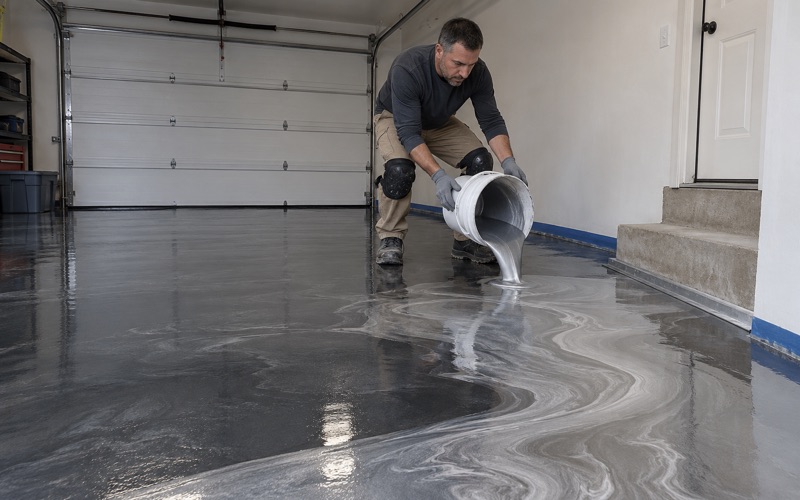
Waukegan Epoxy Flooring has spent more than 20 years installing epoxy flooring in Zion garages, basements and working floors, and the part of a job most owners never see is the paperwork that comes before the grinder. When a project here needs a permit, the city asks for specific things from the contractor and the owner alike. We would rather walk you through those at the first visit than watch a start date slip over one missing signature.
So this page spends less time on color charts and more on how a job gets set up. It covers what a hired crew brings to the counter, what the owner signs, and what changes if you decide to coat the floor yourself. The floor work itself is the process we run everywhere: mechanical preparation, a priced moisture test, and a proposal that names the product and the finished thickness.
One thing we will not do is guess. Whether a particular floor coating needs a permit is a question we put to the Building Department before quoting, not something we assume in either direction.
How a Permitted Job Moves Through Zion
Illinois issues no state license for flooring or coatings contractors, so the local rules are the ones that govern a job. In Zion those rules are written down plainly, and we confirm the current registration and insurance requirements before anything goes on the calendar.
Every trade registers, and in person
The City of Zion Building Department, at 2828 Sheridan Road, posts a notice addressed to all contractors that leaves little room for interpretation. Every trade named on a permit has to be registered, and any contractor who has not registered must come in person to do it. A phone call or an emailed form does not stand in for that visit.
For a coating project this matters because the general contractor submits the application with every trade attached. If an epoxy crew, an electrician moving a garage outlet and a plumber resetting a floor drain all touch one job, each of them has to clear registration before the packet is complete. The city does not accept incomplete paperwork, so one unregistered trade holds up everyone else.
Declaring what the job is worth
The application must state the estimated value of the work including materials and labor costs, and the contracts for that work go in with it. On a floor coating, that figure covers the grinding, crack repair, primer, broadcast and topcoat, plus the hours to install them, not only what the resin cost.
Our proposals already break those pieces out. Because the product, the system build and the finished thickness are named in writing, the value on the application matches a scope you can check against the floor once it cures. If a moisture test or slab repair is part of the work, it appears as a priced line rather than a surprise later.
Ask before assuming
The city’s published notices do not settle whether a residential floor coating on its own triggers a permit. Some jobs plainly bring other trades in, such as one bundled with drain or electrical work. For a coating alone, we ask the Building Department about your address before the schedule is set and tell you exactly what they said.
Looking for epoxy-flooring closer to Libertyville? See Epoxy-Flooring Services in Libertyville.
The Consumers Rights Acknowledgement Form and Your Contract
Zion’s application packet requires the owner to sign a Consumers Rights Acknowledgement Form. It is a short step, but the paperwork is not accepted without it, so it belongs on the checklist before anyone books a grind date.
Owner details and the signature
The contractor notice also asks for the owner’s name, address and phone number on the application. That sounds obvious, yet a blank field is one of the easiest ways for a packet to come back across the counter. We go through those lines with you so the form is filled in once.
The city’s form sits alongside a state requirement we already follow on every home job. Under the Illinois Home Repair and Remodeling Act (815 ILCS 513), a homeowner receives a written contract and the Home Repair: Know Your Consumer Rights pamphlet before work begins. We hand over both at signing, so you have the state’s consumer-rights material in hand by the time the city asks for its own acknowledgment.
What our contract spells out
The contract the city wants attached is the same document that protects you on the floor. Ours lists surface preparation by diamond grinding or shot blasting to a stated ICRI CSP profile, the moisture testing method, the coating system, the broadcast and the topcoat. We do not acid etch, and the contract says how the slab will be opened instead.
It also reads out the warranty exclusions before you sign, with moisture named first. A coating is a film that follows the concrete under it; if the slab shifts, a crack can show through, and we put that in writing rather than letting a warranty suggest otherwise.
Coating It Yourself: The $300,000 Liability Rule
Some homeowners price a hired crew against a kit from the hardware store. If the work needs a permit and you plan to do it yourself, Zion sets terms that are worth knowing before you make that comparison.
What the city asks of an owner-builder
Under Zion Municipal Code 10-9.1, a homeowner applying for a permit on an owner-occupied home must bring a homeowner’s insurance policy showing at least $300,000 in liability coverage. The application also needs a materials cost list, and the permit comes before any work starts. The owner has to be the one doing the work, though immediate family may help.
That is the threshold a do-it-yourself buyer meets before a contractor is even in the conversation. If you are leaning that way, pull the declarations page of your policy early and check the liability limit, because it decides whether the owner route is open at all.
Where kit floors usually go wrong
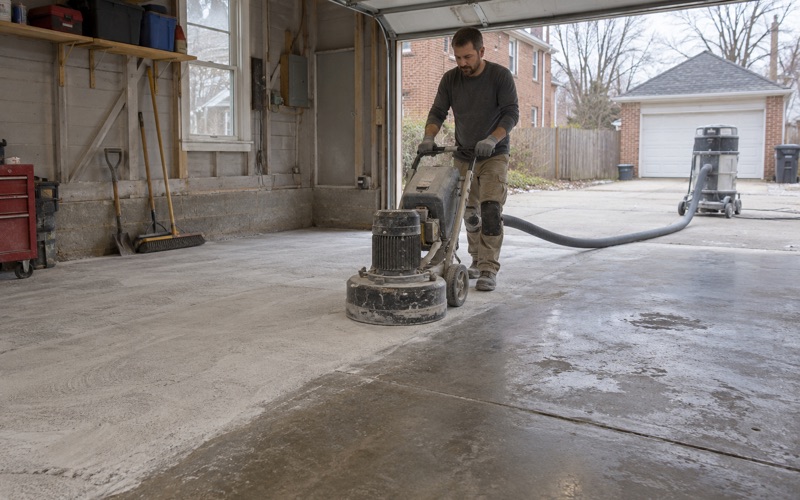
The paperwork is the easy part. Most failed garage floors we are asked to look at were rolled over a slab that was never opened mechanically, or over one carrying moisture nobody measured. A thin water-based kit on smooth, troweled concrete has little to grip, and hot tire pickup can lift it the first warm week a car parks on it.
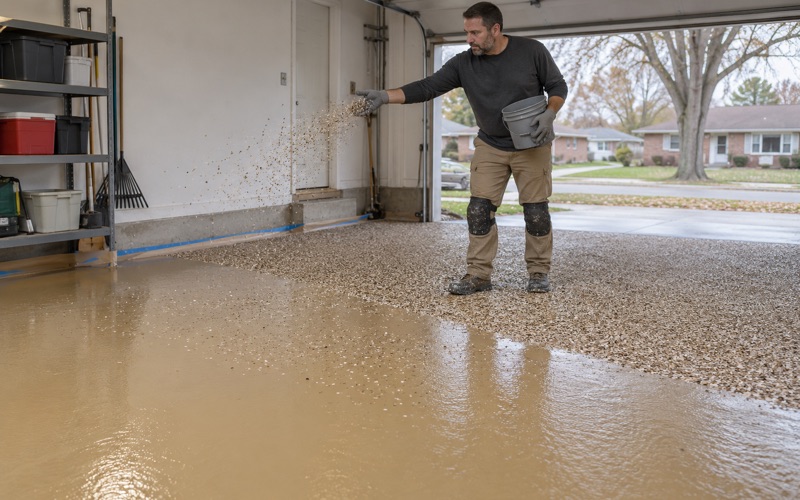
A professional system starts with diamond grinding, then 100% solids epoxy or a moisture-mitigation primer depending on the test results, a vinyl flake or quartz aggregate broadcast, and a polyaspartic or polyurea topcoat. If you take the DIY route anyway, at least run an ASTM D4263 plastic sheet test first, and watch for amine blush if the garage is cool and damp while the epoxy cures.
Keeping the slurry on site
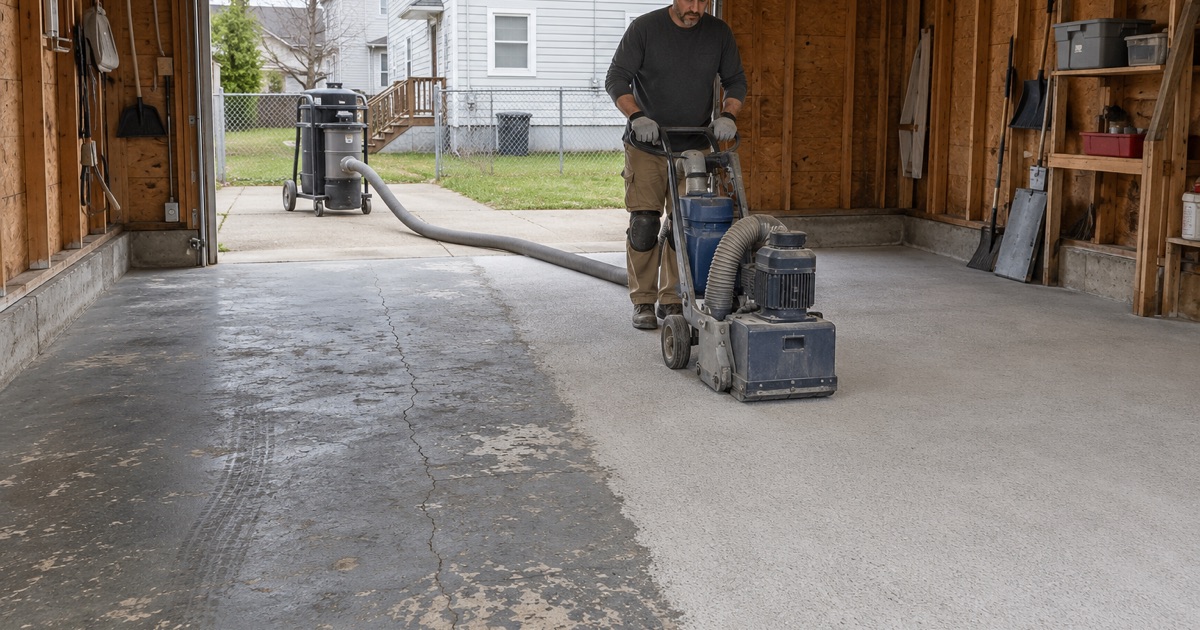
Whether we grind or you rent the machine, the dust and slurry should stay where they were made. We collect ours on site with vacuum shrouds and never wash it toward a street drain.
Getting a Quote for Epoxy Flooring in Zion
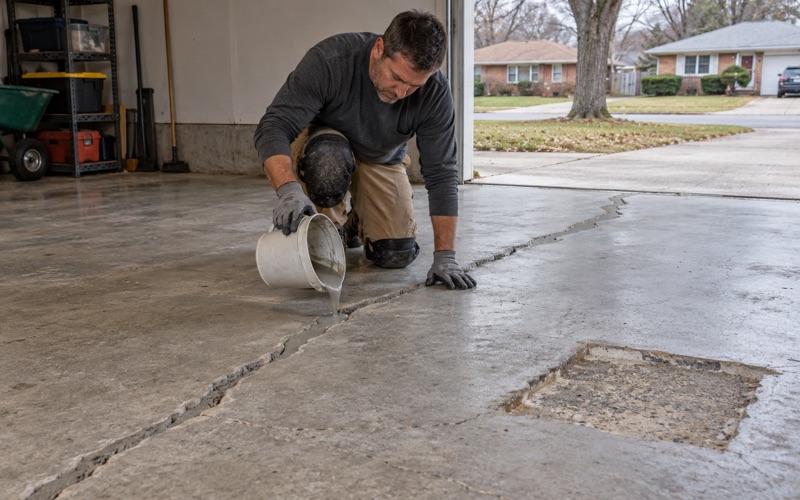
A quote from us starts on the slab, not over the phone. We read the cracks and any old coating, and if the concrete needs repair or replacement before it can hold a coating, we say so at the visit rather than pricing a floor that will fail.
Moisture testing is on the scope
Every proposal carries moisture testing as its own line, on a garage and a basement alike. On a garage we may use ASTM F1869 calcium chloride kits, while ASTM F2170 in-situ relative humidity probes give a truer read on a basement slab where hydrostatic pressure pushes from below. A slab that looks dry may have no vapor retarder under it at all, so the test comes before the coating, not after a blister.
In a basement, the edges matter as much as the field. We detail the coating around the sump pit and floor drain so water that does arrive has somewhere to go, and we look for efflorescence along the walls as a sign of where moisture has already been moving. A floor that has seen a sewer backup gets cleaned and tested before any primer goes down.
We also keep one line clear. A floor coating is not radon reduction, and we do not sell it as such; in Illinois that work takes a radon mitigation license from IEMA, so we point you to a licensed mitigator if a test has come back high.
Built for salt, timed by the slab
Zion garages take the same calcium chloride brine and rock salt that every Lake County driveway sees through the winter. We build garage systems for that, with a full broadcast and a chemical-resistant topcoat that cleans up without dulling. Products are chosen within the Illinois VOC limits in 35 Ill. Adm. Code Part 223, which bind the installer as well as the manufacturer.
Curing follows the concrete, not the calendar. We check slab temperature and the dew point spread at the surface, and if an unheated garage is too cold to cure properly, we tell you plainly that it should wait for spring.
Houses and working floors
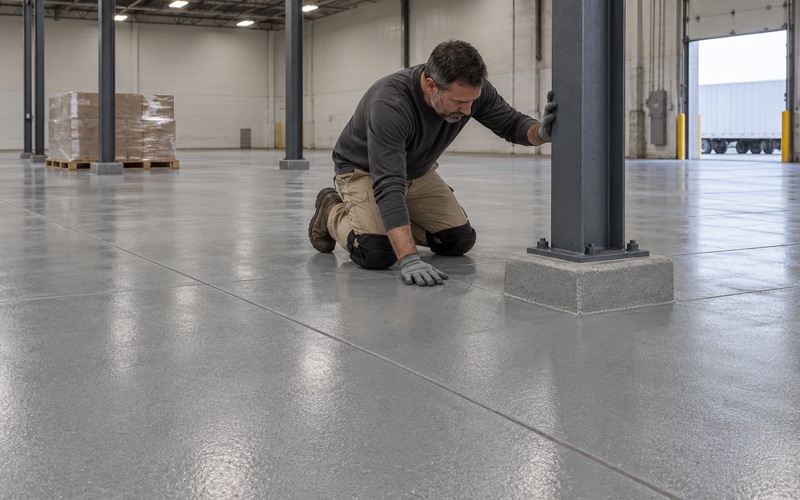
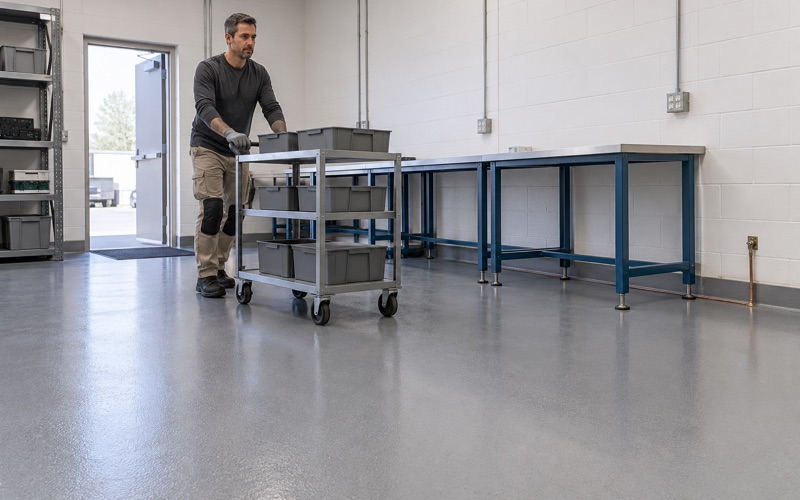
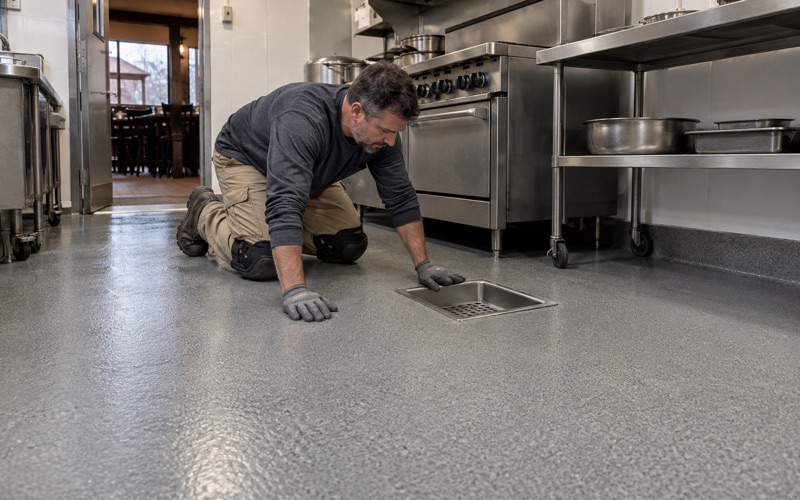
Most of our residential work here is in owner-occupied detached houses, of which Zion has about 4,579 according to ACS table B25032. We also coat warehouse, shop, restaurant and hospital floors, scheduled around the hours the building has to keep running, including overnight and weekend windows. Food-service kitchens get coved floor-to-wall junctures where FDA Food Code 6-201.13 calls for them.
Tell us the size of the floor and how the space is used, and we will set up a visit, check the permit question with the Building Department, and put the full scope in writing before anything is signed.
- 20+ Years Coating Floors
- Moisture Testing in Every Scope
- Free Written Estimates