
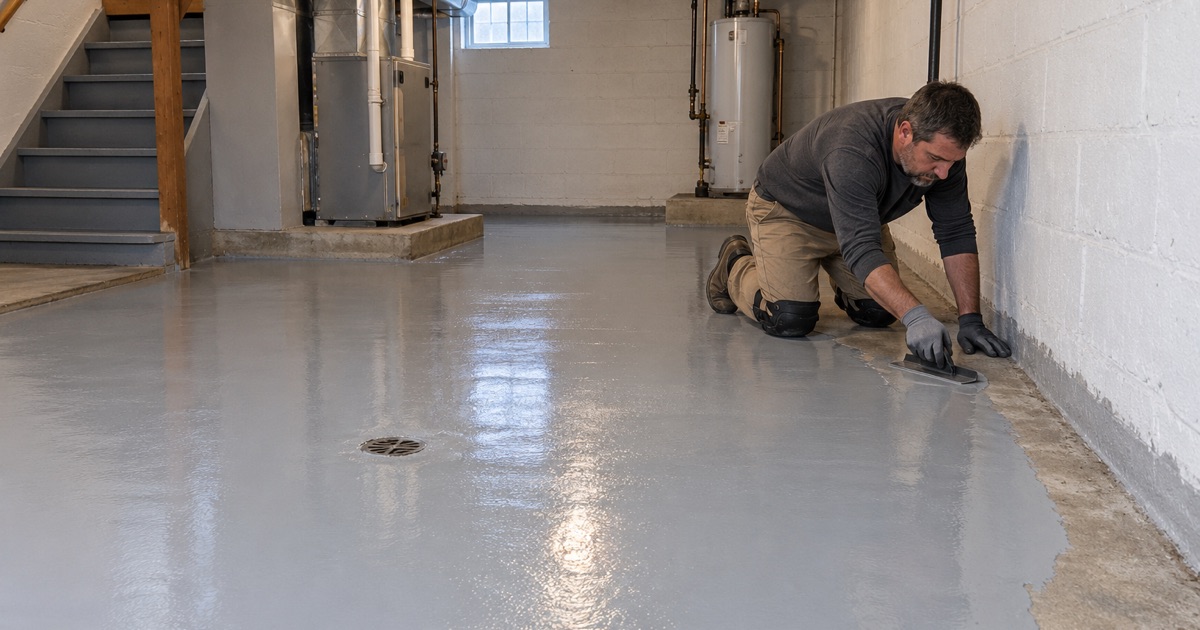
Waukegan Epoxy Flooring coats basement floors with epoxy in Waukegan, IL, serving surrounding cities including Park City, Gurnee, North Chicago, Beach Park and Green Oaks. A basement slab is the hardest floor in a house to coat well, because it sits against wet ground on every side and carries whatever the decades have left on it. Over more than 20 years, we have learned to answer the moisture question before anyone looks at colors.
Every basement quote we write includes moisture testing as its own line. We look at the walls, the drain, the sump pit, the history of water in the room and the condition of any old paint or patches, then test the slab. The result decides whether a standard epoxy will hold, whether a mitigation primer is needed, or whether the floor should not be coated yet at all.
We also say plainly what a coating cannot do. It is a film bonded to the top of the concrete, so it will not stop water pushed up from below, and it will not make a damp basement dry. What it does well is give a finished room a durable, cleanable floor.
The Moisture Question Comes First
Clay Till and Spring Water Tables
Much of Lake County sits on dense, slow-draining clay till that holds water against foundations through a wet spring. A basement floor that looks dry during a summer visit may be passing far more vapor in April. We read the slab against the ASTM F710 thresholds and the coating manufacturer’s own limits rather than against how dry it looks on the day.
When a floor is close to the limit, we would rather wait for a reading in the wet season than gamble on one taken in the driest month of the year.
Slabs Without a Vapor Retarder
Modern basements are typically poured over an under-slab vapor retarder meeting ASTM E1745. Many older basements in Waukegan were poured before that was common, and some have nothing between the concrete and the soil. Vapor moves up through those slabs constantly and collects under any film laid on top.
Hydrostatic Pressure and When Not to Coat
When groundwater pushes up against the underside of a slab, it creates hydrostatic pressure. That pressure can lift and blister even a well-bonded coating. If a floor is taking on liquid water through cracks or at the cove joint, the answer is drainage or waterproofing first, and we will tell you so rather than sell a floor that cannot last.
What We Find on Older Basement Floors
Efflorescence and Mineral Deposits
White powder or crust on a basement floor is efflorescence: salts carried up by water and left behind when it evaporates. It shows where moisture is moving and is a warning sign for any coating. We clean it off, find its source and adjust the system to the readings.
Decades of Paint, Tile Adhesive and Patches
Nearly one Waukegan home in five predates 1940, and those basements can carry layers of floor paint, black tile mastic, leveling patches and sometimes a second slab poured over the first. Each layer is a separate bond. We grind through what we can, test the concrete underneath and tell you if the floor needs more than a coating.
Cracks and Settled Sections
Hairline shrinkage cracks can be routed and filled before coating. Cracks with offset edges or sections that have dropped are signs of movement, and a coating follows the slab beneath it. We point those out at the first visit.
Building a Basement Floor System
Moisture-Mitigation Primer
When a slab tests above what a standard epoxy will tolerate but is not taking on liquid water, a moisture-mitigation primer is the usual answer. It is a dense epoxy formulated to resist vapor drive, and the rest of the system bonds to it. It adds cost, so it is recommended only where the readings call for it.
Base Coat, Broadcast and Topcoat
Over the primer or a standard base coat, we can add a vinyl flake broadcast for color and texture, a quartz aggregate for extra grip, or a metallic look for a finished room. A polyaspartic or urethane topcoat protects the surface and resists scuffs from furniture and foot traffic.
Finishing at Drains, Sump Pits and Walls
The edges of a basement floor are where water collects. We terminate the coating cleanly at the sump pit and floor drain so it turns down into them rather than sealing them over, and we finish along the foundation wall so the cove joint can still be inspected. A drain is never coated shut.
Basements After Water Events
Coating After a Sewer Backup
A basement sewer backup leaves contamination deep in the pores of the concrete. Before any coating, the slab has to be cleaned, disinfected and dried out completely, and we test again before we start. Many nearby villages fund overhead sewer conversions or backflow devices, and we usually suggest looking into one before installing a new floor.
Floors in Flood-Prone Rooms
A coated floor is easier to clean after a minor leak than bare concrete or carpet, but it is not a flood barrier. In a room with a history of water, we recommend keeping finishes simple, raising stored items off the floor and choosing a system that can be cleaned and recoated rather than replaced.
Finished Basement Rooms on a Coated Slab
Laundry, Storage and Utility Rooms
A coated laundry or utility floor is easy to mop and shows leaks from a washer or water heater right away, before they spread into stored boxes. A solid color with a light anti-slip texture works well where the floor may get wet.
Playrooms and Home Gyms
A basement playroom or gym benefits from a thicker system and a tougher topcoat. Dropped weights and rolling toys mark thin coatings quickly, so we build these floors to handle the load and suggest rubber mats where the heaviest impact happens.
Rental Units and Two-Flat Basements
In a two-flat or a small rental building, the basement is often shared laundry and storage for several households. We schedule those floors with the owner and around the tenants who still need the washer, the water heater and their storage cages, and we can phase a large basement so part of it stays in use.
Every residential job, owner-occupied or rented, gets a written contract and the Home Repair: Know Your Consumer Rights pamphlet before work begins, as Illinois law requires.
Curing a Coating in a Cool Basement
Slab Temperature and Dew Point
Basements stay cool year-round, and a cool slab in humid summer air can sit close to the dew point. When it does, moisture condenses on the surface, and epoxy cured in those conditions can develop amine blush, a waxy film that weakens the next coat. We measure the slab temperature and the dew point spread before each coat and use a dehumidifier or heat when the readings call for it.
Ventilation and Odor
We choose basement products within the Illinois limits on VOC content for floor coatings and ventilate the space during installation. Doors to the living area stay closed while each coat cures, and we tell you when it is comfortable to use the room again.
- 20+ Years Coating Floors
- Moisture Testing in Every Scope
- Free Written Estimates