Waukegan Epoxy Flooring brings more than 20 years of epoxy flooring work to Wood Dale, and commercial jobs here start with a date rather than a product. Each business space in the city carries a certificate that is renewed every year after an inspection, so the practical question for an owner is not only which coating to choose but when the room can be out of service. We plan the grinding, coating and cure around that calendar instead of discovering it halfway through a job.
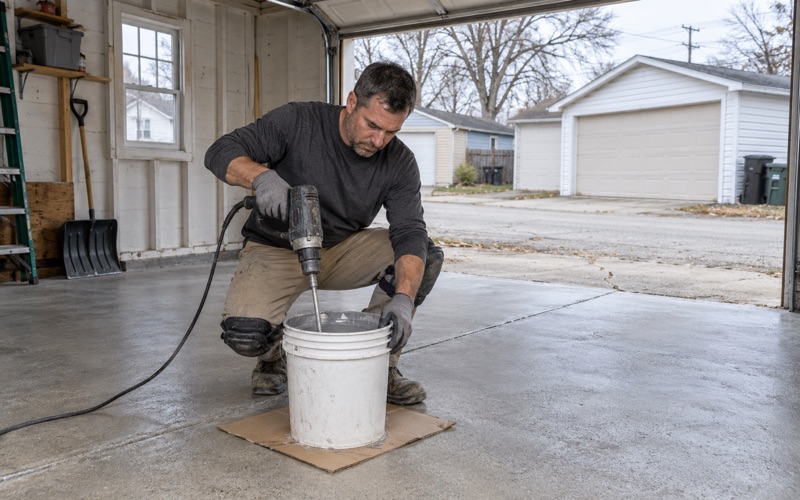
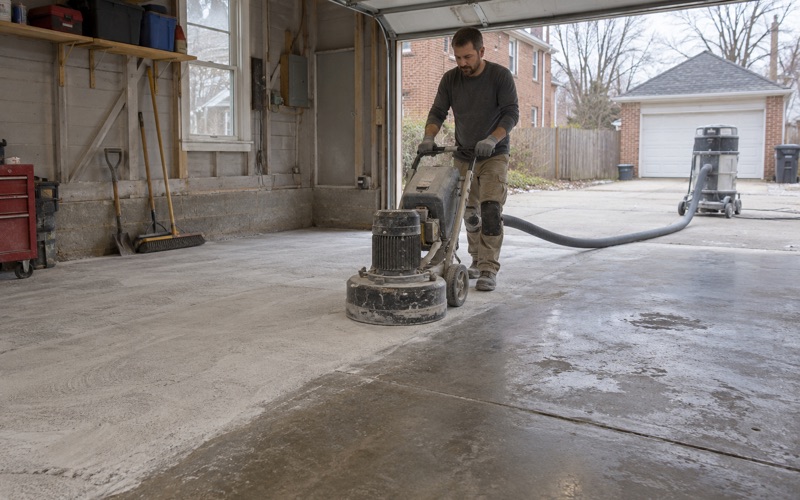
Every scope we write starts on the slab. We open the surface with a diamond grinder or a shot blaster, never acid, and moisture testing appears in the proposal as its own line rather than being offered after a blister shows up. The same proposal names the product, the system build and the finished thickness, so a facility manager can check what went down against what was quoted.
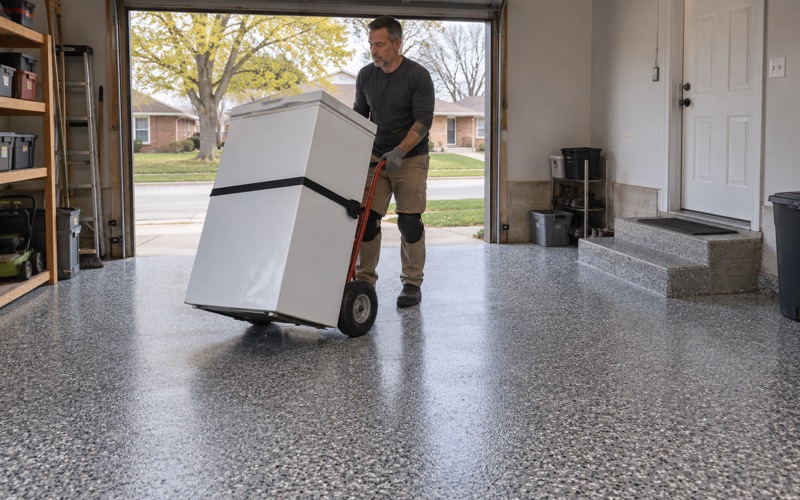
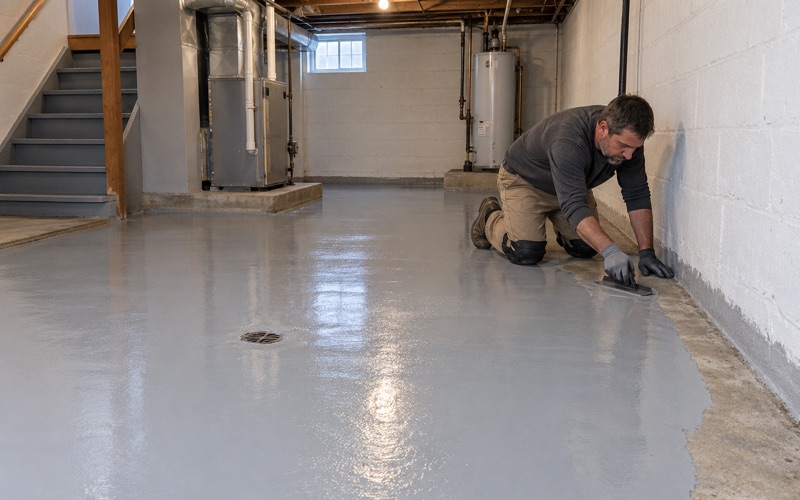
Homeowners get the same preparation on a garage or basement slab, along with a written contract and the state’s Home Repair: Know Your Consumer Rights pamphlet before any work begins, as the Illinois Home Repair and Remodeling Act requires. What changes on a business floor is the clock it runs against, and in Wood Dale the city sets that clock.
The Commercial Occupancy Certificate and Who Inspects for It
The City of Wood Dale runs a Commercial Occupancy Program that reaches every business space in town. It asks for an annual application and payment of fees, and the Commercial Occupancy Certificate issues only after the space passes an inspection. A shop, lab, office or showroom that wants to keep operating renews that certificate every year, not once at move-in.
Renewals go through the fire district
For a business that is renewing, the inspection is handled by the Wood Dale Fire Protection District. The district works out of 589 N Wood Dale Rd with two career-staffed stations, and it covers Wood Dale plus a small part of Itasca. Its inspection line is (630) 766-1147.
We do not claim to know what a renewal inspector writes up, and we would be wary of any flooring contractor who said otherwise. What we can say is that the inspection is a fixed appointment, and a room that is half ground, taped off or sitting inside a cure window is a room nobody wants to explain that day. Our aim is a floor that is finished, cured and back in use well before the inspector arrives.
When a business cannot close for the length of a full system, we phase the floor instead. One bay or room is ground, coated and cured while the rest of the space keeps working, and the next section starts only after the first is back in service. Phasing adds days to the calendar, which is one more reason to know the inspection date before the first section is opened.
A new business sees more than one inspector
A new business goes through a broader first inspection. One or more city departments inspect alongside the Wood Dale Fire Protection District, and Community Development can be reached at (630) 766-5133. Because that first certificate is what lets a tenant open its doors, floor work in a new space belongs early in the build-out schedule rather than after it.
Looking for epoxy-flooring closer to Bensenville? See Bensenville Epoxy-Flooring.
Renewal Zones: Knowing Which Month Is Yours
Wood Dale does not run every renewal on a single deadline. Inspections and renewal deadlines are organized by geographic Renewal Zones shown on a city map, so the date that matters depends on where a building sits. We have not read the current zone calendar and we do not quote one, so the owner or property manager confirms the zone and its deadline with the city before we set a start date.
Working backward from the deadline
Once the zone deadline is known, the floor schedule runs backward from it. A full commercial system means grinding, crack and joint repair, primer, body coats and a topcoat, followed by a cure before carts, pallet jacks or foot traffic return. A polyaspartic or polyurea topcoat can shorten the return-to-service window, while a thicker 100% solids epoxy or urethane cement build needs more of it, and the proposal names the cure time for whichever system is chosen.
Leaving room in the calendar
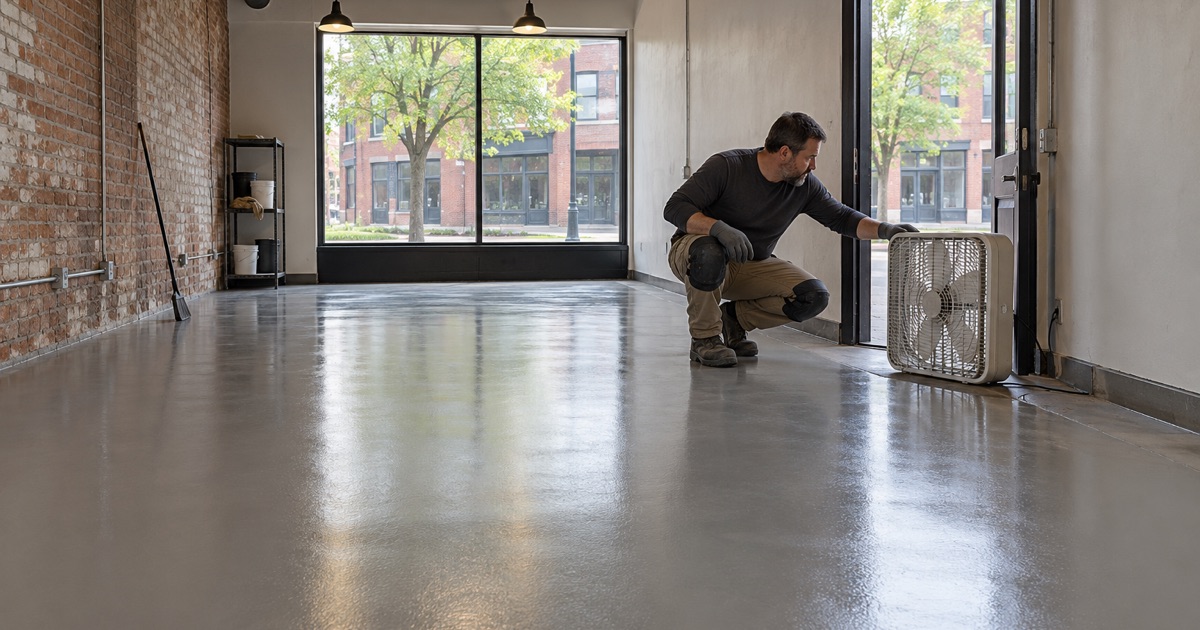
We would rather finish weeks ahead of an inspection than days. A moisture reading that comes back high, a crack that needs repair, or a cure slowed by a cold slab can each add time, and a schedule with no margin turns any one of them into a rushed topcoat. Curing is set against slab temperature and the dew point spread at the slab surface rather than the calendar, because amine blush and a soft film are what a hurried cure leaves behind.
Commercial space south of Thorndale
Many of Wood Dale’s commercial spaces sit inside the Thorndale Corridor TIF District, established in 2015. It takes in 250 parcels and about 603 acres of improved land south of Thorndale Avenue between Wood Dale Road and IL Route 83, plus frontage on IL 390 and Wood Dale Road. Every one of those buildings answers to the same annual certificate, and its zone tells us which stretch of the year to keep clear.
Several businesses under one roof
A multi-tenant building does not renew as one unit. Each business inside it holds its own certificate, so a landlord coating a shared corridor or loading area may be working near several suites at once. We ask the property manager which tenants are due when, and we sequence the common areas so no suite loses access to its own space in the weeks before its inspection.
Floor Work Before the Inspector, Not During
The order of operations matters as much as the date. Most of what can stretch a commercial floor job shows up in the first visit or the first day of prep, so we front-load the work that answers those questions.
Reading the slab before the quote is final
The first visit is for the concrete itself. We read the cracks and any old coating, and we say plainly when a section needs repair or replacement before anything can be applied over it. Moisture testing follows, using ASTM F1869 calcium chloride kits for vapor emission rate or ASTM F2170 in-situ relative humidity probes, with the results read against the product’s published limits.
An older slab is where this matters most. A slab poured decades ago may have no vapor retarder under it at all, and a dry-looking surface can still push enough vapor to lift a coating months later. When the readings call for it, a moisture-mitigation primer goes into the system and into the proposal, not into a change order.
Repairs that set the timeline
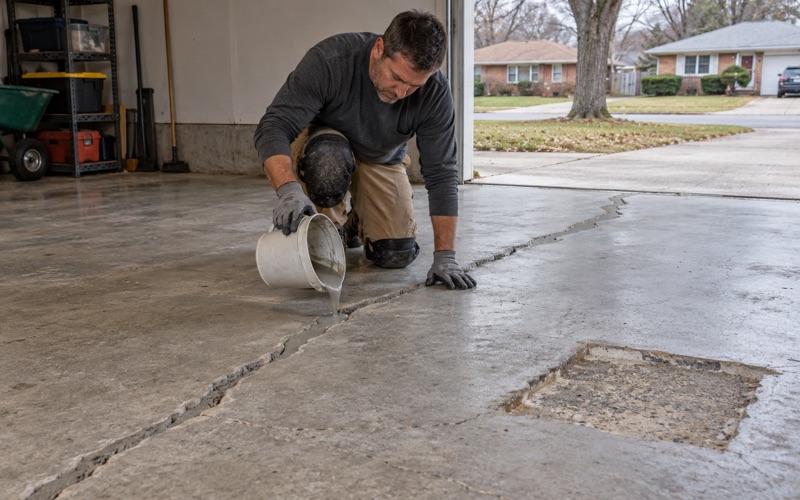
Cracks, spalls and broken joints are repaired before any primer goes down, and they are often what decides how long a job takes. A dormant hairline crack can be filled and ground flush in the same day, while a joint that still moves is detailed so the coating does not bridge it rigidly. Where a section of slab is too far gone to coat, we say so at the first visit, because replacing concrete adds a cure time of its own that has to fit ahead of the inspection.
Prep that keeps the building running
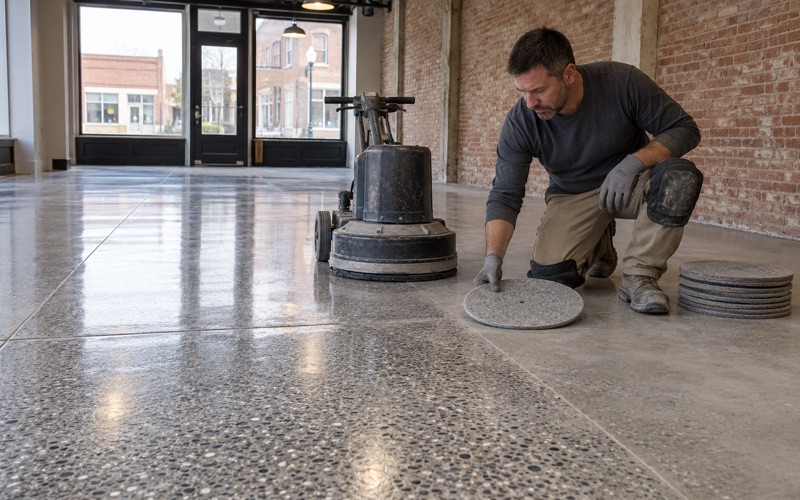
Diamond grinding and shot blasting open the concrete to the ICRI CSP profile the coating calls for. Grinding dust and slurry are collected on site and never washed toward a street drain, which keeps an occupied building cleaner while the rest of it stays open. On working commercial floors we schedule around the hours the operation has to run, including overnight and weekend windows.
What we say before the contract
A coating is a film that follows the slab beneath it. It does not stop a moving crack or a settling joint, and we say that before the job is sold rather than after. Warranty exclusions are read out at the same meeting, with moisture named first, and coatings are chosen within the Illinois limit on VOC content, which binds the installer as well as the manufacturer.
A New Tenant, a New Certificate, a Floor to Finish First
Turnover is the cleanest time to coat a commercial floor. Between one tenant leaving and the next opening, the space is empty, the old coating or adhesive can come up without working around equipment, and the new certificate has not been issued yet. That last point carries weight here, because a new business in Wood Dale is inspected by city departments and the fire district before it opens.
Taking up what the last tenant left
A vacated space usually comes with someone else’s floor. That can be a worn coating, tile mastic, carpet glue or paint, and none of it is a sound base for a new system. We test how well any old coating is holding, grind or blast the rest down to clean concrete, and price the removal in the proposal rather than finding it after the first pass.
Matching the system to the room
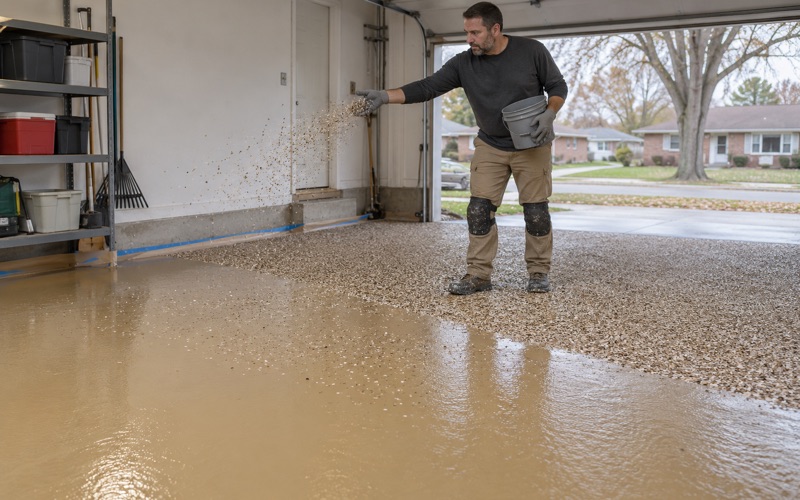
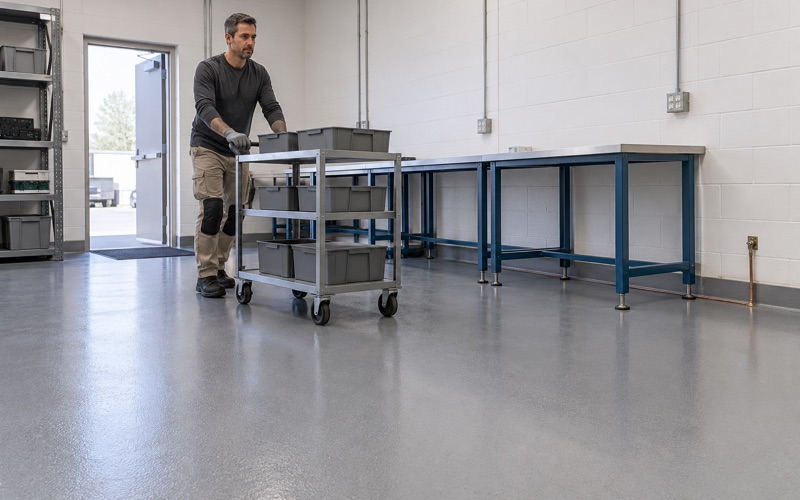
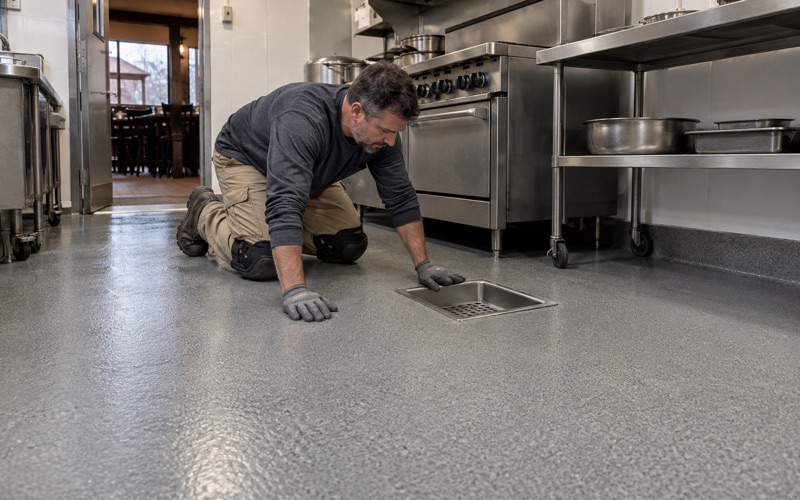
The right system depends on what the room will do. A clean assembly area may want a 100% solids epoxy with a quartz aggregate broadcast for grip, a showroom or office back room may suit a vinyl flake broadcast under a polyaspartic topcoat, and an electronics bench may need static-dissipative or ESD flooring tested to its resistance range. Where a tenant only needs a hardened, sealed bare slab, a lithium silicate densifier can be the honest answer instead of a coating.
Coordinating with the build-out
We fit our days between demolition and fixture install, ahead of shelving, benches and casework. The other trades stay off the floor during the cure, and we tell the general contractor exactly when foot traffic and when rolling loads can return. That way the coating does not get scuffed by a ladder or a pallet jack the week before the space is shown to an inspector.
Handing the floor back
We finish with the floor cured and in service, and the product data and finished thickness on paper for the owner’s file. The tenant moves in, the build-out contractor carries the space through its first inspection, and the floor is already behind them. When the renewal comes around a year later under that building’s Renewal Zone, the coating is simply part of a room that has been working the whole time.
- 20+ Years Coating Floors
- Moisture Testing in Every Scope
- Free Written Estimates