Waukegan Epoxy Flooring has put more than 20 years into epoxy flooring in Winthrop Harbor and across Lake County, and the floors here that teach us the most are the ones that smell of gasoline. A shop slab where outboards get serviced, a storage building where hulls drip through the off season, a home garage where a trailered boat gets its spring tune-up: each one takes fuel, oil and solvent that bare or painted concrete soaks up and holds.
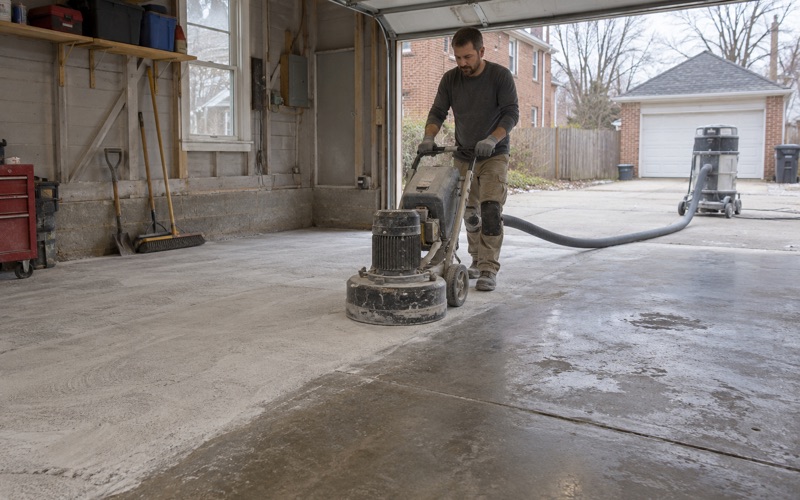
That changes what goes down and how the slab is prepared for it. Concrete that has absorbed petroleum for years has to be opened up and checked for contamination before any primer will grip it, and the topcoat has to stand up to chemical attack rather than simply look glossy on the day we leave. We grind or shot blast every slab and never acid etch, and our written proposal names the product, the system build and the finished thickness so you can check the floor against the quote.
Most of what we quote in this village falls into two groups: commercial floors tied to boating, and garages attached to owner-occupied houses. The sections below take each in turn, starting with why the commercial side looks the way it does.
A 1,500-slip state marina, and what its kind of floor has to resist
Winthrop Harbor sits on the state’s northern border, and the village was laid out as an industrial town after the Winthrop Harbor and Dock Company bought more than 2,000 acres in 1899. It stayed residential instead until North Point Marina was built in 1989. That project changed what kind of commercial floor exists here.
The marina itself
The Illinois Department of Natural Resources lists North Point Marina as constructed in 1989 with 1,500 slips, from 30 to 60 feet, inside the 297-acre North Point Marina State Recreation Area. The marina address on N Point Dr sits inside the village limits. For the 2026 season it is operated by SkipperBud’s under an IDNR contract, with a showroom, storage for boats on trailers and a full service center.
We have no contract with the marina or its operator, and we don’t claim one. We mention it because a harbor that size makes marine service floors the main commercial floor stock in a village that otherwise has very little industry. Shops, storage buildings and service bays that work on boats all share the same set of spills.
Fuel, oil, bilge water and solvent
Gasoline and diesel soften some coatings and stain the rest, and they wick into any crack or unsealed edge. Engine oil, gear lube and hydraulic fluid drip from outdrives and lifts and sit on the floor until someone finds them. Bilge water is oily water carrying whatever drained out of the hull, and it tends to arrive in quantity when a boat is pulled and tilted.
Solvent is the hardest of the four on a thin film. Parts washers, brush cleaners and paint strippers carry chemicals that will lift a single-coat hardware-store epoxy in an afternoon. A marine service floor has to be built for all four at once, plus the traction a wet, oily surface demands.
How we build for it
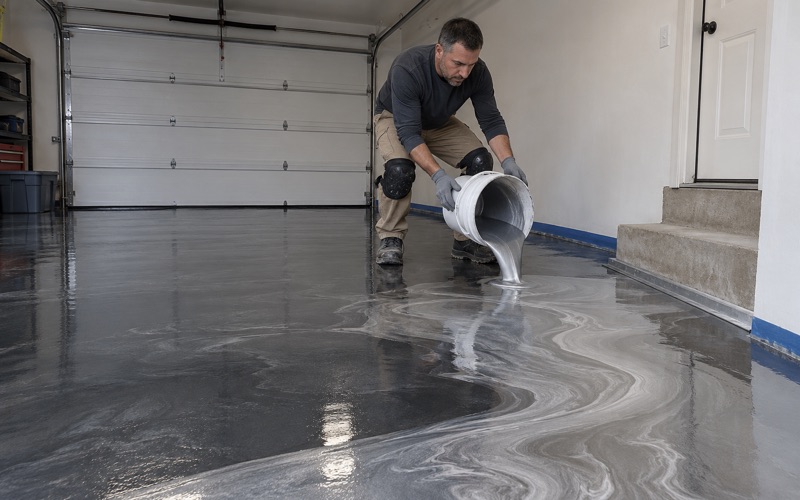
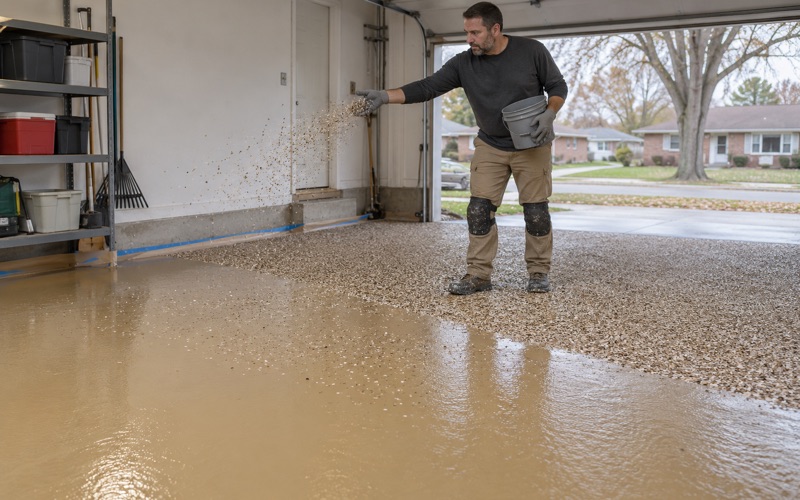
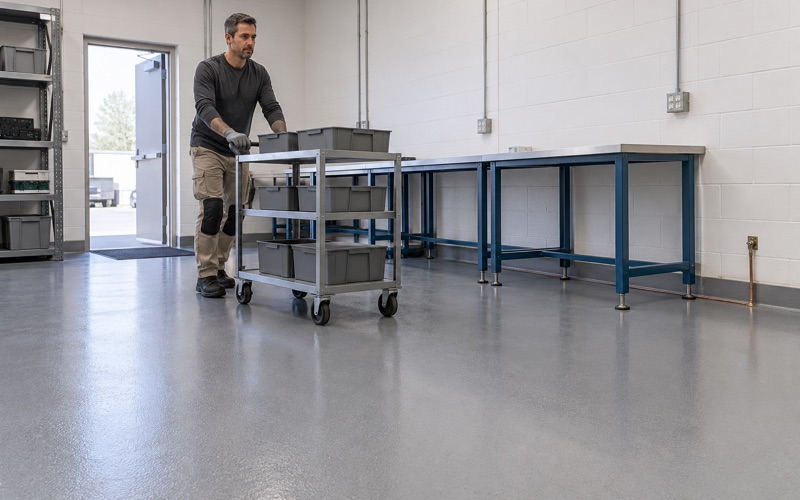
The usual answer is a 100% solids epoxy base at a real film thickness, a quartz aggregate broadcast for grip, and a chemical-resistant topcoat chosen for the specific fluids in that bay. Polyaspartic and polyurea topcoats handle fuel and UV well, and urethane cement earns its place where hot-water washdown or aggressive solvent is part of the daily routine. Along walls and around drains we can cove the coating up the wall so a spill stays on the floor instead of running under the base.
Looking for epoxy-flooring closer to Lindenhurst? See Epoxy-Flooring in Lindenhurst.
Boat storage buildings and service shop floors
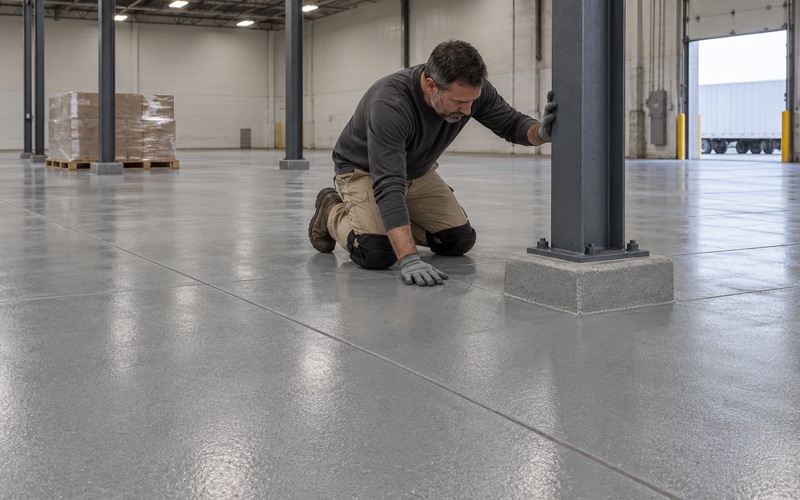
A storage building and a service shop look alike from the parking lot, but they wear differently. Storage floors carry concentrated point loads and long periods of stillness, while shop floors get constant traffic, rolling carts and repeated spills in the same few spots.
Trailers, jack stands and tires
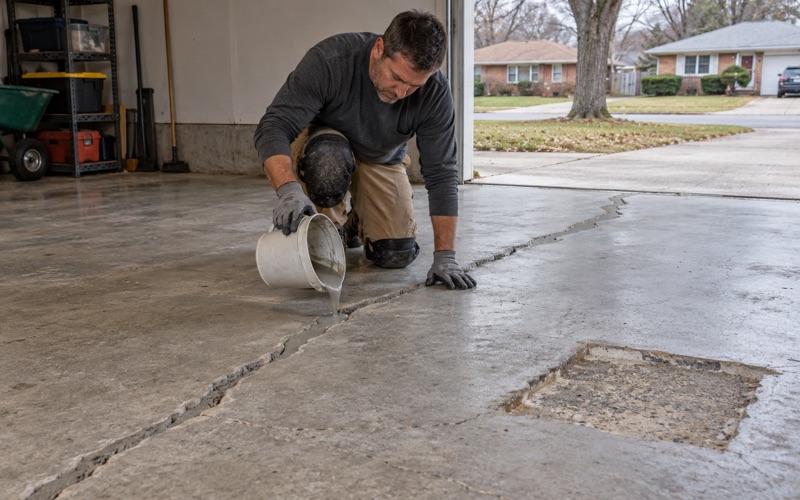
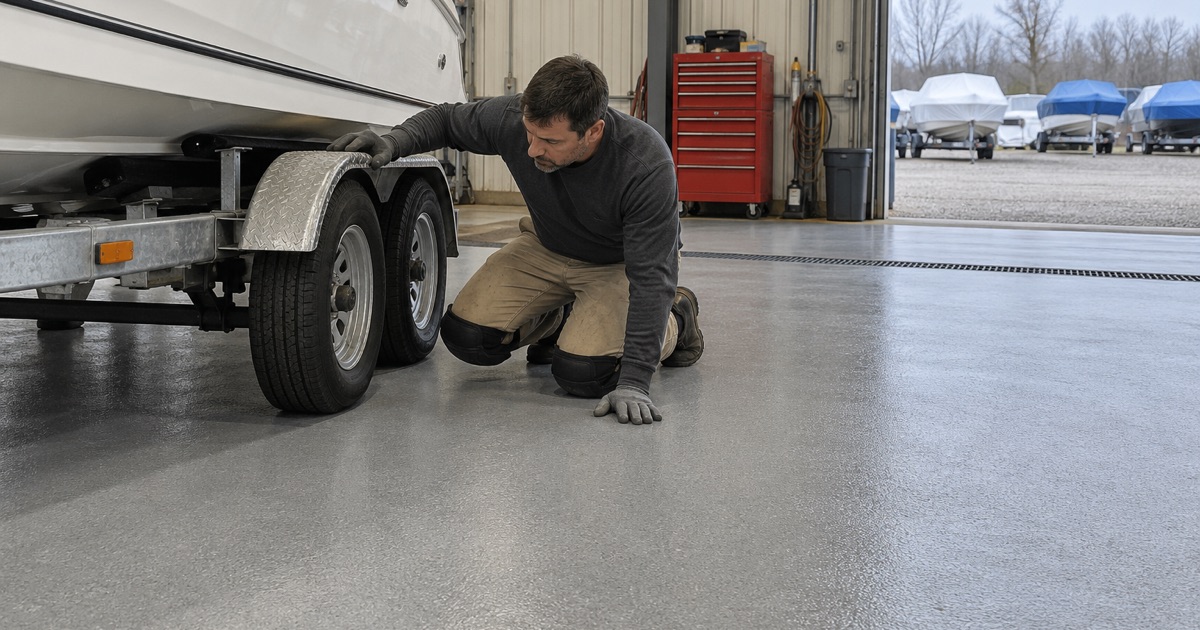
A boat on jack stands puts its weight through a few small steel pads, and a trailer tongue jack does the same on a smaller scale. Those loads will crack a thin coating over a weak or hollow patch of concrete, so we sound the slab and read the existing cracks before we price anything. When a section needs repair or replacement before it can be coated, we say so in writing.
Not every storage floor needs a resin system. A dry, clean storage aisle that never sees service work can be ground and treated with a lithium silicate densifier, which hardens the surface and cuts dusting for less money. We reserve the full coating build for the bays where fuel, oil and solvent actually land.
Tow vehicles bring hot tire pickup into the picture. A soft or under-cured coating will lift where a hot tire stops and turns, which is why we match cure schedules to slab temperature and dew point at the surface rather than to the date on a calendar. In an unheated building that sometimes means waiting for warmer weeks.
Contaminated concrete
Old service bays are rarely clean concrete. Years of oil spills leave the slab saturated near drains, lifts and parts washers, and a coating applied over that will release no matter how good the product is. We degrease, grind to the profile the system calls for on the ICRI CSP scale, and test the result; where oil has gone too deep, the contaminated area has to be cut out and patched before it can be coated.
A coating is a film that follows the slab under it. It will not hold a moving crack together, and we explain that before the job rather than after.
Working around a season
A marine business has a busy window and a slow one, and a floor job that shuts a shop in May costs far more than the same job in a quiet stretch. We schedule commercial floors around the hours a building has to keep running, including overnight and weekend windows.
Grinding dust is vacuumed at the machine and slurry is collected on site. None of it is washed toward a street drain, which matters more than usual in a village whose storm water ends up in the harbor.
Garages in a village of owner-occupants
The residential side of Winthrop Harbor is unusually uniform. Census figures put 2,482 of the village’s 2,500 owner-occupied homes in single-family detached houses, so the person asking about a garage floor here is almost always the person who owns it.
When the boat comes home
Some owners bring a trailered boat home for winter or for spring work, and we have not counted how many. When one does, the garage floor inherits a small version of the marina’s problem: oil changes, gear lube from the lower unit, fuel stabilizer, and the odd puddle of bilge water draining from a plug. A vinyl flake broadcast floor with a polyaspartic topcoat handles that well and makes a drip easy to spot and wipe.
Trailer jacks and stands still concentrate weight, so we use a full-build system rather than a thin roll-on, and we check that the slab under the stand location is sound.
The rest of the year the same garage floor sees the ordinary Lake County load: calcium chloride brine and rock salt carried in on the tires, then left to dry into a crust. A sealed, seamless coating keeps that brine out of the concrete pores, and a light texture in the broadcast keeps the floor from turning slick when it is wet. Hot tire pickup is the other test, which is why the topcoat has to be fully cured before a car parks on it.
Moisture first
Many residential slabs here may have no vapor retarder under them, and the code permits that: IRC R506.2.3 exempts garage floors from the under-slab vapor retarder requirement. A dry-looking floor can still push enough moisture vapor to blister a coating, so testing is a line item in every scope. Depending on the slab, that means an ASTM D4263 plastic sheet test, ASTM F1869 calcium chloride testing or ASTM F2170 in-situ relative humidity probes, and a moisture-mitigation primer where the numbers call for one.
If testing shows a problem, we tell you before the job is sold. Moisture is the first exclusion we read out of the warranty, not something we mention once a floor fails.
Getting a quote in Winthrop Harbor
The Village of Winthrop Harbor sits in Benton Township in Lake County, with village hall at 830 Sheridan Rd. We could not find the village’s contractor registration, bond or permit rules for floor coating published online. We call village hall before a job is scheduled rather than guess at the answer either way.
What the state requires, and what it doesn’t
Illinois issues no state license for flooring or coatings work, and we don’t present ourselves as holding one. What the state does require for home jobs is a written contract and the Home Repair: Know Your Consumer Rights pamphlet under the Illinois Home Repair and Remodeling Act, and every residential customer gets both before we start. The coatings we install also fall under the Illinois limit on VOC content, which binds the installer as well as the manufacturer.
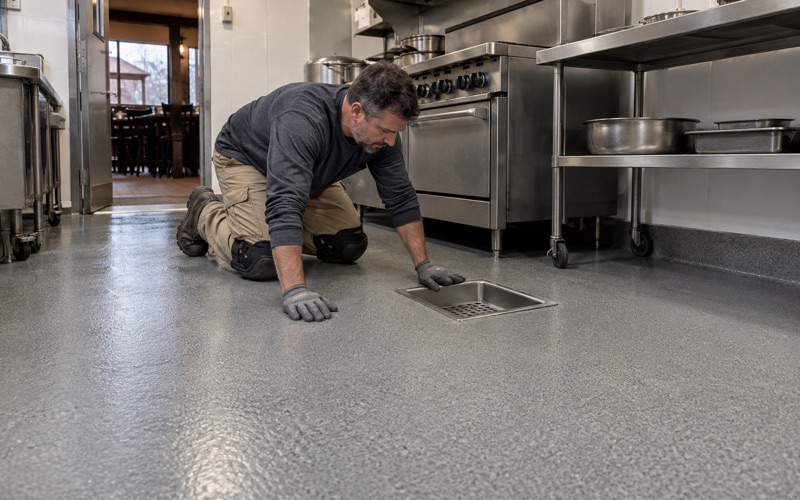
Two other boundaries are worth naming. A food service floor in Lake County goes through Lake County Health Department plan review, and the FDA Food Code calls for coved floor and wall junctures in those spaces, so we design that detail in from the start. And we do not sell a floor coating as radon reduction, since that work takes a state radon mitigation license from IEMA.
What the walkthrough covers
On a site visit we look at the cracks, any old coating, the drains and the areas where fluids collect, then we set up the moisture test. For a shop or storage building we also ask which fuels, oils and solvents are used on the floor and when the building can be closed. The proposal that follows lists the system, the thickness, the testing and the exclusions, in that order, so the price is easy to compare.
- 20+ Years Coating Floors
- Moisture Testing in Every Scope
- Free Written Estimates