Waukegan Epoxy Flooring plans every job of epoxy flooring in Winnetka around a clock the village posts, and after more than 20 years of coating floors we treat that clock as part of the scope. The first question we answer for a homeowner here is not which color of flake to pick. It is which days, and which hours of those days, a crew can actually be at the house.
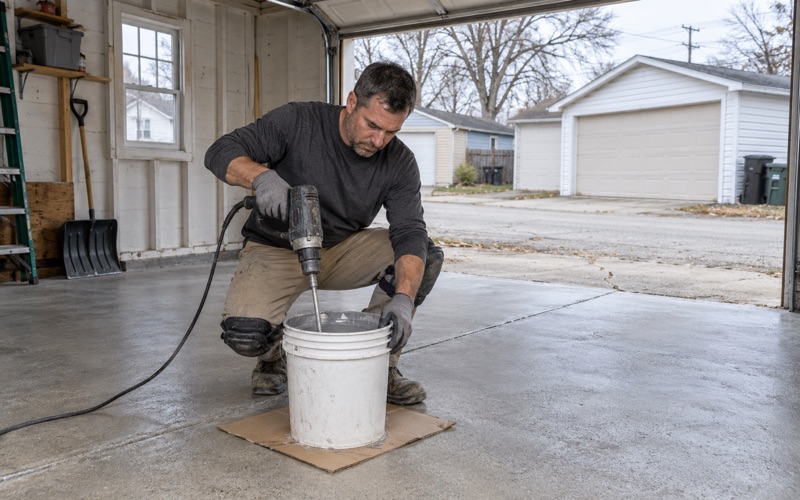
A coated garage or basement floor is rarely a one-day job. The concrete is opened with a diamond grinder or a shot blaster, a base coat goes down, a broadcast follows, and a topcoat seals it, with cure intervals between the steps that the product sets rather than the installer. When the working day has a hard start and a hard stop, those intervals decide which day each coat lands on.
So the proposal we hand a Winnetka homeowner does two jobs at once. It names the product, the system build and the finished thickness, so what was quoted can be checked against what went down. It also lays out a day-by-day sequence that never asks a crew to arrive early, stay late or return on a day the village has closed.
When a Crew May Work in Winnetka
The Village of Winnetka publishes Construction Site Management Requirements, effective January 18, 2023, and much of the document reads like a timetable. Regular construction hours run from 7:00 a.m. to 7:00 p.m. on weekdays and from 9:00 a.m. to 6:00 p.m. on Saturdays. Workers for any trade are not supposed to be on site before or after those posted hours.
The requirements are written for construction sites, and they do not say whether an interior coating job with no permit falls under them. We do not ask a homeowner to find out the hard way. We plan every Winnetka floor as though the posted hours apply, because a crew that keeps to them never leaves the owner explaining an early grinder to the house next door.
The weekday window
Twelve hours is a workable day for a floor crew. A two-car garage can be ground, vacuumed, crack-filled and primed inside it, with the base coat and broadcast going down while the slab and the air sit in the range the product data sheet calls for. Within that day we still watch the dew point spread at the slab surface, since a coat laid on concrete too close to dew point can blush or lose its grip.
What the weekday window rules out is the habit of starting at six to get ahead of the day. In Winnetka a 7:00 a.m. start means the grinder spins up at seven and not before. The last coat of the day goes down early enough that cleanup, the equipment load-out and the walk-through are finished by seven at night.
Saturday runs shorter
The Saturday window opens two hours later and closes one hour sooner, nine working hours instead of twelve. That matters most for the loud work. We would rather put grinding and shot blasting on a weekday and let Saturday carry a quieter step, such as a topcoat or a final inspection, whenever the sequence allows it.
The same document bars demolition, excavation and foundation concrete work on Saturdays and Sundays. We read the cracks and the old coating before we quote, and when a slab needs repair or replacement before it can be coated, we say so plainly. If that repair amounts to foundation concrete work, it goes on a weekday, and the schedule shows it from the start.
Sunday is closed
Construction activity is prohibited on Sundays in Winnetka, and we do not schedule a crew there on one. The gap is useful when it is planned for. A coat applied on a Saturday afternoon gets an extra full day to cure before anyone comes back on Monday, which can suit a system whose topcoat wants a long wait before vehicle traffic.
Looking for epoxy-flooring closer to Barrington? See Barrington Epoxy-Flooring.
Six Holidays and a Floor That Takes Several Days
The village also closes six holidays to construction: New Year’s Day, Memorial Day, the Fourth of July, Labor Day, Thanksgiving Day and Christmas Day. On a floor system that runs three or four working days, one of those dates in the middle of the week can push the last coat across a weekend. We check the job calendar against the list before a homeowner commits to a start date, not after the base coat is down.
Reading the holiday weeks
Memorial Day and Labor Day always fall on a Monday, so a job that starts the Thursday before either one loses Sunday and Monday back to back. Thanksgiving lands on a Thursday, which makes the Monday-to-Wednesday stretch of that week a tidy window for a short garage system and a poor one for anything longer. The Fourth of July, Christmas and New Year’s Day move around the week from year to year, and we look at where each one lands before booking.
A three-day gap is not automatically a problem. Some primers and base coats have a recoat window that closes, after which the surface has to be abraded before the next coat will bond properly. We pick the start date so that no coat sits past its window over a holiday weekend, and when that cannot be done we build the extra sanding pass into the scope and the price.
Fitting each coat into the day
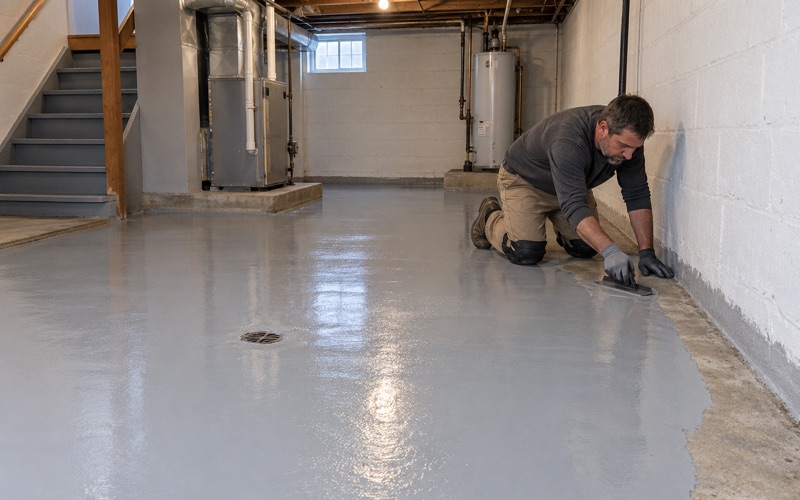
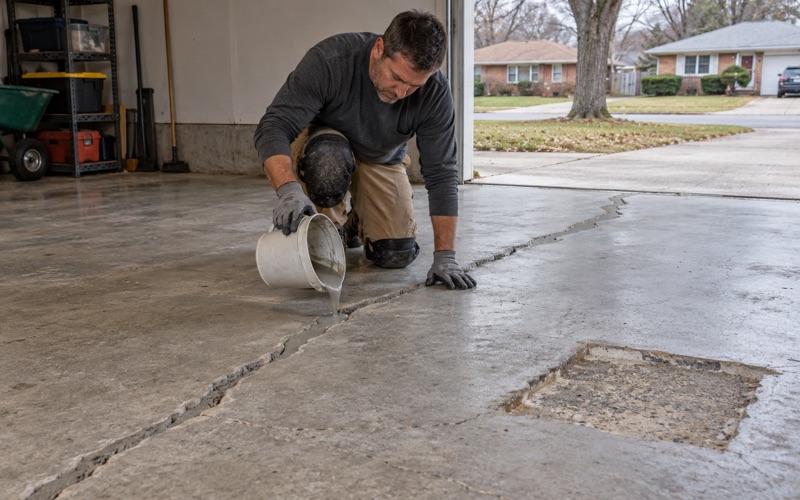
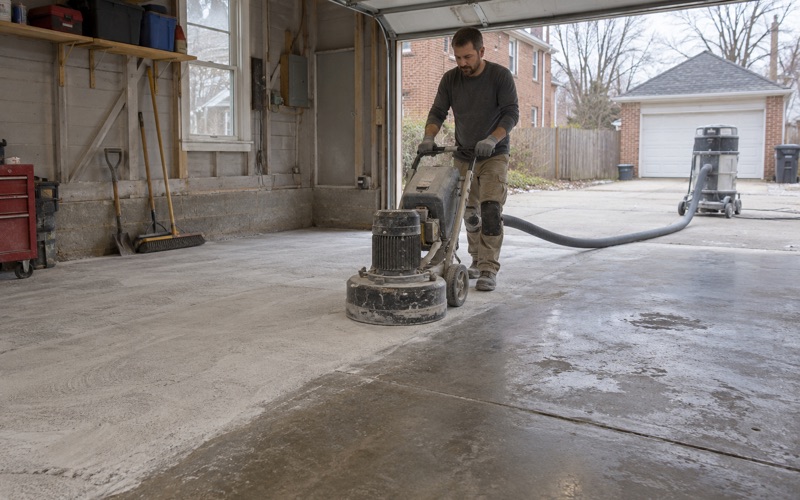
Day one is mechanical preparation: diamond grinding or shot blasting to the ICRI concrete surface profile the primer calls for, then crack and spall repair and a thorough vacuum. We do not acid etch. Moisture testing is already a line item in our scope, and when the result calls for it the first coat is a moisture-mitigation primer rather than a standard base coat.
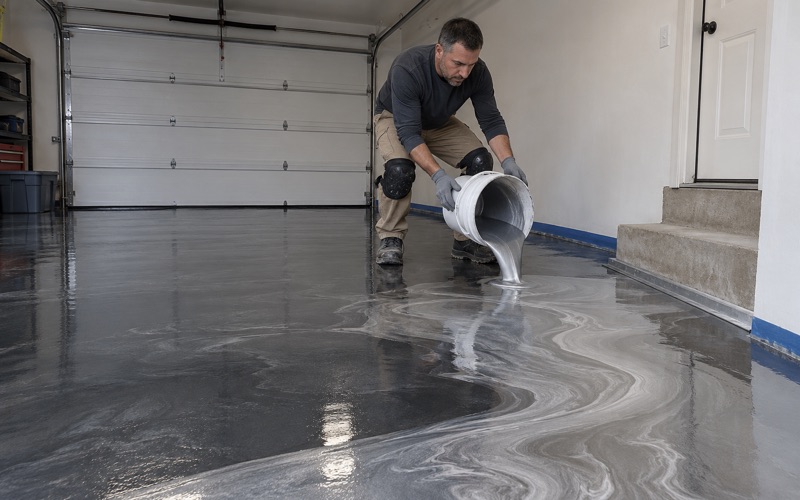
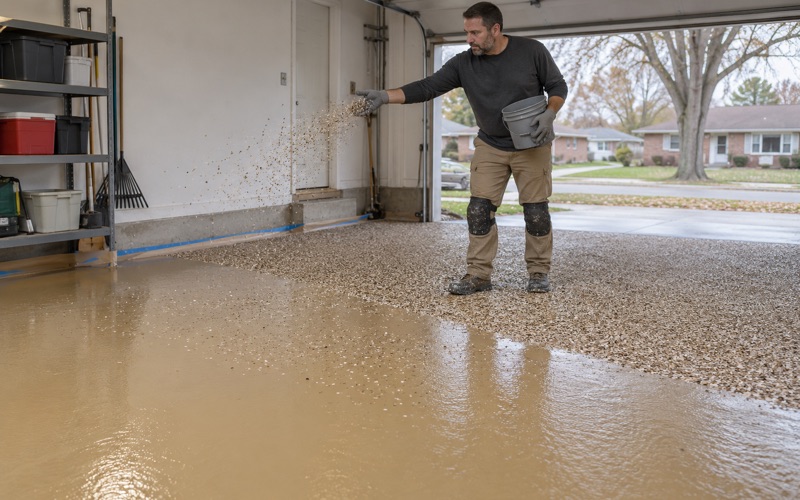
From there a vinyl flake or quartz aggregate broadcast goes into the wet 100% solids epoxy, and the polyaspartic or urethane topcoat follows once the base coat has reached the recoat window the manufacturer prints. Those windows are product facts, not village rules, and they stretch in a cool garage. We line each one up with the posted hours so a coat never has to go down at the end of a day because the one before it was slow.
When the calendar says wait
Curing in an unheated garage follows slab temperature, and late in the year a garage slab can sit too cold for the products we use to cure the way they should. When that happens we say so and book the job for spring rather than squeezing a coat in ahead of a holiday weekend. A floor that waits a few months costs a homeowner far less than one that lifts under hot tires the first winter.
Dust, Noise and the Gasoline Generator Rule
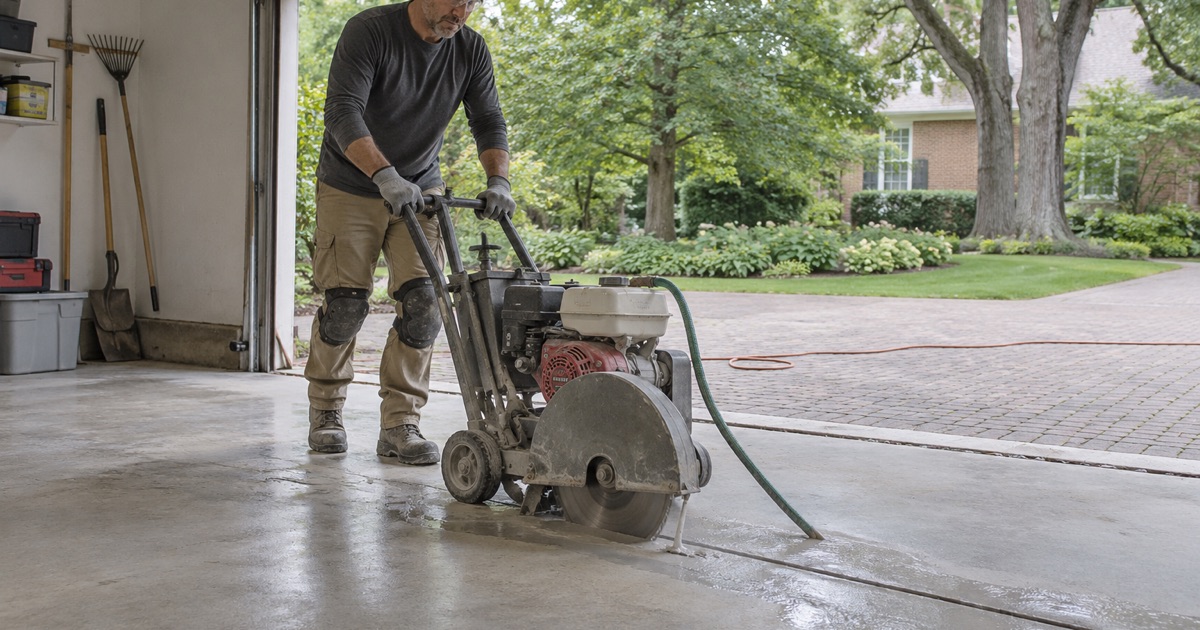
Winnetka’s requirements cover how the work is done as well as when it is done. Water must be used to control the release of dust when cutting stone, brick, concrete or similar materials. Idling vehicles and contractor music on neighborhood streets are prohibited, and gasoline-powered generators are not allowed in construction activity.
Water on every cut
Most of a floor job is grinding rather than cutting, and our grinders run with vacuum extraction that pulls the dust off the slab as it is made. When a job does call for a saw, whether to chase out a failed joint, cut back a spalled edge or square up a patch, the cut is made wet, as the village asks. The slurry that comes off that cut is collected on site and never rinsed down the driveway toward a street drain.
Power without a gas generator
Floor grinders and industrial vacuums draw serious current, and plenty of crews bring a gasoline generator to run them. That option is off the table here, so we confirm during the walk-through that the garage or basement has the circuits our electric equipment needs. If the outlets or the breaker layout will not carry the load, we work out where to plug in before the first morning rather than on it.
Keeping the street quiet
No crew radio carries past the garage door, and no truck sits idling at the curb while someone runs back for a mixing paddle. Those are small courtesies. In Winnetka they are also on the village’s own list, and we treat them that way.
Deliveries, Parking and the Neighbors’ Driveways
Building material and equipment deliveries have to be scheduled inside the permitted construction hours as well. For a floor job that means the grinder, the vacuums, the resin kits and the broadcast media arrive after 7:00 a.m. on a weekday or after 9:00 a.m. on a Saturday. Nothing is dropped off the evening before so the crew can get a head start.
Winnetka is a village in Cook County’s New Trier Township, about 17 miles north of downtown Chicago, and our crews travel down from Lake County to reach it. We time that drive so the van pulls up when the window opens rather than idling on the block waiting for it. On a Saturday, that means a later departure and a shorter first stretch of work.
Where the trucks go
Most of Winnetka’s housing is detached single-family homes, so most of our work here is a garage or a basement reached from a private drive. Our vehicles stay off the neighbors’ driveways and are kept at least two feet from any driveway, and we do not stage on a residential street. Where a street is narrow or a drive is shared, we settle the parking with the homeowner before the first day.
The paperwork before the first day
Every home job starts with a written contract and the Home Repair: Know Your Consumer Rights pamphlet, as the Illinois Home Repair and Remodeling Act requires. Illinois issues no license for flooring or coatings work, and Winnetka runs no contractor licensing program of its own, so we confirm what the village expects of contractors before a date goes on the calendar. Warranty exclusions are read aloud before the job is sold, with moisture named first.
Who answers questions about the rules
Questions about the construction rules themselves belong with the village, through Community Development’s code enforcement line at (847) 716-3521. We follow the posted hours, but we do not interpret them on the village’s behalf. When a homeowner’s situation sits outside what the requirements plainly say, a call there settles it before the schedule does.
- 20+ Years Coating Floors
- Moisture Testing in Every Scope
- Free Written Estimates