Waukegan Epoxy Flooring brings more than 20 years of epoxy-flooring work to Salem Lakes, and the first thing we tell a homeowner here is that crossing the state line changes the paperwork more than the floor. The grinder, the moisture test and the resin system are the same ones we use in Lake County. What shifts is which coating rules bind the installer, when a Wisconsin credential matters, and what a contract has to say before a deposit changes hands.
So most of this page is about that difference. We walk through the VOC regime on the Wisconsin side, the permit question and who answers it, and the written contract Wisconsin requires once any money is paid ahead of completion. Then we cover the lake homes that sit empty for a season, because curing a floor in a house nobody heats is its own scheduling problem.
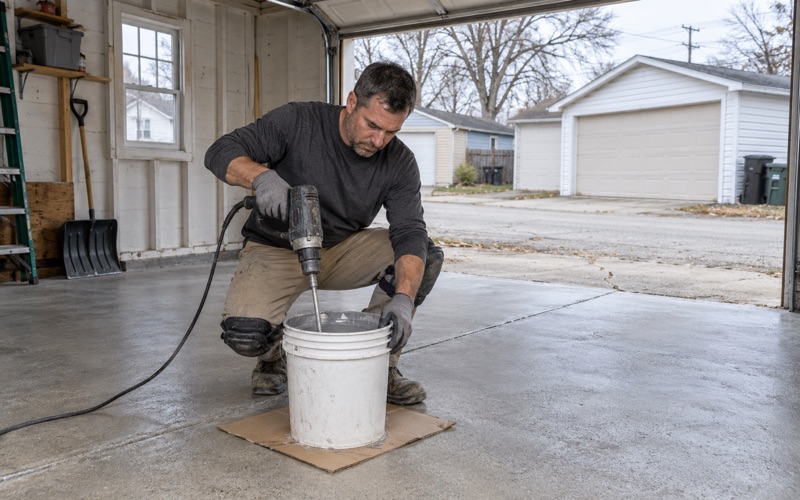
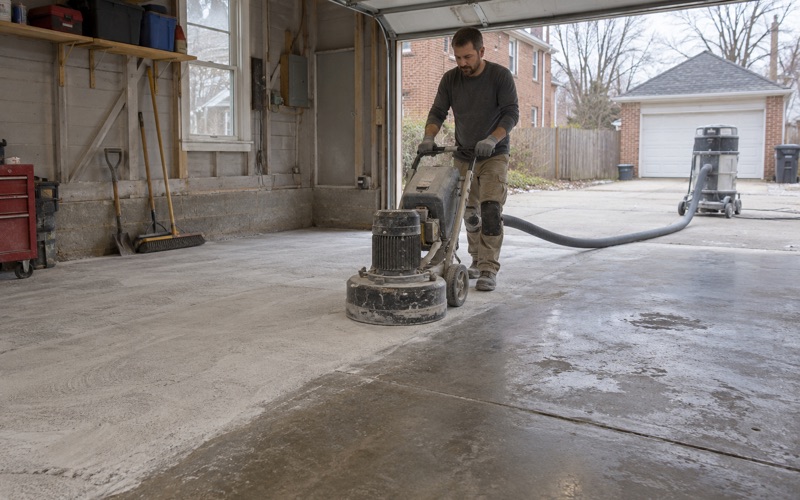
None of it changes how we prepare a slab. Every floor is opened with a diamond grinder or a shot blaster to a measured ICRI CSP profile, never acid etched, and moisture testing is written into the scope before anyone talks about flake colors.
Wisconsin’s VOC Rules and Why the Product List Changes at the Line
In Illinois, 35 Ill. Adm. Code Part 223 sets a VOC ceiling of 250 grams per liter for floor coatings, and that limit binds whoever applies the product, not only whoever makes it. That is why every Lake County proposal we write stays inside it. Drive north into Kenosha County and that Illinois rule no longer reaches the job.
No State Architectural-Coating Rule, Only the Federal One
The Wisconsin DNR’s air rules in NR 422 carry no architectural or floor-coating section, and 40 CFR 52.2570, the federal list of Wisconsin’s approved plan provisions, adds none. What does apply is the national architectural coatings rule, 40 CFR 59 Subpart D, with its 400 g/L limit for floor coatings. That limit is written for manufacturers and importers, so it governs what can be sold rather than what an applicator chooses to put down.
That is a real limit, not an absence of one, and anyone who tells you otherwise has skipped a step. It also means a can that is legal to sell on a Wisconsin shelf may not be legal to apply a few miles south in Illinois.
What We Actually Specify Here
We do not change systems at the border. A 100% solids epoxy base coat carries very little solvent to begin with, and the polyaspartic topcoats we pair with it are chosen against the stricter Illinois figure on both sides of the line. Holding one standard means a crew never carries a product onto an Illinois job that was bought for a Wisconsin one.
The proposal names that product, the system build and the finished thickness in mils. If you want to check what went down against what was quoted, the label on the pail and the line item on the page will match.
Where Kenosha County’s Ozone Boundary Falls
Part of Kenosha County sits inside the Chicago-area 2015 ozone nonattainment area, classified Serious, but that portion is bounded on the west by the I-94 corridor, with the whole corridor included. The village lies west of it. The classification drives regional air planning; it does not add a Wisconsin coating rule for a garage floor in Salem Lakes.
Looking for epoxy-flooring closer to Prospect Heights? See Epoxy-Flooring in Prospect Heights.
Permits, the Uniform Dwelling Code and the Dwelling Contractor Question
Whether an epoxy floor needs a permit in the village is a local-ordinance question, and we ask before we schedule rather than guess. The answer comes from the village, not from us and not from a neighbor who coated a garage last summer.
Who Handles Building Permits in Salem Lakes
The Village of Salem Lakes was created on February 14, 2017, when the Town of Salem and the Village of Silver Lake merged. Its building inspections are contracted to Bluestone Inspections, with Justin Border serving as the village building inspector, and the village’s building page directs permit applications to the Kenosha County online permitting portal. Zoning administration is handled by Kenosha County staff.
If a permit does apply to your job, that portal is where it starts. Village hall sits at 9814 Antioch Road, on STH 83, when a question is easier to settle at a counter than by email.
Where the Uniform Dwelling Code Stops
Wisconsin’s Uniform Dwelling Code, SPS 320 through 325, governs one- and two-family homes. Under SPS 320.05 and 320.09(2) it does not reach alterations to a dwelling begun before June 1, 1980 unless the municipality has adopted it for alterations, and permits for alterations follow local ordinance. That is why an honest answer to whether a floor coating needs a permit runs through the village inspector and nobody else.
When a Dwelling Contractor Credential Matters
Wisconsin’s Dwelling Contractor certification, issued by DSPS and paired with a Dwelling Contractor Qualifier, is tied by Wis. Stat. 101.654 to obtaining a building permit for a one- or two-family dwelling. Owner-occupants pulling their own permit are exempt, and the state issues no separate license for floor-coating work. The credential question therefore follows the permit question: where no dwelling permit is pulled, the statute’s trigger is never reached.
We would rather tell you that plainly than hint at a credential the job may not call for. If the village says a permit is needed, we settle who pulls it before a start date goes on the calendar.
What a Wisconsin Home Improvement Contract Must Say
In Lake County every home job we take gets a written contract and the state’s consumer-rights pamphlet, because the Illinois Home Repair and Remodeling Act requires both. Wisconsin reaches a similar place through a different rule, ATCP 110, and its trigger is money. The rule names garages, basements and attached floor coverings among the work it covers, so a coated garage floor falls squarely inside it.
The Deposit Is the Trigger
Under ATCP 110.05(1), once any payment is due before the work is finished, a written contract is mandatory. It has to give start and completion dates, describe the products being used, and state any warranty terms. A deposit to hold a spring slot or to order resin is exactly that kind of payment.
Our proposals already carry most of that, since they name the resin, the build and the finished thickness. On a Wisconsin job we turn the proposal into a signed contract with dates attached before a single dollar moves.
Insurance Claims and Warranty Exclusions
ATCP 110 also says a contractor who claims to be insured has to back that claim with a written description of the coverage. We put that description in the paperwork rather than say the word and move on.
Warranty exclusions get the same treatment. We read them aloud before the job is sold, moisture first, because a slab pushing vapor up from below can lift any coating and no warranty pretends otherwise. A coating is a film that follows the concrete under it, so it will not stop a crack that is still moving, and we would rather say that now than after the first winter.
The Lien-Rights Notice
Wisconsin’s construction lien statute, Wis. Stat. 779.02(2), calls for a lien-rights notice from the prime contractor to the owner. It goes in the written contract, or is delivered within 10 days of first furnishing labor or materials, and it explains that unpaid suppliers and subcontractors can have lien rights against the property. Expect to see it on our Wisconsin paperwork, worded the way the statute sets it out.
Seasonal Lake Homes Around Silver, Camp and Cross Lakes
The village covers 33.29 square miles, and 2.81 of them are water. Silver Lake, Camp Lake, Cross Lake, Voltz Lake, Lake Shangrila and Benet Lake all lie wholly or partly within it, and Census figures count 274 homes held for seasonal, recreational or occasional use. Those houses shape our schedule here more than anything else does.
An Unheated House Changes the Cure
A lake home closed for the off-season has a slab that settles toward the temperature of the ground and the still air around it. We schedule curing against slab temperature and the dew point spread at the slab surface, not against the calendar, because a cold slab with damp air over it invites amine blush on epoxy and a weak bond for the coat that follows. When a garage or basement simply has no heat, we say so and book it for spring.
If the owner can bring the house up to temperature for the days before, during and after the install, the window opens earlier. That is a decision we make with you, checked with a surface thermometer and a hygrometer on the day, rather than a promise made over the phone.
Coordinating With an Owner Who Is Not There
Many seasonal owners live somewhere else for most of the year, which makes the written contract more useful, not less. Dates, products and the finished thickness on paper mean nobody has to remember a conversation from three months back. We photograph the slab after grinding and again after the final coat so an absent owner can see both stages.
Grinding dust and slurry are collected on site with vacuums and never rinsed toward a drain, a ditch or a shoreline. With this much water inside the village line, that habit matters as much as anything written in the contract.
Mobile Homes, Moisture Tests and What a Coating Is Not
The village also counts 319 mobile homes, and a mobile home has no slab to coat, so some calls end there with a straight answer. Where a detached garage or a poured pad does exist, the moisture test still comes first: an ASTM F1869 calcium chloride test or ASTM F2170 in-situ relative humidity probes, listed in the scope as their own line rather than sold after a floor has blistered.
One more line we hold on both sides of the border is that a floor coating is not a fix for radon. Illinois licenses the people who do that work and Wisconsin’s DHS issues no such license, but in either state it is a separate job for a separate specialist, and we will not price it into a floor.
- 20+ Years Coating Floors
- Moisture Testing in Every Scope
- Free Written Estimates