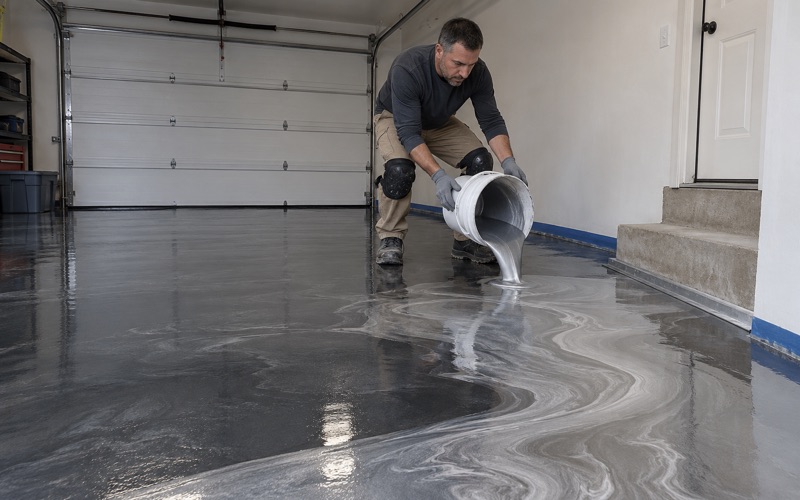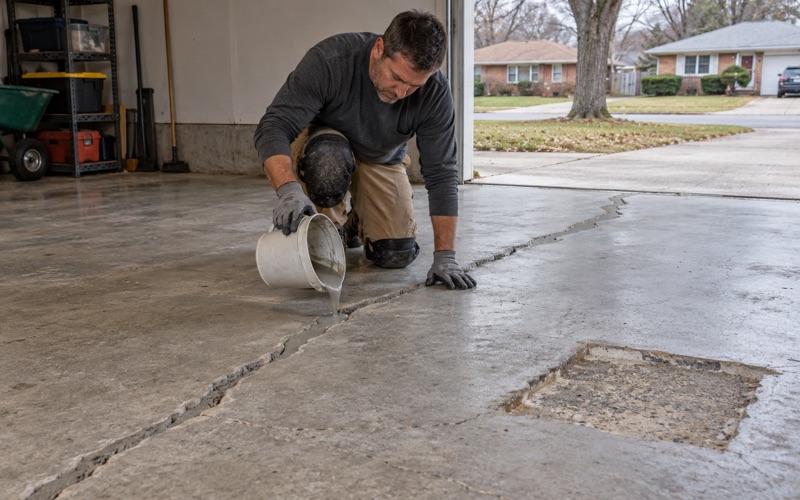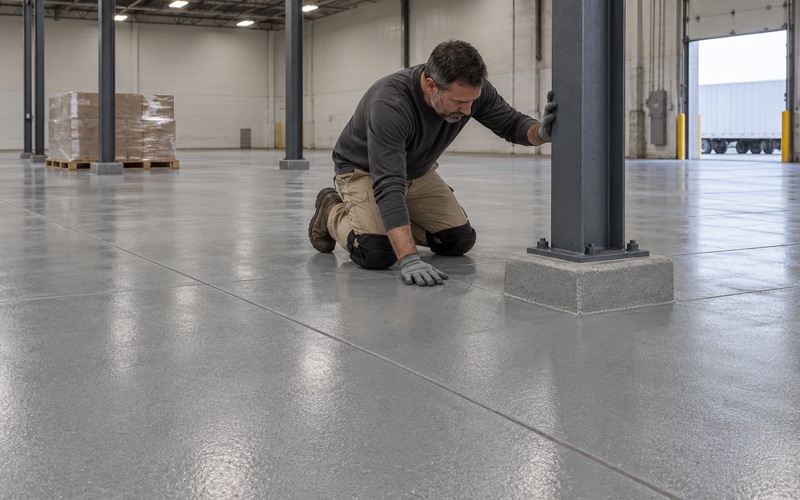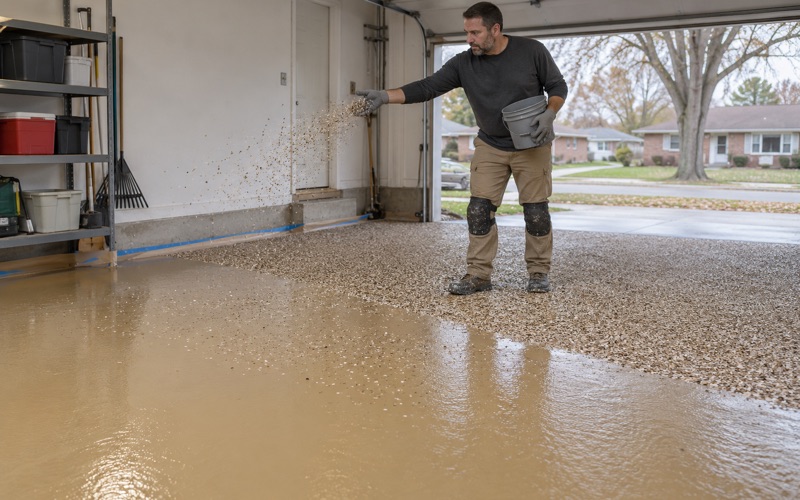
Waukegan Epoxy Flooring brings 20-plus years of slab preparation and resin work to epoxy-flooring in Round Lake, and this page is written for the buildings where vehicles drive onto the floor rather than walk across it. A contractor bay, a storage building or a light-manufacturing shop with a drive-in door asks more of a coating than a finished basement does. Tires carry grit, the door line sees standing water and dripped fluid, and stored equipment sits in one spot for months.
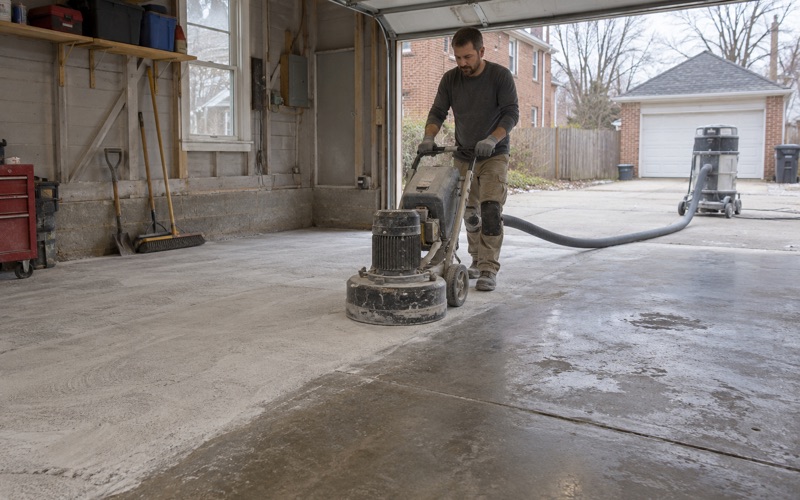
We start every one of those floors the same way: the slab is opened with a diamond grinder or a shot blaster, never acid etched, and the cracks and any old coating are read before a number is written down. When a slab needs repair before it can hold a coating, the quote says so plainly. The proposal then names the product, the system build and the finished thickness, so a building owner can check what went down against what was priced.
Homeowners in the village get the same preparation and the same paperwork, scaled to a garage, along with a written contract and the state’s consumer-rights pamphlet before work starts. The sections below stay with the commercial side, because drive-in shop and storage floors are the work this page is about.
An Industrial Park Inside Round Lake Itself
Round Lake has its own small industrial park, the Round Lake Industrial Park, set along Illinois Route 134 near IL 83 and US 12. One building there shows what this kind of floor work looks like: 702 Valentin Drive, a 19,940-square-foot metal building put up in 2002 on 0.94 acres. Its listing markets it as ideal for contractors, small businesses and light manufacturing, and a boat-storage business occupies it today.
We use that building as a reference point rather than a client story, since its current floor finish was never read and we make no claim about it. What it tells us is the type: a metal shop with 16-foot clear height, drive-in access and a concrete slab that carries vehicles, not just foot traffic. That profile drives nearly every choice we make on a floor of this kind.
Confirming which Round Lake the building sits in
The name causes real confusion on paperwork. Round Lake, Round Lake Beach, Round Lake Park and Round Lake Heights are four separate villages, and each one issues its own permits even though the Greater Round Lake Fire Protection District covers all of them. Before scheduling, we run the address through the US Census Geocoder; 702 Valentin Drive, for example, geocodes inside Round Lake village, in Avon Township, Lake County.
For a building inside the village, the building department is the Village of Round Lake’s, at 442 N. Cedar Lake Road. Illinois issues no state license for flooring or coatings work, so we confirm the village’s own registration, bond and insurance requirements directly before a commercial job goes on the calendar. Fire prevention and inspections come from the fire protection district, which serves about 52,000 residents across roughly 15 square miles.
What a drive-in metal building means for the slab
A drive-in metal building stands on a slab-on-grade floor poured to take vehicles. Nobody can say from the surface what went under that slab in 2002, so we don’t guess; the vapor question gets answered with a test, covered further down. What we can see on arrival is the slab itself: saw cuts, cracks, patched areas, sealer residue, and the wear pattern that shows where vehicles actually travel.
Looking for epoxy-flooring closer to Antioch? See Epoxy-Flooring in Antioch.
Grade-Level Doors: Everything Rolls Straight Onto the Slab
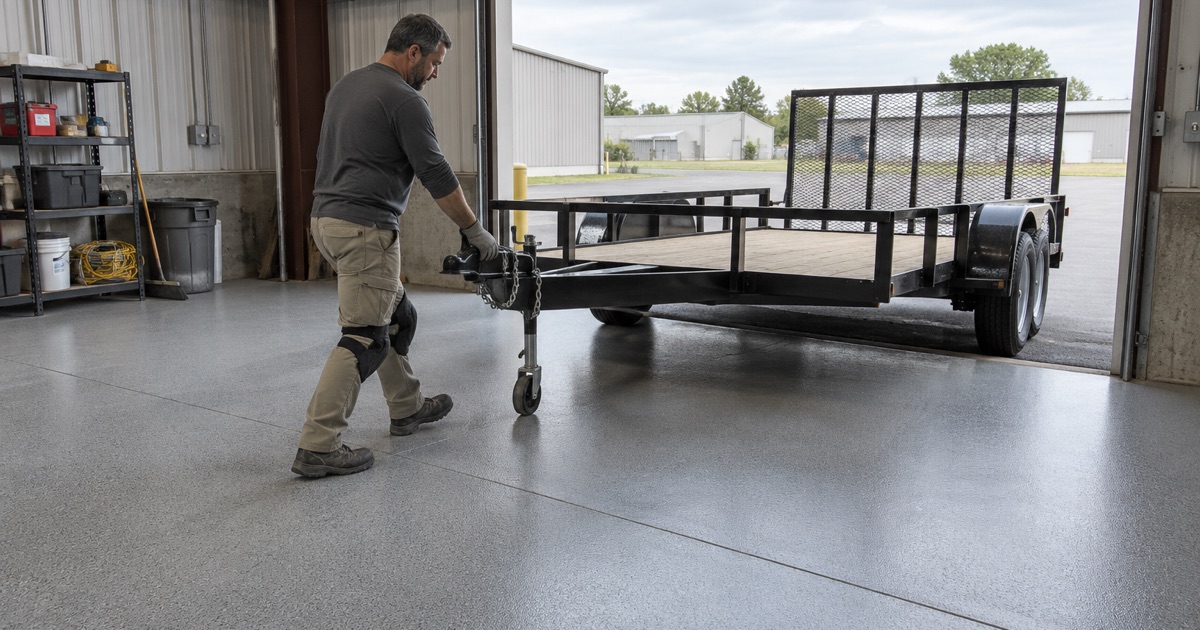
702 Valentin Drive has two 16-foot grade-level doors, and that is the detail that defines the floor. With no dock and no ramp, a truck, a trailer on a hitch or a boat on its trailer comes straight across the threshold onto the concrete. Whatever is on the tires, the hull or the undercarriage arrives with it.
The door line takes the hardest wear
The first stretch of floor inside a drive-in door sees more turning, braking and standing water than anywhere else in the building. Tires scrub sand and grit across that strip, and fluid drips there while a door is open and a vehicle is being positioned. We treat the door line as its own zone in the scope, with a heavier build and a broadcast aggregate for traction, rather than coating the whole floor to a single average.
Choosing a system for tire traffic
For a vehicle floor we generally build on a 100% solids epoxy base, broadcast with quartz aggregate or vinyl flake, and finish with a polyaspartic or polyurea topcoat. Hot tire pickup is the failure owners of drive-in buildings know best: warm tires soften a thin or poorly bonded film and lift it off in patches. The defense is preparation and build rather than a sales promise, meaning a surface profile in the right ICRI CSP range from diamond grinding or shot blasting, and a film thickness that the proposal states in writing.
Fluids, cleanup and the drain
Oil, fuel, hydraulic fluid and the residue from a boat hull all end up on the floor sooner or later. A sealed, nonporous coating keeps those on the surface where they can be cleaned up instead of soaking into bare concrete. During the job itself, our grinding dust and slurry are collected on site and never washed out the door toward a drain.
Storage Bays for Boats, Trailers and Equipment
A storage floor is a different problem from a working shop floor, and a building like the one on Valentin Drive can be either, depending on who occupies it. Stored boats, trailers and equipment sit in one place for weeks or months, so the floor sees concentrated loads at tongue jacks, stands and wheels rather than constant traffic. Moving those loads in and out is where scuffing and gouging happen.
Point loads and what a coating cannot do
A coating is a thin film bonded to the slab, and it follows whatever the slab does underneath. If a crack moves under a loaded trailer jack, the coating over it will eventually show that crack, and we say so before the job instead of promising otherwise. Where a crack needs filling or a section of slab needs repair first, the quote lists that work separately so the owner can see why it is there.
Working around stored contents
Storage buildings are rarely empty when the floor comes up for discussion. We work bay by bay where a building has to keep operating, scheduling around the hours it needs to stay open, including overnight and weekend windows. Aisle and parking lines can be built into the topcoat stage, which helps a storage operator use the floor area without equipment drifting into walkways.
A densified floor for the quiet bays
Not every square foot of a storage building needs a resin system. For a back bay that only holds equipment and sees little fluid, a ground floor treated with a lithium silicate densifier can be the more economical answer. We lay out both options side by side in the proposal and explain where each one belongs.
A 2002 Slab, and the Moment a Building Changes Hands
A slab poured in 2002 is now well into its twenties. It may still be bare concrete, it may carry a first coating that has worn through at the door line, or it may already be on a second finish layered over the first. Each of those starts differently, which is why we read the existing surface before pricing anything.
Reading the old coating
An old coating that is still well bonded can sometimes stay as a base, but a peeling or contaminated film has to come off entirely. Amine blush on an earlier epoxy layer, oil soaked into worn patches, and old sealers all interfere with adhesion. Mechanical removal by grinding or shot blasting takes the floor back to sound concrete and a known profile, so the new system bonds to the slab rather than to someone else’s work.
Moisture testing on a vehicle floor
No one can tell from looking at a dry-appearing shop floor whether an under-slab vapor retarder meeting ASTM E1745 was ever installed. Moisture testing is a written line item in our scope, using ASTM F1869 calcium chloride kits, ASTM F2170 in-situ relative humidity probes, or an ASTM D4263 plastic sheet test as a first screen. When readings come in high, we specify a moisture-mitigation primer, and when a warranty carries exclusions, moisture is the first one we read out before the job is signed.
Floors redone at a sale or a new lease
The listing for 702 Valentin Drive proposes a sale-leaseback through May 2027, and an ownership or lease change is exactly the moment when a floor tends to get redone. An incoming owner or tenant usually has a narrow gap before moving in, and the floor is easiest to do while the building is empty. We schedule the cure against slab temperature and the dew point spread at the surface rather than a calendar date, which matters in a metal building that may not be heated, and we choose coatings within the Illinois VOC limits in 35 Ill. Adm. Code Part 223. Whoever takes the keys ends up with a documented floor: the product, the build and the thickness on paper, ready for the next time the building changes hands.
- 20+ Years Coating Floors
- Moisture Testing in Every Scope
- Free Written Estimates