Waukegan Epoxy Flooring installs polyaspartic floor coating systems in Waukegan, IL, serving surrounding cities including Park City, Gurnee, North Chicago, Beach Park and Green Oaks. Polyaspartic is the fast-curing, color-stable member of the coatings family, and over more than 20 years we have used it as a full system, as a topcoat over epoxy and as the answer when a floor has to return to service quickly.
The speed of polyaspartic is a strength and a trap. A coating that cures in hours leaves no room to fix poor prep, so the work before the first coat matters even more. Every slab we coat with it is diamond ground or shot blasted, never acid etched, and moisture tested as a standard line in the quote.
Our proposal states the products, how many coats, the broadcast and the finished thickness. You can hold it up against the finished floor and see that what was promised is what went down.
What Polyaspartic Is and Where It Fits
Aliphatic Chemistry and Color Stability
Polyaspartic is a type of aliphatic polyurea. Unlike most epoxies, it does not amber or chalk when sunlight reaches it, so a floor near an open door or a bank of windows keeps its color. That alone makes it the topcoat of choice on many garage and showroom floors.
Fast Cure and Return to Service
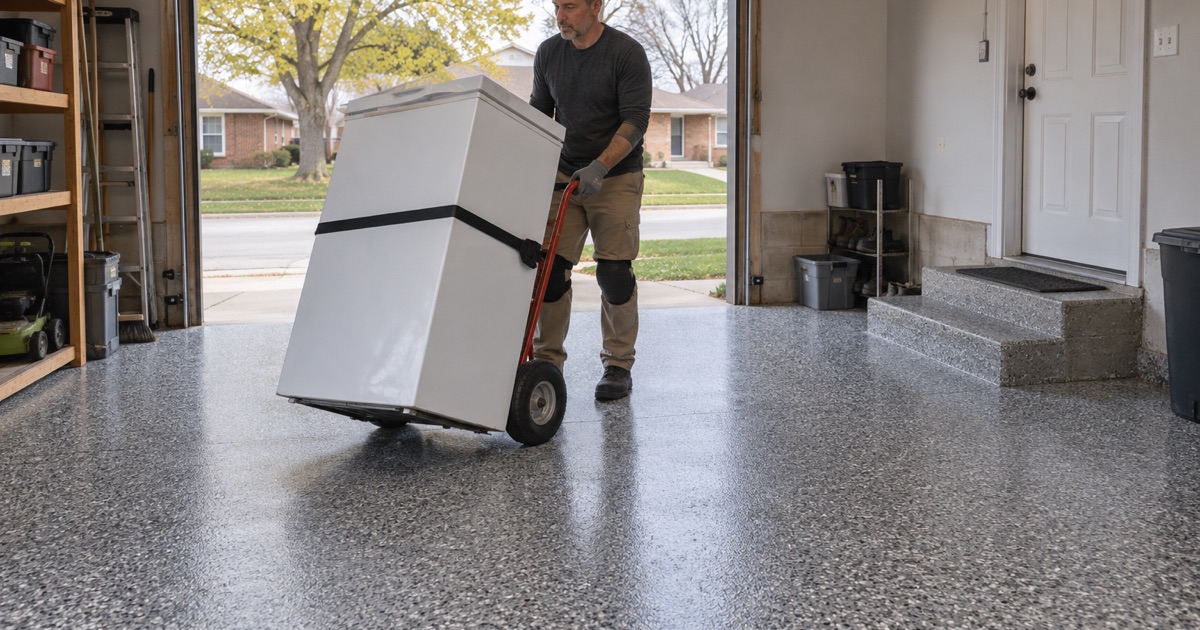
Polyaspartic cures in hours rather than days, which means a garage can often be back in use sooner and a commercial floor can be coated overnight and reopened in the morning. The tradeoff is a short working time; the crew has to be organized, and mixing is done in small batches.
That short pot life is why we do not hand polyaspartic to a crew that has not run it before. Lap marks, uneven gloss and trapped bubbles all come from rushing a material that is already setting.
Temperature Range for Lake County Seasons
Polyaspartic tolerates cooler slabs than standard epoxy, which stretches the coating season in a Lake County fall and spring. It is still bound by the dew point spread at the slab surface, and an unheated garage in midwinter usually waits for warmer weather.
Polyaspartic Garage Floor Systems
Polyaspartic Over a 100% Solids Epoxy Base
Our most common garage system pairs a 100% solids epoxy base with a polyaspartic topcoat. The epoxy builds thickness and grabs the ground profile, the flake broadcast adds color, and the polyaspartic seals it all under a wear-resistant, UV-stable surface.
Full Polyaspartic Systems
Some floors are built entirely from polyaspartic for the fastest turnaround. These systems need very good prep and a dry slab, because there is no thick epoxy base to bridge small flaws. We recommend them when the schedule truly calls for speed.
Resistance to Salt Brine and Hot Tires
A polyaspartic topcoat holds up well to the calcium chloride brine and rock salt that ride into a garage all winter. It also resists hot tire pickup, because it stays hard rather than softening under a warm tire. Grit is what wears it, so we suggest mats and regular sweeping near the door.
Commercial Polyaspartic Floor Coatings
Overnight Coatings for Retail and Service Spaces
A retail store, clinic or office that cannot close during the day can have its floor coated after hours and reopened the next morning. We phase large spaces in sections and plan ventilation and access around the building’s schedule.
Shops, Showrooms and Light Industrial Floors
Auto showrooms, service bays and light assembly areas want a floor that looks good and handles fluids and rolling loads. Polyaspartic offers strong chemical and abrasion resistance, and it can be built with quartz or flake for traction. Heavy forklift traffic usually calls for a thicker epoxy base underneath.
Prep and Moisture Before Any Polyaspartic
Grinding to a Measured Profile
A fast-curing coating bonds only to what it touches in its first minutes, so the surface has to be clean, sound and profiled. We grind to the ICRI CSP profile the product calls for and vacuum the floor completely before the first coat.
Testing for Vapor Under the Slab
Many older slabs in Lake County were poured without a vapor retarder, and garage slabs often still are. We test with a plastic sheet test first and calcium chloride or relative humidity testing when the slab warrants it. If readings are high, a moisture-mitigation primer goes down before the polyaspartic does.
Warranty Terms Read Out Before You Sign
Polyaspartic warranties, like most coating warranties, exclude failure caused by moisture coming through the slab. We read the exclusions out before the job is sold, moisture first, so you know where the coverage stops.
The other common exclusions are slab movement, chemical spills left to sit and gouges from dragged equipment. A coating follows the concrete under it, so a crack that opens after installation will telegraph through, and we say so before the work rather than after.
Choosing a Polyaspartic System for Your Floor
Flake, Quartz or Clear Over Color
A polyaspartic topcoat can seal a full vinyl flake broadcast, a quartz aggregate floor or a solid pigmented base. Flake is the usual garage choice because it hides dust and small blemishes. Quartz builds a harder, grittier surface for shops and wet areas. A clear coat over a solid color gives a clean, uniform look that shows spills quickly, which some workshop owners prefer.
Gloss, Satin and Anti-Slip Texture
Polyaspartic is naturally glossy, and a satin version takes the edge off glare and hides fine scratches. An anti-slip aggregate can be added to the topcoat in walk paths and near doors, where snowmelt and wet boots make a smooth floor slick. We tune the texture so it gives grip without becoming hard to mop.
Thickness and Number of Coats
A single thin topcoat wears faster than a double coat over a full broadcast. On a garage that sees daily parking, salt season and a workbench, we usually build two coats over the broadcast so there is more material between traffic and the color layer. The proposal states the coats and the finished thickness so you can compare quotes on build, not just on price.
Living With a Polyaspartic Floor
Cleaning Salt Brine and Road Grime
Rinse or squeegee winter brine out of the garage rather than letting it dry into a white film, and wash with a pH-neutral cleaner. Harsh solvents and acidic cleaners are not needed and can dull the surface. A floor that is kept clear of grit holds its gloss far longer.
Recoating When Traffic Lanes Wear
When the paths where tires roll begin to dull, the floor does not need to be ground off and started over. A light abrasion and a fresh polyaspartic topcoat restore it, as long as the layers underneath are still bonded. That recoat is a fraction of the cost of the original floor.
Scheduling Around Tenants and Business Hours
The short cure time is what makes polyaspartic useful in buildings that cannot stand empty for days. In a rental two-flat, a shared garage can be coated and back in service quickly, with tenants told exactly when cars have to be out. In a shop, a clinic or a store, the work can run overnight or over a weekend so the doors open on schedule.
Every home job, whether the owner lives there or rents it out, gets a written contract and the state’s consumer-rights pamphlet before anything starts, as the Illinois Home Repair and Remodeling Act requires.
- 20+ Years Coating Floors
- Moisture Testing in Every Scope
- Free Written Estimates