
Waukegan Epoxy Flooring grinds and polishes concrete floors in Waukegan, IL, serving surrounding cities including Park City, Gurnee, North Chicago, Beach Park and Green Oaks. Polished concrete is the one floor we install that adds nothing on top of the slab; the concrete itself becomes the finish. After more than 20 years of grinding slabs for coatings and polish alike, we know how differently two floors poured a mile apart can behave under the same diamonds.
That is why we start by looking hard at the concrete: how soft or hard it grinds, what adhesive, sealer or paint is on it, and where the cracks and patches are. A polished floor shows its slab honestly, so we tell you up front what your floor will reveal rather than promising a showroom finish on concrete that cannot deliver one.
Our quote names the grind depth, the densifier, the final diamond and the sheen, so you know exactly what was agreed. Grinding is done with dust collection on site, and slurry from wet work is captured rather than rinsed toward the nearest drain.
How a Polished Concrete Floor Is Made
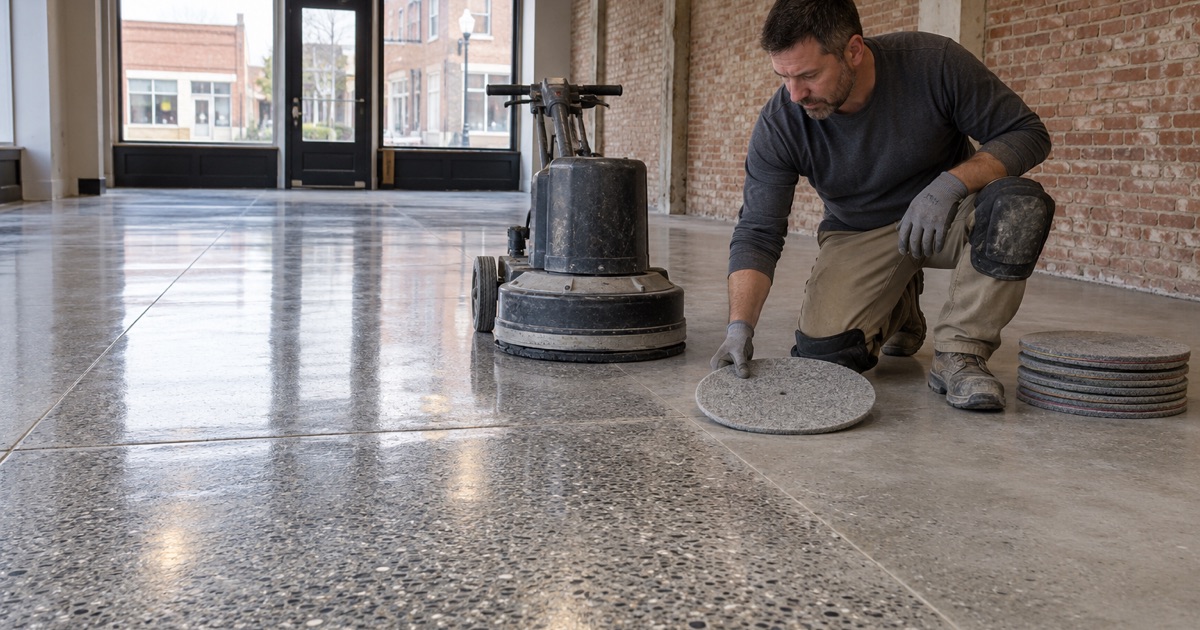
Grinding Through the Diamond Sequence
Polishing starts with coarse metal-bond diamonds that flatten the slab and open the surface to the depth you have chosen. Each pass after that uses a finer tool, removing the scratches the previous one left. Skipping a step leaves swirl marks that show up under raking light.
How many passes a floor needs depends on how hard the concrete is and what was on it. A soft residential slab cuts fast and can be overground; a dense warehouse floor may need extra passes at the coarse end before the finer diamonds go on.
Lithium Silicate Densifier
Partway through the sequence we apply a lithium silicate densifier. It reacts with the free lime in the concrete to form a harder, denser surface that takes a sharper polish and resists dusting and abrasion. Densifying a floor that is going to be polished is not optional; without it the surface stays soft and the shine fades in traffic.
Guard and Final Polish
After the final resin-bond pass, a penetrating guard can be burnished in to slow down staining from oil, coffee or food. It is thin and not a film coating, so it does not peel. The last burnishing pass sets the reflectivity you chose.
Aggregate Exposure and Sheen
Cream Finish Polished Concrete
A cream finish barely breaks the surface paste and shows little or no stone. It suits modern interiors and showrooms that want a smooth, even gray. It needs a flat, well-finished slab, because a high or low spot grinds through to aggregate unevenly.
Salt-and-Pepper Exposure
A light grind exposes the fine sand in the concrete, giving a speckled look often called salt and pepper. It hides dust and wear well and needs less grinding than a full exposure, which keeps the job time down on large floors.
Full Aggregate Exposure
A deeper grind cuts into the coarse stone and shows it across the whole floor. It is the most dramatic look and the most variable, because the stone in the slab is whatever the original mix contained. We grind a test patch so you can see your own aggregate before committing the floor to it.
Choosing a Sheen Level
Sheen runs from a soft matte through satin to a high gloss with a near mirror finish. High gloss reflects light and makes a space feel brighter, but it shows dust and scuffs. Satin is the most forgiving choice for busy floors.
Commercial Polished Concrete Floors
Warehouses and Distribution Floors
Polished concrete is a strong fit for distribution and storage floors because it does not wear through like a coating, and densified concrete resists forklift traffic and dusting. Joints still need attention: we fill them with a semi-rigid filler so wheels ride over them instead of chipping the edges.
Large buildings are polished in sections around racking and active aisles, with overnight or weekend shifts where the operation cannot stop. Because there is no cure time to wait out, an area can go back into service soon after the final pass.
Retail, Showroom and Office Floors
In a showroom, polished concrete reflects light and gives a clean backdrop for product. In an office lobby, it holds up to foot traffic and rolling carts with only routine cleaning. Saw-cut lines, stained bands and borders can add pattern without adding a coating.
Residential Polished Concrete Floors
Polished Basement Floors
A polished basement floor can turn a utility slab into a finished room without adding a film that moisture might push off. It still needs a reasonably sound slab, and older basements often carry paint or adhesive that must come off first. We test for moisture so you know how the floor will behave across the seasons.
Main Floors on New Slabs
On a new home or addition, planning the polish before the pour gives the best result. A slab placed and finished with polishing in mind needs less grinding and shows more consistent aggregate. We can coordinate with the concrete contractor on mix and finish if we are brought in early.
What a Slab Needs Before It Can Be Polished
Removing Adhesives, Paint and Coatings
Carpet glue, tile mastic, old epoxy and paint all have to come off before polishing starts, and some take aggressive tooling. We price that removal as its own line once we have seen the floor, rather than discovering it on day one and adding it later.
Cracks, Patches and Control Joints
Polishing shows a slab’s history: cracks, patches and old repairs all read through the finish. We fill cracks with a color-matched filler and treat joints so they hold up to traffic, and we tell you plainly where a patch will look different from the slab around it.
A crack that is still moving will reopen through any filler, because the filler only follows the concrete. We point out which cracks look active before we start, so nobody is surprised when one reappears after a Lake County winter.
Hardness Testing and a Trial Grind
Two slabs that look the same can grind very differently. Before we price a large polish, we check the hardness of the concrete and, where it makes sense, grind a small trial area through the first few diamonds. That tells us how many passes the floor will take, how much stone a given depth will reveal and whether the surface will hold a high sheen.
The trial also settles questions that are hard to answer from a photo, such as whether an old sealer has soaked deep into the paste or whether a patch will read as a dark island once it is polished.
Caring for a Polished Concrete Floor
Daily and Weekly Cleaning
Grit is the main enemy of a polished surface, because it acts like sandpaper under shoes and wheels. Dust mopping or auto scrubbing with a neutral cleaner keeps the floor bright. Winter salt and sand tracked in at entries should be cleaned up promptly, and walk-off mats at doors catch most of it before it reaches the floor.
Restoring the Shine
A polished floor that has dulled in traffic lanes does not need to be stripped and recoated. A pass with a fine burnishing pad, or a light repolish with the last diamonds in the sequence, usually brings it back. Because there is no film to wear through, restoration is quicker and less disruptive than recoating.
- 20+ Years Coating Floors
- Moisture Testing in Every Scope
- Free Written Estimates