Waukegan Epoxy Flooring has spent more than 20 years on epoxy-flooring in North Chicago and the rest of Lake County, mostly on garage slabs, basement floors and the working floors of small shops. Every job starts with the concrete itself: we read its cracks and whatever old coating is peeling off it, and we tell you plainly whether it can take a new system or needs repair, or even replacement, first.
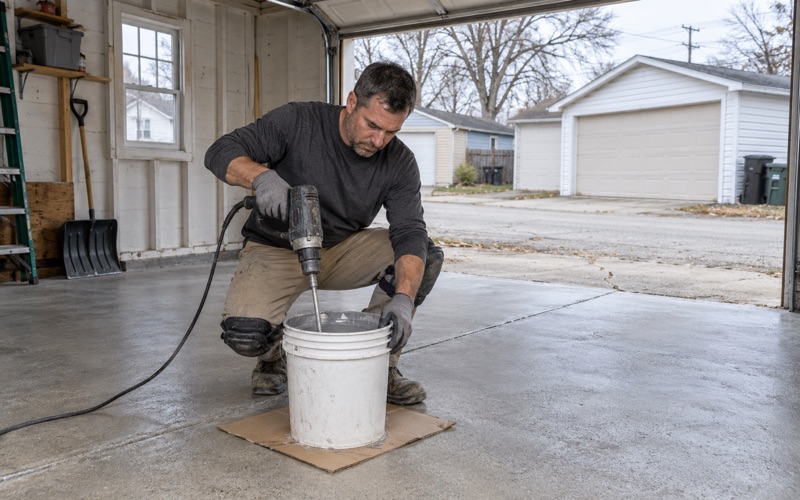
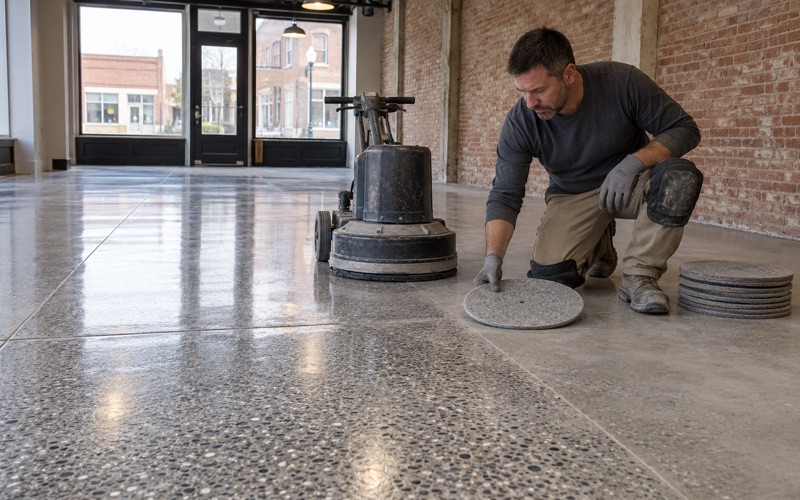
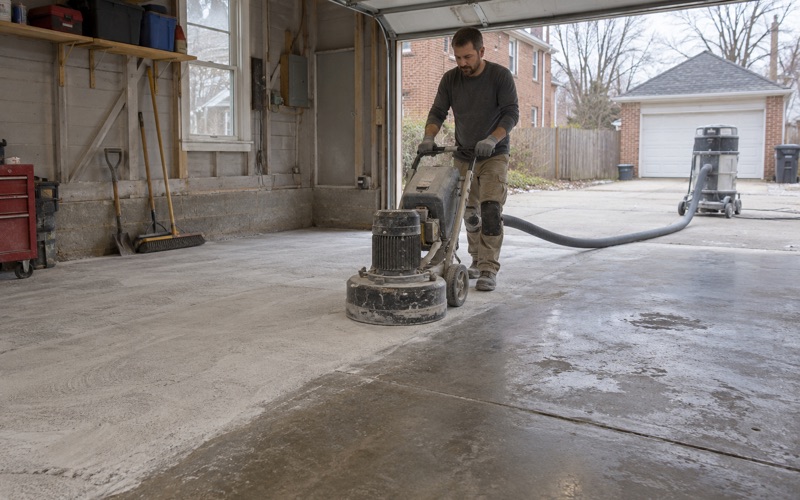
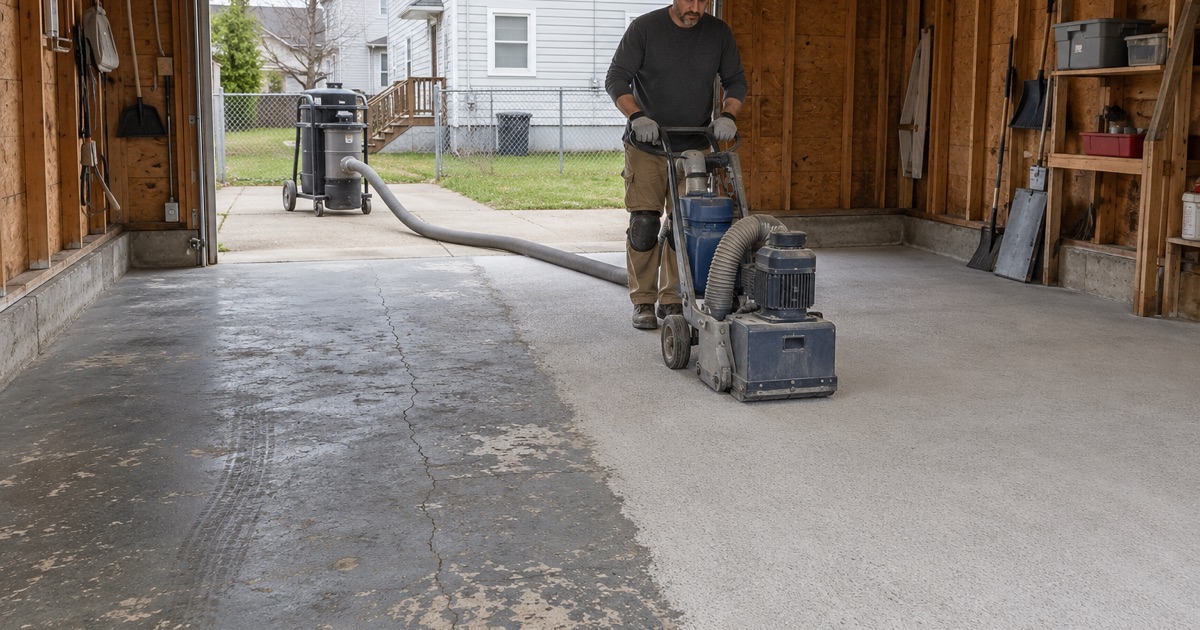
Our proposals are written so you can hold us to them. Each one names the product, the system build and the finished thickness, and moisture testing sits in the scope as its own line item instead of turning up as an upsell after a floor has blistered. We open the surface mechanically with a diamond grinder or a shot blaster and never acid etch, so the coating bonds to a real profile rather than a rinsed one.
This page covers what is different about the work here, including something most towns we serve do not have: a federal installation inside the city limits, with its own rules about who comes through the gate.
A Navy Base Inside the City Limits
Great Lakes is part of North Chicago
Naval Station Great Lakes uses a Great Lakes, IL 60088 mailing address, which makes it easy to assume the base sits in a town of its own. It does not. The station’s address at 2601 Paul Jones St geocodes inside North Chicago city, in Shields Township, the same city whose hall stands at 1850 Lewis Ave. For a flooring contractor, that matters less as trivia than as a reminder that part of this city runs on federal rules, not municipal ones.
What base access takes for a contractor
A floor crew cannot simply drive onto the station with a trailer of grinders. Navy policy requires any new contractor, vendor or supplier requesting base access to obtain a DBIDS credential first. Getting one means presenting a letter or official document from the government organization sponsoring the work that states the purpose of access, valid identification such as a passport or a Real ID-compliant license, and a completed SECNAV 5512/1, the form used for the background check.
The sponsor letter is the piece people overlook. It cannot come from the contractor, and it cannot come from a neighbor who happens to work on base; it comes from the government organization that needs the work done. Without it, the rest of the paperwork has nothing to attach to.
The Visitor Control Center at the Main Gate
That processing happens at the Visitor Control Center, Building 6130, Room 105, at 2535 Sheridan Road, adjacent to the Main Gate. It is a working office with its own sequence, and the sponsor and background check come before any tools cross the line. We describe this so a reader understands how base work is organized, not because we hold a credential: we do not, and we do not present ourselves as approved for work on the station.
Looking for epoxy-flooring closer to Beach Park? See Epoxy-Flooring in Beach Park.
Federal Floors Are Bought Through Federal Channels
The base’s own buildings
Barracks, training buildings and service floors on Naval Station Great Lakes are federal property, and their floors are let through federal procurement. The government organization defines the work, picks the contractor through its own process and then sponsors that contractor through the access steps above. A private customer never touches any of that, and a homeowner calling about a garage on the other side of town is buying something entirely different.
The Lovell Federal Health Care Center
The Captain James A. Lovell Federal Health Care Center at 3001 Green Bay Rd also sits inside North Chicago. It opened on October 1, 2010 as the first fully integrated VA and Department of Defense health care center, merging the North Chicago VA Medical Center with Naval Health Clinic Great Lakes, and it sees about 75,000 patients a year, including an estimated 40,000 Navy recruits.
Floors in a building like that are a federal decision made by federal staff. When we talk about hospital floors elsewhere on this site, we mean private facilities whose owners choose their own contractor; Lovell is not one of them, and nothing on this page suggests otherwise.
Why the distinction helps a private buyer
It is worth separating the two markets because North Chicago’s name is so closely tied to the station. The city’s own houses, shops and small commercial buildings buy flooring the way any other Lake County property does: an owner gets quotes, reads the scope, signs a contract and schedules the work. That is the work we do here, and it is where the rest of this page stays.
Off-Base Garages, Basements and Shops
Owner-occupied houses
Off the base, the census counts 1,768 owner-occupied detached houses in North Chicago, which is the pool most garage and basement coating calls come from. These are floors an owner lives with every day, so we put the effort into the parts nobody sees once the topcoat is down: profile, moisture and repair.
Garage slabs and Lake County salt
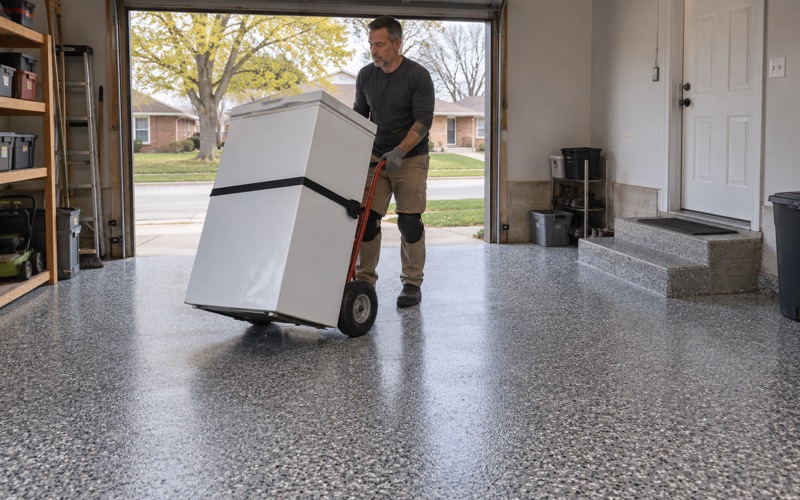
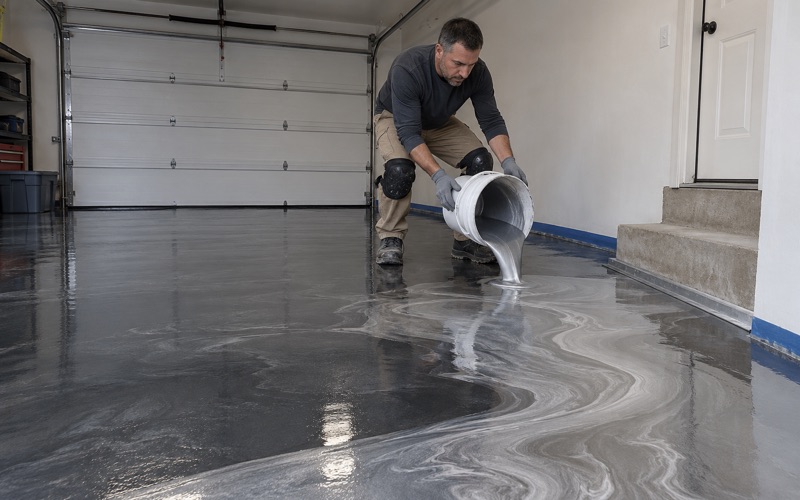
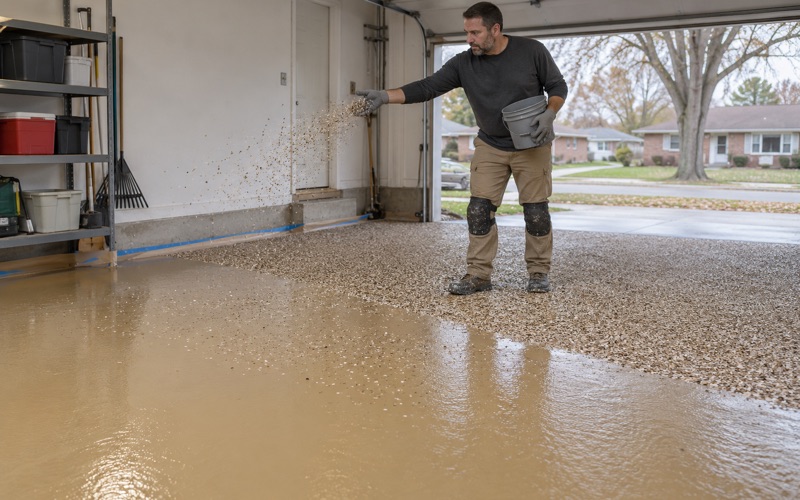
A North Chicago garage floor spends the winter under calcium chloride brine and rock salt dripping off the tires. We build garage systems for that: a 100% solids epoxy base coat on a ground slab, a vinyl flake or quartz aggregate broadcast for texture, and a polyaspartic or polyurea topcoat chosen to stand up to hot tire pickup and the chemical load.
Curing is planned around the slab temperature and the dew point spread at the surface, not around a date on the calendar. When a cold, unheated garage cannot cure a coating properly, we say so, and the job waits for spring rather than risking amine blush or a soft film.
Garage slabs get a moisture test too. The 2021 International Residential Code, at R506.2.3, lets a garage floor go in without a vapor retarder beneath it, so a dry-looking garage is not proof of anything. We would rather find that out with a probe than with a blister in the second spring.
Basements and what is under the slab
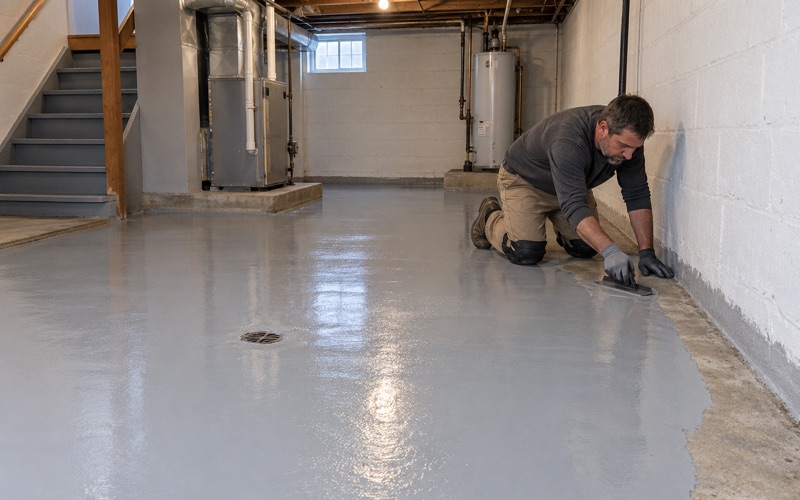
Basement floors bring a different risk. An older slab may have no under-slab vapor retarder at all, and a floor that looks dry can still push moisture up through the concrete or show efflorescence along the walls. We test before we coat, using ASTM F2170 in-situ relative humidity probes or the ASTM F1869 calcium chloride test, with the ASTM D4263 plastic sheet test as a quick first read.
Where the numbers call for it, a moisture-mitigation primer goes down before the build coat. We also look at the sump pit, the floor drain and any history of sewer backup, because those details decide how the coating should terminate. Hydrostatic pressure under a basement slab is a different problem from vapor drive, and no topcoat holds back standing water pushing from below; when that is what the readings point to, the honest answer is a drainage fix before any floor.
Small shops and commercial floors
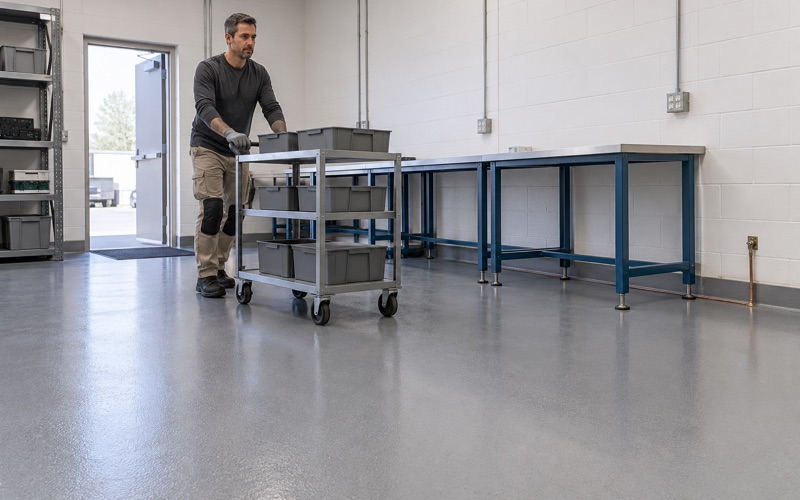
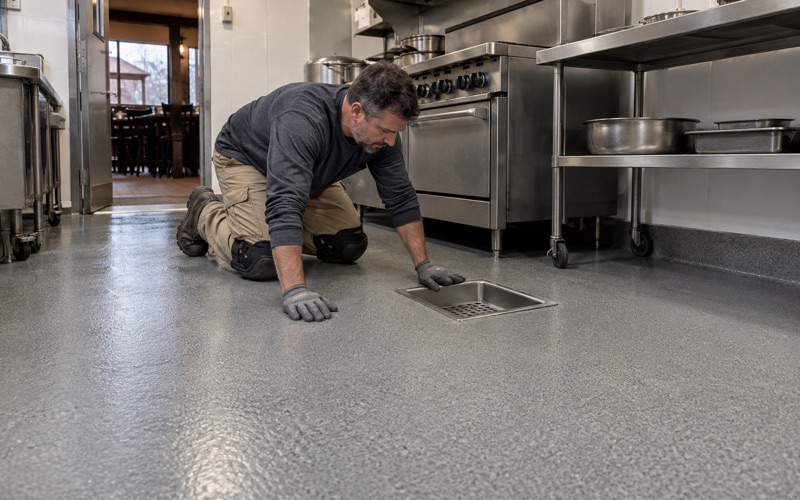
For small commercial floors, we schedule around the hours the building has to stay open, including overnight and weekend windows. A food business adds the Lake County Health Department’s plan review to the list, and coved floor-to-wall junctures often belong in that scope. Urethane cement is usually the better choice where hot water and washdown are daily. A storage room or back-of-house floor that only needs to shed dust can sometimes be ground and treated with a lithium silicate densifier instead of a full resin build, and we will say when that is the better spend.
Getting a Quote in North Chicago
What we look at on the first visit
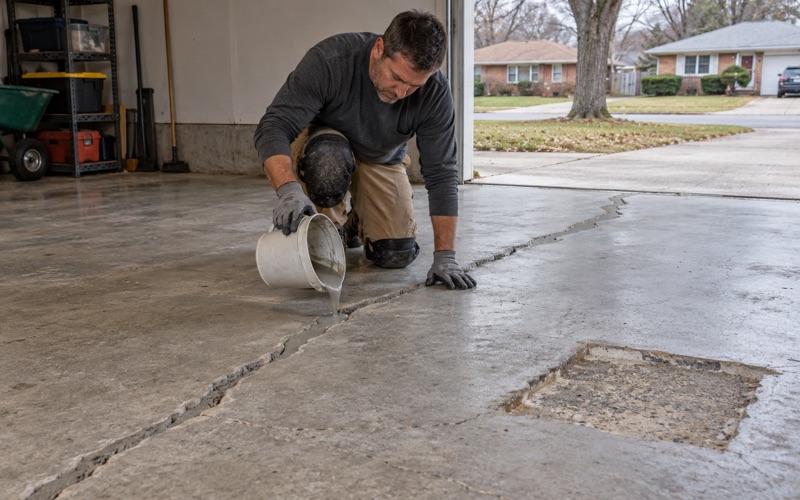
The first visit is mostly reading the slab. Cracks tell us whether the concrete is still moving; old coating tells us how it failed and what has to come off. A coating is a film that follows the slab under it, so we say before the job that it will not stop a moving crack, and we name the cases where repair comes first.
We also write down the surface profile the prep is meant to reach, stated on the ICRI CSP scale, and which moisture test the slab will get. If you are comparing our number with another quote, those lines make the comparison fair: two proposals that name different products, different film builds or no test at all are not pricing the same floor, even when the totals look close.
The paperwork, before any grinding
Every home job gets a written contract and the state’s Home Repair: Know Your Consumer Rights pamphlet before work begins, as the Illinois Home Repair and Remodeling Act requires. Warranty exclusions are read out before the job is sold, with moisture named first, so nobody learns about them after a failure.
Illinois does not license flooring or coatings contractors, so there is no state license to quote here. Local rules are a separate question: we could not confirm the City of North Chicago’s contractor registration and bond requirements for floor work online, so we confirm them with the city, along with insurance, before a job goes on the schedule.
On the day of the work
Grinding dust and slurry are collected on site and kept out of the street drains. The coatings we use fall within the Illinois limit on VOC content, a rule that binds the installer as well as the manufacturer. And if anyone asks whether a sealed basement floor will fix a radon reading, the answer is no; that work takes a state radon mitigation license, and we do not sell a coating as a substitute for it.
- 20+ Years Coating Floors
- Moisture Testing in Every Scope
- Free Written Estimates