Waukegan Epoxy Flooring has put more than 20 years into epoxy flooring in Libertyville and across Lake County, and the floors that test a coating hardest here are the ones a car drives onto while its tires are still hot. A tire fresh off the highway can soften the wrong topcoat and peel it off the slab when the car pulls away. That is why we specify a floor by what rolls, drips and gets dragged across it, not by a color chart.
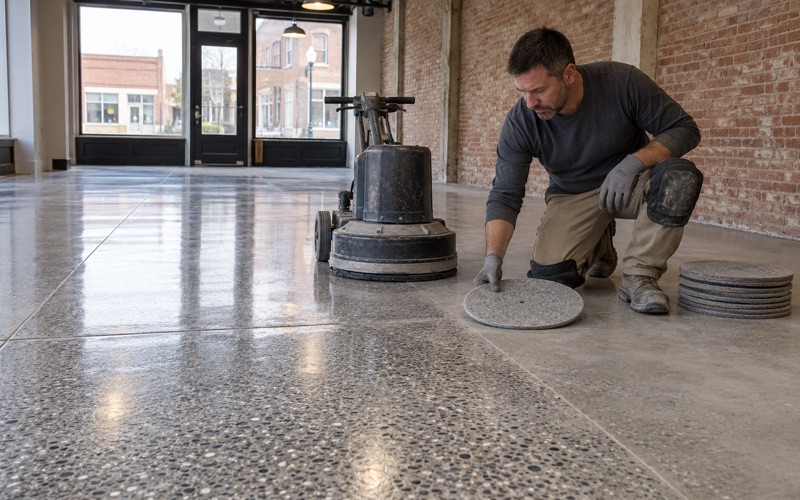
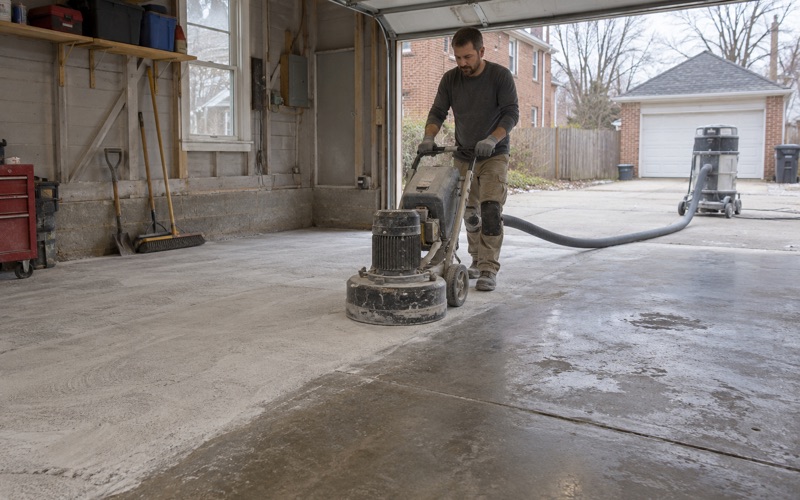
The question is the same for a multi-bay service shop and a two-car garage; only the scale changes. On both, the concrete is opened with a diamond grinder or a shot blaster before anything is mixed, and we never acid etch. The proposal then names the product, the system build and the finished thickness, so the quote can be held up against the floor that actually went down.
What follows covers the commercial service floors this village has more of than most, the paperwork Libertyville actually checks, and the older homes whose garages make up the rest of our work here.
Milwaukee Avenue Service Bays: Lifts, Hot Tires and Fluids
South Milwaukee Avenue carries a run of new-car dealerships that is hard to miss. Hyundai, Lincoln, Chevrolet, Ford, Honda, Mazda, Toyota and Acura stores, along with Liberty Auto Plaza, sit at addresses from the 900 block to 1620 S. Milwaukee Ave, and Liberty Auto City and Liberty Auto Plaza-Kia both appear on the village’s own major-employer list. Behind every showroom is a service department, and service bays are a different floor problem from anything inside a house.
Lift posts and point loads
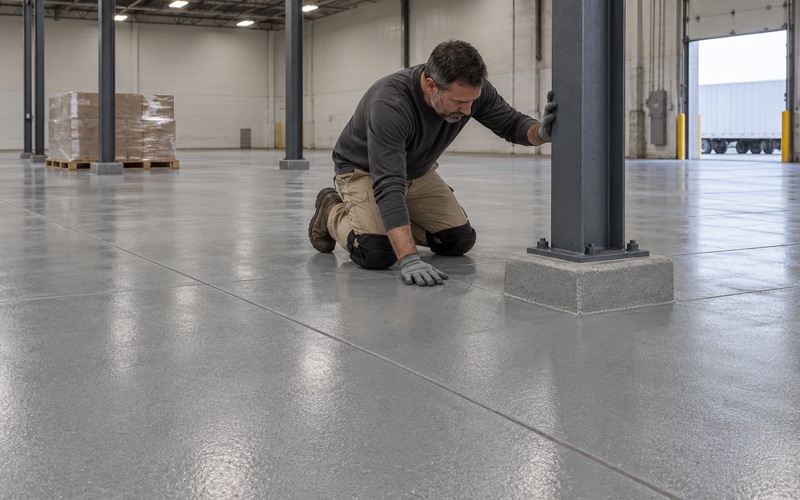
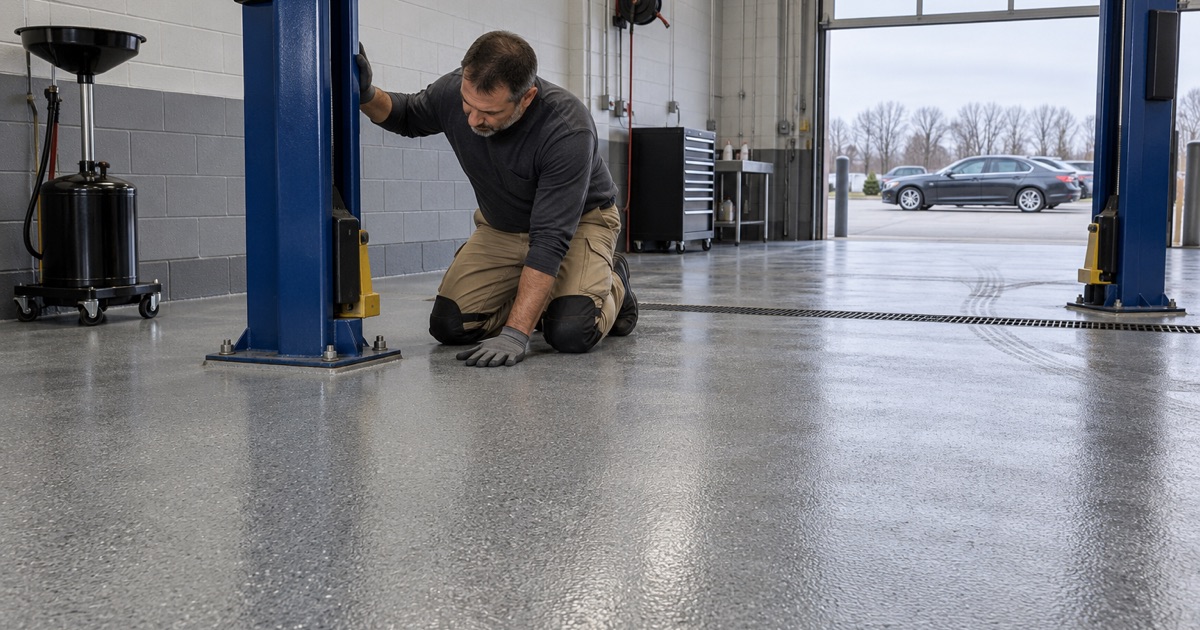
Two-post and four-post lifts concentrate a vehicle’s weight onto base plates anchored through the slab. Coating around those plates has to be detailed rather than flooded, because a film poured over an anchor that later gets re-torqued or replaced will crack at the edge of the plate. We read the existing cracks before quoting, and where a slab has broken up around a lift footing we say it needs repair before any coating goes over it.
Hot tire pickup
A tire coming back from a road test can be hot enough to soften a thin, single-coat epoxy and pull it loose once the car sits and is later moved. The answer is not a thicker paint but a different build: a 100% solids epoxy base locked into a mechanically profiled slab, a quartz aggregate broadcast, and a polyaspartic or polyurea topcoat that holds up to heat and abrasion. Profile matters as much as product, so we grind to the ICRI CSP range the system’s data sheet calls for instead of guessing.
Oil, coolant and brake fluid
Service bays collect every fluid a car holds. Motor oil, transmission fluid, coolant and brake fluid each attack coatings differently, and brake fluid in particular can stain or soften a topcoat that shrugs off oil. Where a shop handles heavy fluid volume, urethane cement is worth pricing next to epoxy, since it tolerates chemical exposure and thermal shock that a thin film will not.
Wet-tracking and slip
Every tire that enters a service drive in winter brings calcium chloride brine and rock salt with it, and that slush gets tracked across the floor for months. A broadcast aggregate gives traction when the surface is wet without turning it into sandpaper for a technician on a creeper. We size the grit to the zone: where people walk, where cars roll and where creepers run.
Looking for epoxy-flooring closer to Winthrop Harbor? See Winthrop Harbor Epoxy-Flooring.
Coating a Service Drive While the Service Department Stays Open
A dealership cannot shut its service department for a week, and we do not ask it to. Shop floors are scheduled around the hours the building has to keep running, which in practice means phases: a few bays at a time, or the service drive over a weekend, with the rest of the shop working.
Phasing the work
A service drive and a row of bays can be divided by a joint line, a column grid or a lane stripe, so each piece is ground, coated and handed back before the next one is opened. Polyaspartic topcoats help because they cure fast enough to return a closed section to service sooner than a standard epoxy topcoat would. The phase plan is set in writing before the first section is taped off, so the service manager knows which bays are down and for how long.
Curing against conditions, not the clock
A service drive with overhead doors cycling open all day in January is a cold, damp space. We schedule against slab temperature and the dew point spread at the slab surface, because a coat applied too close to the dew point can develop amine blush, a waxy film that weakens the bond of whatever goes on next. If the readings do not allow a section to be coated that night, it waits.
Dust, slurry and VOC limits
Grinding a shop floor makes dust and, with wet methods, slurry. Both are collected on site and never washed toward a street drain. Lake County sits inside the Chicago nonattainment area for the 2015 ozone standard, and Illinois caps floor coatings at 250 grams per liter of VOC under 35 Ill. Adm. Code Part 223, a limit that binds us as the applicator as well as the manufacturer. Every product on a Libertyville job is chosen within it.
Insurance Libertyville Asks For, and Why There Is No Registration
Plenty of towns run a contractor registration with a form and a fee. Libertyville does not; in the village’s own words, there is no form to fill out nor any fee to pay. Illinois licenses no general, flooring or coatings contractor either, so what the village checks instead is the certificate of insurance.
The $40,000 step
For projects up to $40,000, the village asks for general liability of $500,000 per occurrence, $500,000 aggregate and $500,000 property damage. Above $40,000, the aggregate rises to $1,000,000 and the certificate must also show $1,000,000 in excess coverage. Statutory workers’ compensation is required of every contractor regardless of job size.
Which jobs cross the line
A two-car garage in Libertyville will not come near $40,000. A full service-department floor, with multiple bays, a service drive and phased night work, can, and that changes the certificate the village needs to see. Because no state license covers this trade, we confirm each town’s own insurance rule and check the tier against the actual contract price before a job goes on the calendar.
Permits and the Building Division
Building questions here go to the Village of Libertyville Community Development, Building Division, which works under the 2018 International Building Code and 2018 International Residential Code, adopted in March 2019 and effective that May. Flooring does not appear on the village’s published permit list either way, and the village’s own rule of thumb is that if you have to go to the hardware store, you probably need a permit. We do not guess at the answer for a coating job; we ask the Building Division at 847-918-2020 and pass along what it says.
Garage Floors in Libertyville’s 1970s and 1980s Homes
Most of the village’s houses are not new. Of roughly 7,925 housing units, 1,967 were built in the 1970s and 1,405 in the 1980s, together about 42.5 percent of the stock, while fewer than 12 percent date from 2000 or later. Most are owner-occupied, single-family detached homes, so the typical residential call is a homeowner whose garage slab has carried cars for decades.
What decades of salt do to a garage slab
Years of road brine dripping off cars can leave a garage slab scaled, pitted and stained just inside the door. Old sealers and worn paint sit on many of these floors too. We grind through both to sound concrete, fill pits and spalls, and say plainly when a slab is too far gone to coat and needs replacing instead.
Cracks that still move
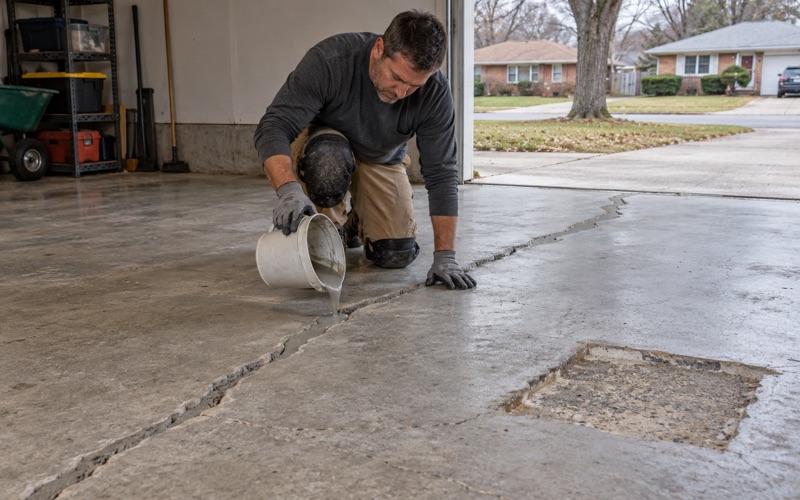
A garage slab poured in the 1970s will have cracks, and some of them still open and close with the seasons. A coating is a film that follows the concrete under it: it can cover a dormant hairline crack once that crack is repaired, but it will not stop a moving one from showing through. We tell homeowners which cracks are which before they sign.
Moisture, contracts and warranty terms
Moisture testing is a written line item on a garage job here, using a plastic sheet test under ASTM D4263 or a calcium chloride test under ASTM F1869 depending on the slab. Warranty exclusions are read out before the job is sold, and moisture is the first one named. Every home job also gets a written contract and the Home Repair: Know Your Consumer Rights pamphlet before work starts, as the Illinois Home Repair and Remodeling Act requires.
Building the residential system
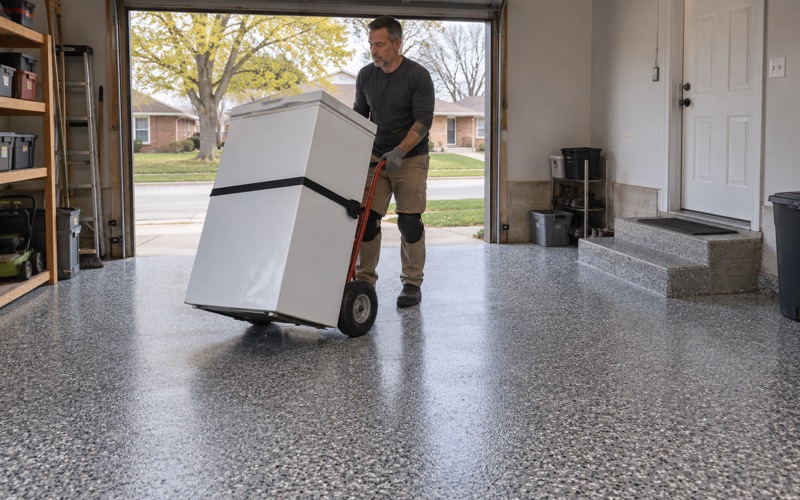
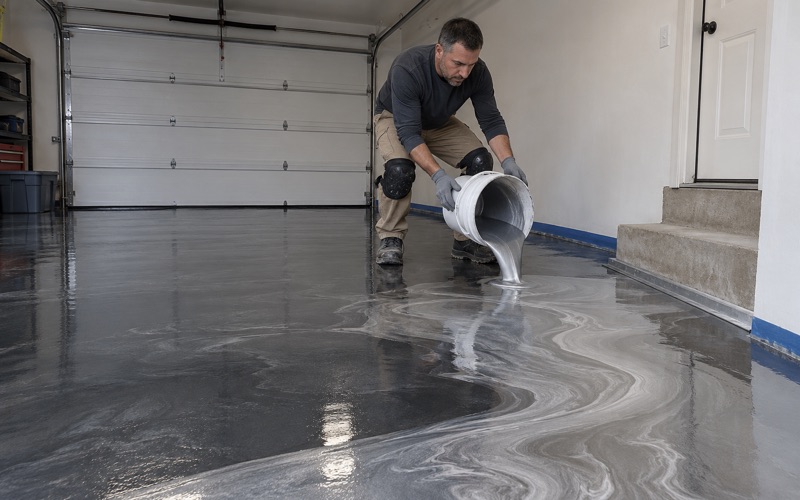
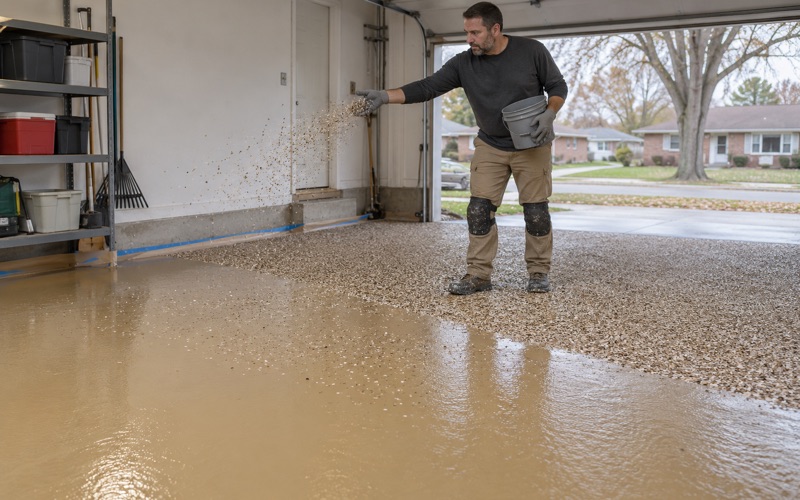
For a family garage, we usually recommend a 100% solids epoxy base, a full vinyl flake broadcast and a polyaspartic topcoat. The flake hides the minor surface texture of an older slab, and the topcoat handles the same hot tires a dealership floor sees, just fewer of them. Curing is timed to slab temperature, so a detached, unheated garage booked in deep winter may have to wait for spring.
- 20+ Years Coating Floors
- Moisture Testing in Every Scope
- Free Written Estimates