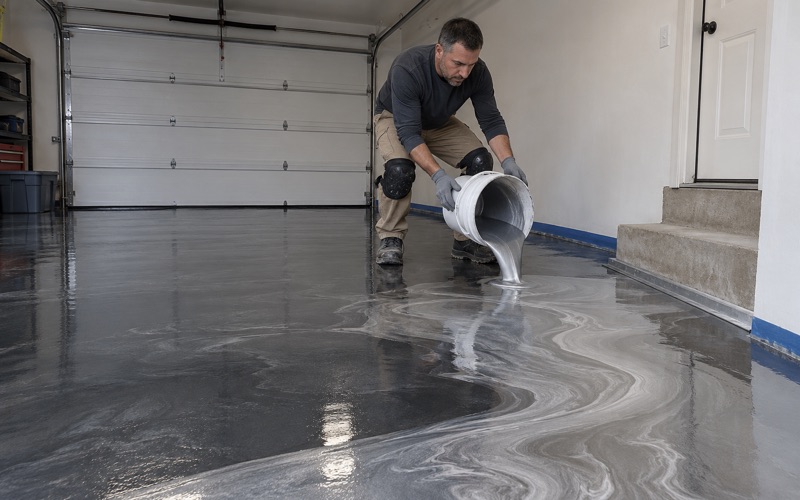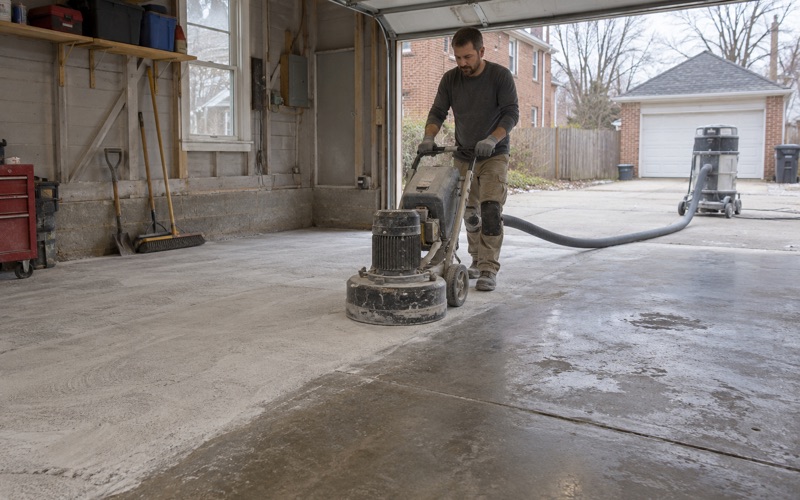
Waukegan Epoxy Flooring has spent more than 20 years on epoxy flooring in Knollwood and across Lake County, and the work here splits into two very different jobs: production, lab and dock floors inside working plants, and two-car garages under family homes. Both start the same way. We open the slab mechanically with a diamond grinder or a shot blaster, never with acid, so the primer bites into clean, profiled concrete instead of sitting on a weak surface skin.
What changes is the system that goes on top. A forklift aisle, a quality-control lab and a residential garage each ask something different of a floor, and a coating chosen for one tends to fail early in another. Our proposals name the product, the system build and the finished thickness for every area, so a plant manager or a homeowner can check what was quoted against what actually went down.
Before we price anything we read the slab: the cracks, the joints, the old coating if there is one, and the moisture. When a floor needs repair or replacement before it can carry a coating, we say so in the quote rather than discovering it halfway through the job.
Manufacturing Floors on Knollwood’s Stretch of Waukegan Road
Most people picture Knollwood as a small pocket of houses between Lake Bluff, Lake Forest and Green Oaks. It also holds real manufacturing floor. Buehler, an ITW company that makes metallography equipment and employs about 375 people, sits at 41 N. Waukegan Road, and Profile Plastics runs a thermoforming plant at 65 N. Waukegan Road. Both carry Lake Bluff mailing addresses, and both geocode inside the Knollwood census-designated place, in Shields Township.
The business parks around Rockland Road and Waukegan Road are often described as Lake Bluff’s, and much of that corridor is inside the village. These two plants are not. That puts production floors, shipping docks and lab spaces on the list of real Knollwood job types, right alongside the garages a few blocks away.
Who signs off on a plant alteration
Knollwood is unincorporated, so alterations to a building on this part of Waukegan Road go through Lake County Planning, Building & Development rather than the Village of Lake Bluff. The county requires a permit for new structures, additions and alterations, exempts painting and carpet installation, and offers a registration-in-lieu track for a list of minor improvements. Which of those a given floor scope falls under depends on what else the project touches, so we confirm it with the county before anything is scheduled.
What a light-manufacturing floor asks of a coating
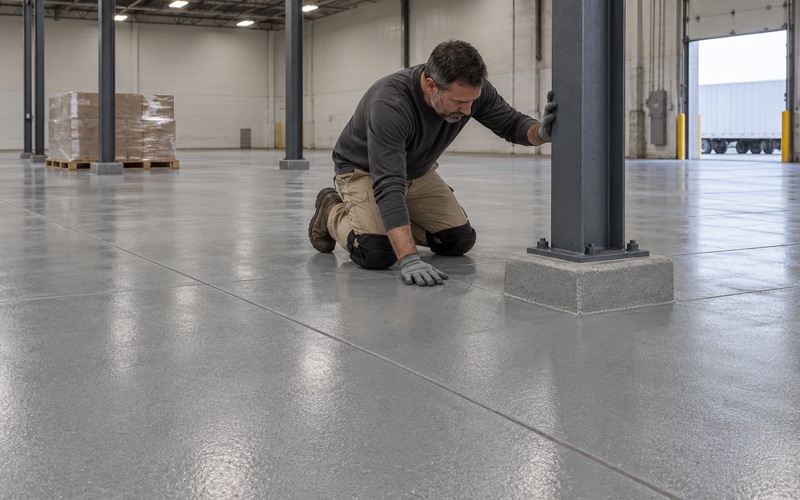
A plant floor takes loads a garage never sees: pallet jacks, forklift wheels turning in place, dropped tooling, and the oils, coolants and cleaners that come with light manufacturing. That calls for a thicker build than a residential flake floor, typically a 100% solids epoxy body coat at a stated film thickness, with urethane cement reserved for areas that see heat or harsh washdown. We size the system to the traffic and chemistry in each area rather than coating a whole building with one recipe.
Why the slab gets ground first
Older plant slabs often carry layers of sealer, old paint, oil and wax that acid etching cannot remove. We profile with diamond grinding or shot blasting to the ICRI CSP range the primer calls for. The grinding dust and slurry are collected on site and never washed toward a storm drain along Waukegan Road.
Looking for epoxy-flooring closer to Lake Bluff? See Epoxy-Flooring Services in Lake Bluff.
Production, Lab and Dock Floors Need Different Systems
A single building on this corridor can hold three or four distinct floor zones, and each one fails in its own way when it is coated wrong. We walk the plant with whoever runs it, mark the zones on a floor plan, and write each one into the proposal as its own line with its own system and thickness.
Production lines and forklift lanes
On the production floor the priorities are impact resistance, chemical resistance and traction where people stand for a whole shift. A quartz aggregate broadcast locked between epoxy coats gives a textured surface that holds up under boots and wheels, and we tune the grit so the floor can still be cleaned easily. Forklift lanes and pedestrian walkways get line striping in a durable coating, laid out with the plant’s safety staff so the lanes match how material actually moves through the building.
Lab, QC and clean workspaces
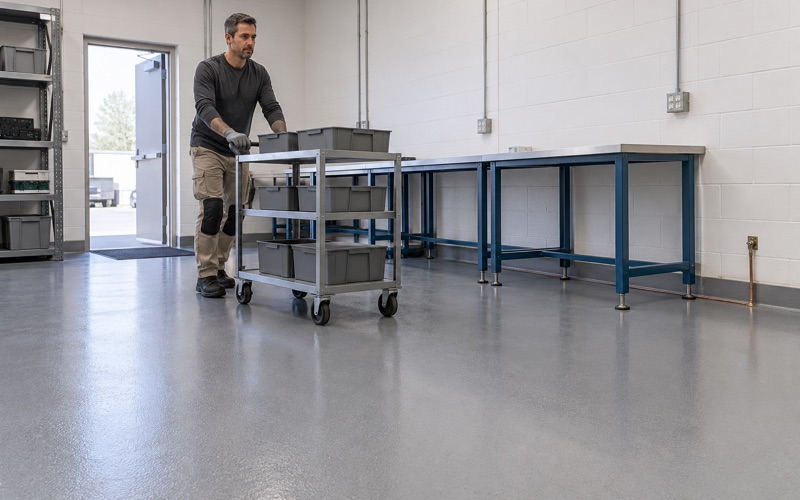
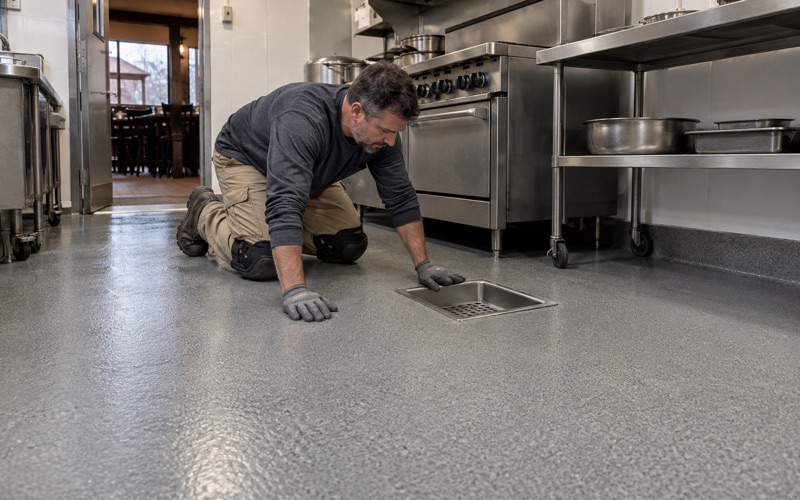
Labs and quality-control rooms want something closer to a seamless, low-texture surface that wipes down quickly and gives dust nowhere to settle. Where sensitive instruments or electronics are in use, a static-dissipative or ESD system can be specified to a stated resistance range, and the finished floor should be tested against that range rather than trusted to a data sheet. A polyaspartic or polyurea topcoat over the epoxy body is often the right finish here because it resists staining and scuffing.
Shipping docks
Dock floors take the worst of it: truck tires, pallets dragged in off the trailer, and winter slush carrying calcium chloride and rock salt off Lake County roads. Near the dock doors we favor a heavier broadcast and a topcoat chosen for salt and abrasion. We also detail the transitions where the coated floor meets the dock plate or a trench drain, because a thin, unsupported edge is where a dock coating starts to chip.
Keeping the Plant Running While the Floor Is Coated
A manufacturing floor rarely gets to sit empty for a week. We schedule industrial work around the hours a building has to keep running, which often means overnight shifts, weekends or a planned shutdown, and we phase large floors so one area cures while the rest stays in production.
Phasing a floor zone by zone
A typical sequence takes one bay or aisle out of service, grinds and repairs it, applies the primer and body coats, and hands it back once the coating has cured enough for its traffic. Dust collection on the grinders keeps fines out of neighboring production and lab areas, which matters most where an inspection station or clean workspace sits next door. Fast-curing polyaspartic topcoats can shorten the return-to-service window when the system and slab conditions allow it, and we put the expected downtime for each zone in writing.
Curing against conditions, not the clock
Epoxy cures to slab temperature and humidity, not to a schedule on a whiteboard. We check the dew point spread at the slab surface before every coat, because a cold slab near an open dock door can sweat and leave amine blush that weakens the bond of the next layer. If conditions are wrong, we say so and move the window rather than putting down a coat that will not hold.
Moisture testing and VOC limits
Every scope carries moisture testing as a line item, using ASTM F2170 in-situ relative humidity probes or ASTM F1869 calcium chloride tests read against the coating maker’s limits. Where readings run high, a moisture-mitigation primer goes into the proposal before the body coat rather than appearing as a change order. We also choose coatings within the Illinois VOC limits in 35 Ill. Adm. Code Part 223, which bind the installer as well as the manufacturer in the Chicago-area ozone nonattainment region.
Garage Floors in Knollwood’s Mid-Century Homes
Away from Waukegan Road, most of Knollwood is single-family houses, and most of those houses are mid-century ranches and split-levels. About 72 percent of the CDP’s 688 housing units were built between 1950 and 1979, so a typical garage here has decades of parked cars, oil drips and, often, a coat of hardware-store paint behind it.
What a ranch or split-level garage needs
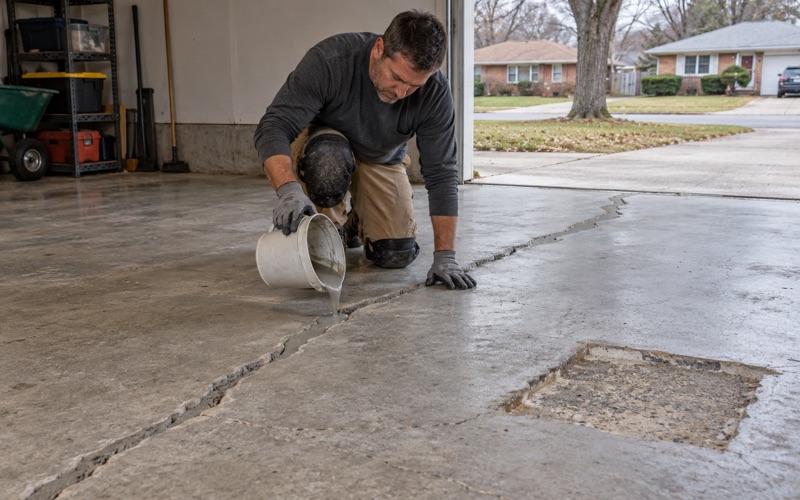
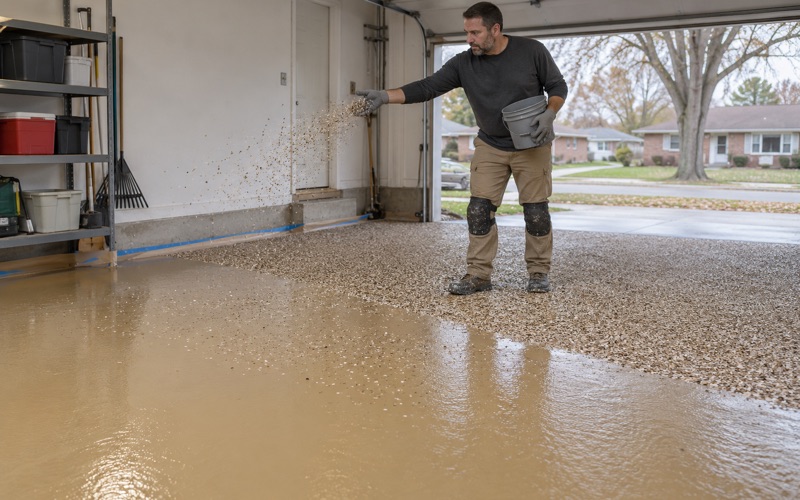
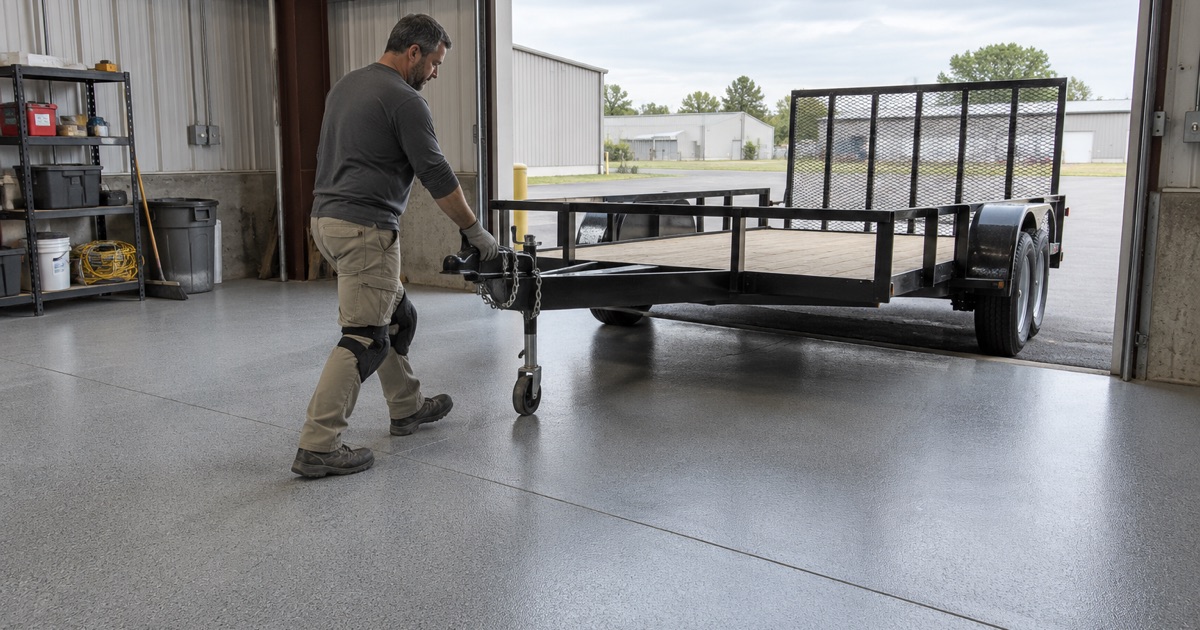
We grind all of that old film off, fill cracks and spalls, and build a system meant for the calcium chloride brine and rock salt that ride in on the tires all winter. For most homes that means an epoxy base with a vinyl flake broadcast and a polyaspartic topcoat that resists hot tire pickup. A coating is a film that follows the slab beneath it, so we tell homeowners plainly that it will not stop a moving crack from showing through again.
Cold garages and timing
Many Knollwood garages are unheated. Because curing is set by slab temperature and dew point, an unheated garage in deep winter may have to wait for spring, and we say so up front rather than coating a floor that cannot cure properly. Moisture testing is part of a garage quote here just as it is in a plant, and the warranty exclusions are read out before the job is sold, with moisture named first.
Paperwork on a home job
Every residential job gets a written contract and the Home Repair: Know Your Consumer Rights pamphlet before work starts, as the Illinois Home Repair and Remodeling Act requires. Illinois licenses no flooring or coatings contractor, so we confirm the registration, bond and insurance expectations that apply in unincorporated Lake County before a date goes on the calendar. A floor coating is also not radon reduction; in Illinois that work takes an IEMA radon mitigation license, and we do not sell a coating as a substitute for it.
- 20+ Years Coating Floors
- Moisture Testing in Every Scope
- Free Written Estimates