Waukegan Epoxy Flooring has spent 20+ years installing epoxy flooring in Green Oaks and the rest of Lake County, and the first step on a job here is not grinding anything. It is a phone call. Garage and basement floors in this village sit inside a permit conversation most homeowners never expect to have about a coating, and we would rather settle it before the scope is final than after the grinder is on the trailer.
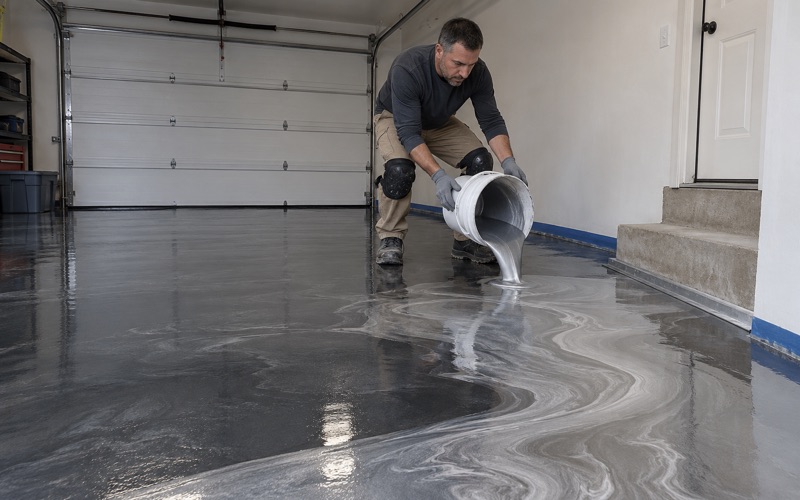
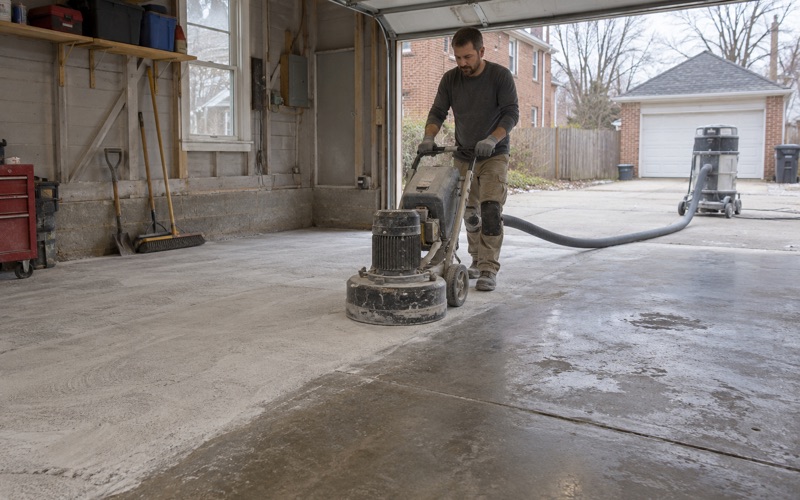
Our method does not change at the village line. Every slab is opened mechanically with a diamond grinder or shot blaster, never acid etched, and moisture testing is written into the price rather than offered once a floor has already lifted. The proposal names the product, the system build and the finished thickness, so you can hold what we quoted against what went down.
What does change in Green Oaks is the order of the first few steps. Below we walk through the permit list, the garages and basements we see most often here, and the calendar a village permit puts around a floor job.
Garages and basements are on Green Oaks’ permit list by name
What the village list actually says
The Village of Green Oaks publishes a list of work that requires a permit, and it is more specific than many homeowners expect. Basement remodeling is on it. So are garages, listed twice: attached garages and detached garages, each by name. The same list covers decks and patios, driveways and aprons, fences, sheds, room additions and re-roofing, so the village clearly pays attention to the outbuildings and hardscape of a residential lot.
The rule over the list is a single sentence: a permit shall be obtained before beginning construction, alteration or repairs, other than ordinary repairs. That exception is where a floor coating lands, and it is the reason we do not treat a Green Oaks garage like a garage in a town that says nothing on the subject.
Coating alone or part of a remodel
The village does not say whether coating an existing garage or basement slab counts as an ordinary repair. We are not going to answer on its behalf, and we will not tell you a coating is exempt or that it needs a permit, because the published material settles neither. A recoat of a sound slab and a floor installed as one piece of a larger remodel are also very different jobs, and the village may see them differently.
What we can describe is where the line tends to fall in practice. When the floor is the whole job, the question is about the coating alone. When the floor is the last step of a finished basement or a garage rebuild, it is part of work already on the list by name, and the permit for that work is the one that governs.
Asking the Village Administrator first
In Green Oaks the Village Administrator issues permits and sets the fee schedule, and that office is the one to ask. We tell homeowners to make that call, or we make it with them, before we sign a contract that schedules grinding. A short answer in writing from the village is worth more than any contractor’s opinion, ours included.
Illinois issues no state license for flooring or coatings work, so we also confirm whether the village wants contractor registration, a bond or proof of insurance on file before a job goes on the calendar. The village posts a business registration form, and we check its terms for our own work rather than assuming they match the next town over.
Looking for epoxy-flooring closer to Gages Lake? See Gages Lake Epoxy-Flooring.
Garage floors on Green Oaks’ country-lot homes
Detached houses, detached garages
The village calls itself a Community of Country Living, and the housing bears that out. Of 1,113 owner-occupied homes, 1,110 are detached single-family houses, so nearly every garage floor we quote here belongs to a standalone house, and many sit in a separate detached garage set back on the lot. That changes the job in practical ways: a longer run for power and dust collection, a slab that may never see heat, and an apron that is its own item on the village permit list.
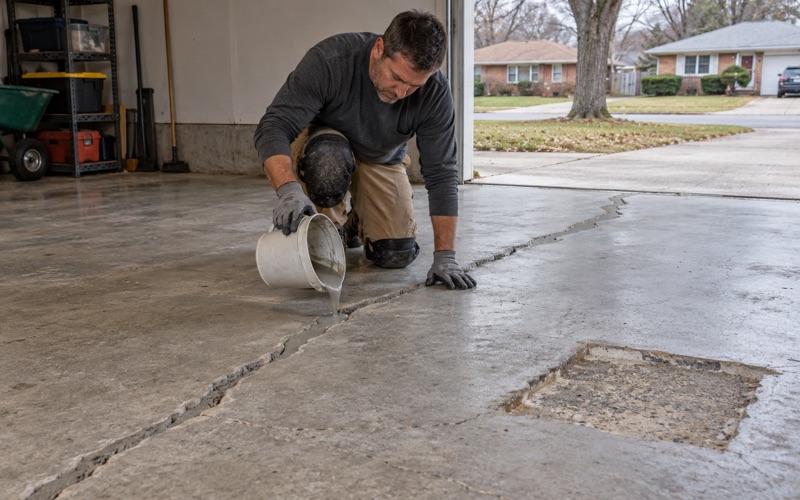
We collect grinding dust and slurry on site and never wash it toward a street drain or down a driveway, which matters more when a garage sits at the low end of a long apron. Before quoting, we read the cracks and whatever coating is already down, and if a slab needs repair or replacement before it can carry a new floor, we say so plainly instead of coating over the problem.
Built for brine and rock salt
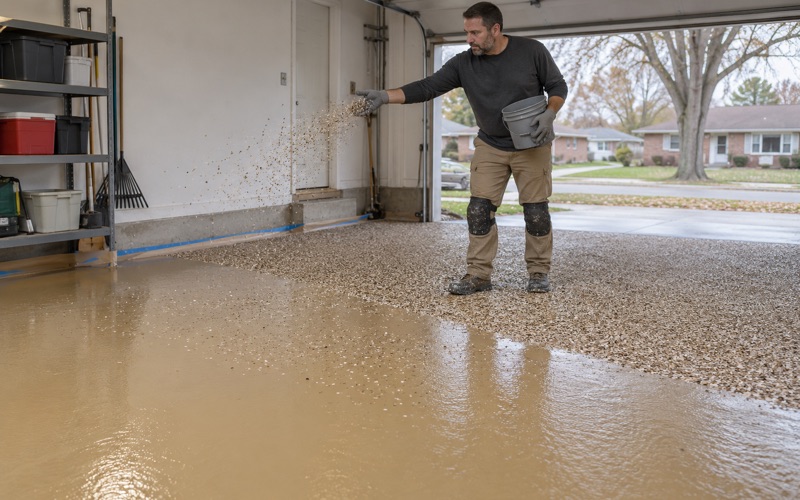
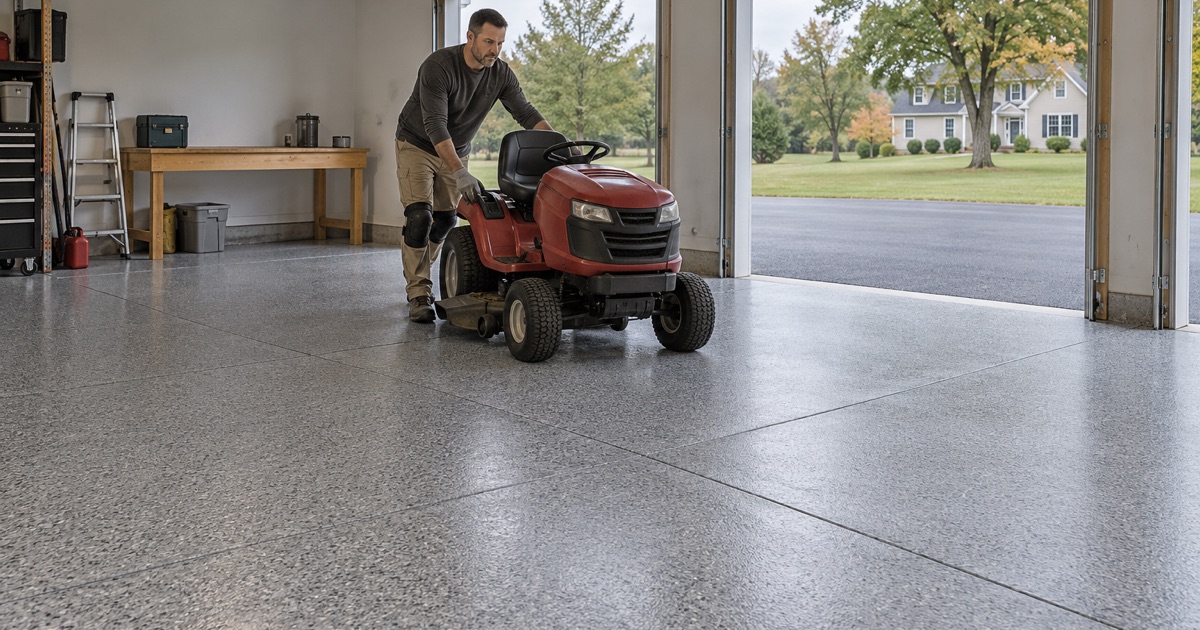
A Lake County winter puts calcium chloride brine and rock salt on every tire that pulls into a Green Oaks garage. The melt water carries that salt into every hairline crack and pinhole in a bare or thinly coated slab, where it keeps working long after the snow is gone. Our garage systems start with a 100% solids epoxy base, a full vinyl flake broadcast and a polyaspartic topcoat chosen for chemical resistance and resistance to hot tire pickup.
A coating is a film that follows the slab under it, and we say so before the job: it will not stop a moving crack from moving. What it will do is keep salt out of the surface, hold up under parked tires, and make the floor easy to rinse clean at the end of a long winter.
Curing in an unheated garage
Many detached garages here are unheated, and that sets the calendar. We schedule curing against slab temperature and the dew point spread at the slab surface rather than against a date. When the slab is too cold, amine blush and poor adhesion follow, and no product data sheet changes that.
So for an unheated garage we will say plainly when the floor has to wait for spring. An attached garage that shares warmth with the house usually gives us a longer working season, and we plan the two kinds of garage differently from the first visit.
Basement floors inside a permitted remodel
When the floor is the last step
Because basement remodeling is on the Green Oaks permit list, a basement floor here is often installed under a remodel that already carries a permit. In that case we coordinate with the homeowner and the remodeling contractor so the floor goes down when framing, drywall and trim allow, and our slab work fits inside what the village approved for the project.
When we coat a basement as a standalone job, we raise the same ordinary-repairs question with the Village Administrator before the contract is signed. Either way, the floor is never the place to discover that a remodel was scoped without the village.
Moisture testing as a line item
Basement slabs fail from below. Hydrostatic pressure, efflorescence along the cracks and a damp corner by the sump pit are all signs a slab is moving water, and a coating that traps that water will blister. Moisture testing is a priced line on our scope, on a basement slab and a garage slab alike.
We start with the ASTM D4263 plastic sheet test as a screen, then use ASTM F1869 calcium chloride emission testing or ASTM F2170 in-situ relative humidity probes where the slab calls for numbers. If readings run high, the system changes to a moisture-mitigation primer or a urethane cement base. Warranty exclusions are read out before the job is sold, and moisture is the first one we name.
Drains, backups and radon
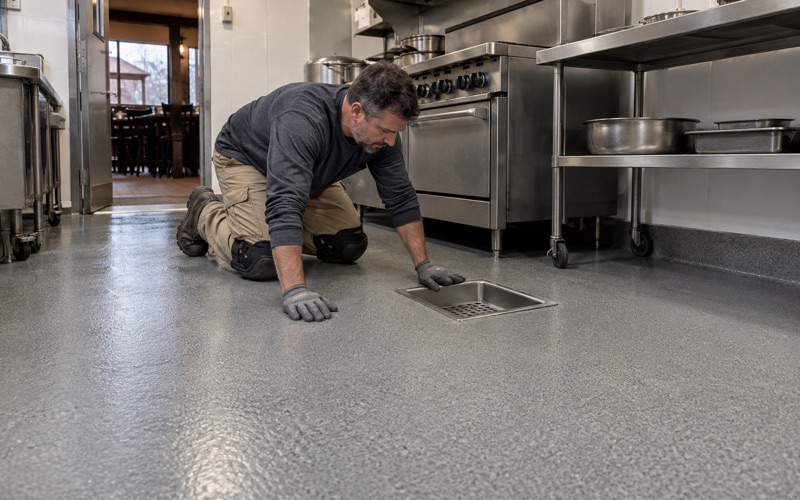
We detail the floor around the sump pit and the floor drain so the coating terminates cleanly and the drain still does its job. A basement that has had a sewer backup gets a closer look at the surface before we grind it to the right ICRI CSP profile for the primer.
One thing we do not sell is a floor coating as radon reduction. In Illinois that work takes an IEMA radon mitigation license, and a sealed basement floor is not a mitigation system, however well it is installed.
Timing: the six-month permit clock
Six months to start, six months to stall
Green Oaks permits lapse if work does not start within six months, and they also lapse if work is abandoned for six months. For a remodel that includes a basement floor, or a garage project that ends with one, that clock matters to us as much as to the homeowner. A floor waiting out a cold season in an unheated garage can easily run into it.
We plan around that. If a garage permit is issued in late fall, we talk through whether the floor should be the first warm-weather job and how the rest of the project keeps moving in the meantime. We would rather tell you in October that the coating goes down in April than let a permit lapse in silence.
Writing it down before we start
Every home job gets a written contract and the Home Repair: Know Your Consumer Rights pamphlet before work starts, as the Illinois Home Repair and Remodeling Act requires. The contract names the product, the system build and the thickness, and it records which permit question was asked and how the village answered it.
Our coatings are chosen within the Illinois limits on VOC content in architectural coatings, which bind the installer as well as the manufacturer. Lake County sits inside the Chicago 2015 ozone nonattainment area, so those limits apply to every floor we put down here.
The right desk for a Libertyville address
Many homes inside the village carry a Libertyville mailing address under ZIP 60048, and some homeowners assume that sends them to Libertyville for permits. The village line, not the ZIP code, decides which permit desk applies, and for a home inside Green Oaks that desk belongs to the Village Administrator. Fire protection comes through the Libertyville Fire Protection District, which covers the village and unincorporated Libertyville Township, but a garage or basement permit stays a village matter.
- 20+ Years Coating Floors
- Moisture Testing in Every Scope
- Free Written Estimates