Waukegan Epoxy Flooring has handled epoxy flooring in Gages Lake for homeowners and facility managers across more than 20 years of slab work, and the first thing we settle on any job here is who signs off on it. That answer is not the same for a garage on a quiet street as it is for a corridor in a school building, and a quote that gets it wrong starts the project at the wrong desk.
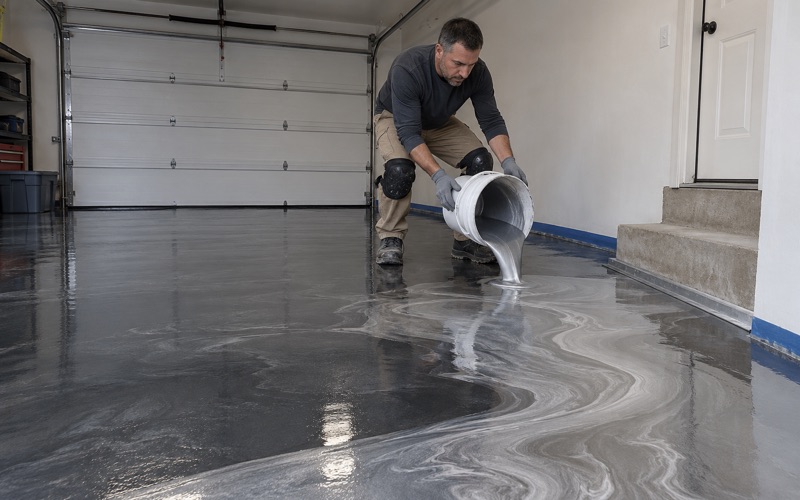
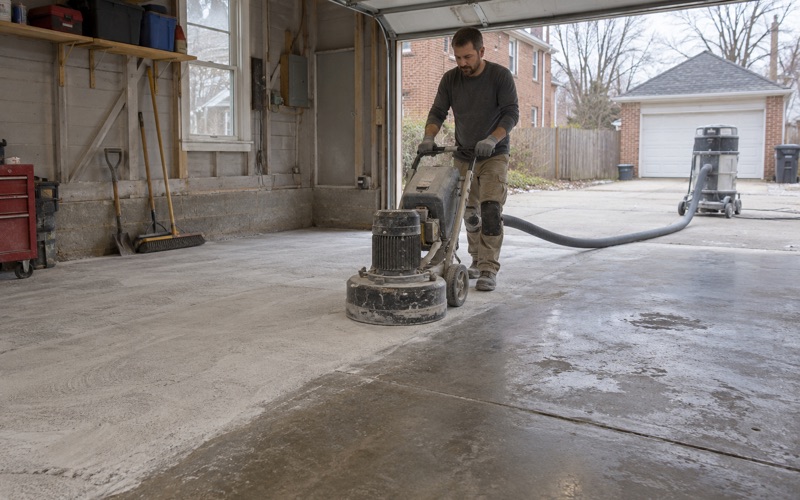
Our method does not change with the owner of the floor. We open the concrete with a diamond grinder or a shot blaster to a measured profile, we never acid etch, and moisture testing sits in the scope as its own priced line. The proposal names the resin, the system build and the finished thickness, so a facilities director or a homeowner can hold the paperwork against the floor once the crew has left.
What does change in Gages Lake is the paperwork around that floor. The sections below take the public side first, because the largest floor in the community belongs to a public high school, and then turn to the home garages that fill out the rest of the map.
A high school campus inside Gages Lake, and who permits its floors
Warren Township High School’s Almond Campus
Gages Lake is a census-designated place in Warren Township, Lake County, covering 3.17 square miles with no village government of its own. Inside that boundary sits Warren Township High School’s Almond Campus at 34090 Almond Road. The mail for that address reads Gurnee, but the parcel geocodes inside the Gages Lake CDP, and the campus is the largest single floor plate in the community.
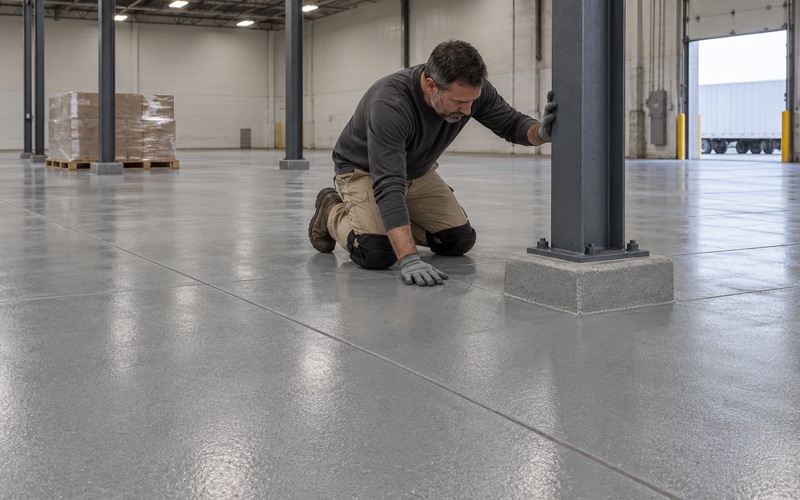
The Almond Campus opened in 1997 as the district’s second campus. A high school building of that scale holds nearly every floor type we coat: locker rooms that stay wet, a kitchen washed down after every service, shop rooms that take dropped steel and spilled fluid, and long corridors that carry the whole student body between bells.
The Regional Superintendent, not the county
In most of unincorporated Lake County, a building question goes to Lake County Planning, Building & Development. Public school construction and remodeling is the exception. Under 105 ILCS 5/3-14.20, the Regional Superintendent of Schools reviews the plans for code compliance and issues both the building permit and the occupancy permit, working from the Illinois State Board of Education’s Health/Life Safety code at 23 Ill. Adm. Code 180.
For a Lake County school, that review runs through the Lake County Regional Office of Education. The county building department is not the approving desk for a school floor, and a coating contractor who walks onto a school job assuming otherwise has already lost time the calendar cannot give back.
What that review means for scheduling
Plan review adds a step that a homeowner’s garage never sees. When a district’s architect or facilities office brings a coating contractor into a floor project, the system description, the finished thickness and the product data have to travel with the drawings through that review. We write our proposals so those pieces can be lifted straight into a submittal rather than rebuilt from a sales sheet.
School floors also run on the academic calendar. Grinding, priming and topcoat windows get planned around breaks, nights and weekends, and cure times are set against slab temperature and dew point rather than the date a semester starts. If the slab is not ready, we say so before the window opens instead of after it closes.
Looking for epoxy-flooring closer to Knollwood? See Epoxy-Flooring in Knollwood.
What a school or public-body coating bid has to carry
Prevailing wage on public work
A public school district is a public body for Illinois prevailing-wage purposes, so coating a floor at a school is public work and the obligations of the Illinois Prevailing Wage Act attach to the labor on it. A bid that prices the crew as if the job were a private garage will not survive contract review.
We build public-body bids with those obligations already carried in the labor line rather than discovered after award. That keeps the number a district sees on bid day close to the number it actually pays, and it keeps a change order from becoming the first conversation of the project.
Specifications a facilities office can check
A public bid is compared line against line, so loose coating language costs everyone time. Our proposals name the primer, the body coat, any broadcast and the topcoat, along with finished thickness in mils and the ICRI CSP surface profile the grind will reach. That is the same discipline we bring to a home garage, but on a school floor a reviewer can actually hold the installer to it at closeout.
Moisture is written into the bid as a test rather than an assumption. On slab-on-grade school floors we run ASTM F2170 in-situ relative humidity probes or ASTM F1869 calcium chloride tests and compare the readings against the coating manufacturer’s limits before a primer is chosen. When the readings call for a moisture-mitigation primer, the bid already shows what it costs, so nobody is surprised by a blister in the second semester.
Dust, odor and an occupied building
A school is often partly occupied while one wing is under work. We collect grinding dust and slurry on site with shrouded, vacuum-connected equipment and never wash either toward a street drain. Coatings are selected within the Illinois architectural coating VOC limits in 35 Ill. Adm. Code Part 223 Subpart C, which bind the installer as well as the manufacturer.
That VOC choice matters most where odor can travel down a corridor and into classrooms. Lower-odor systems and a cure schedule that finishes before students return are part of the bid, not a favor asked for on the day.
Locker rooms, kitchens, shops and corridors
Locker rooms
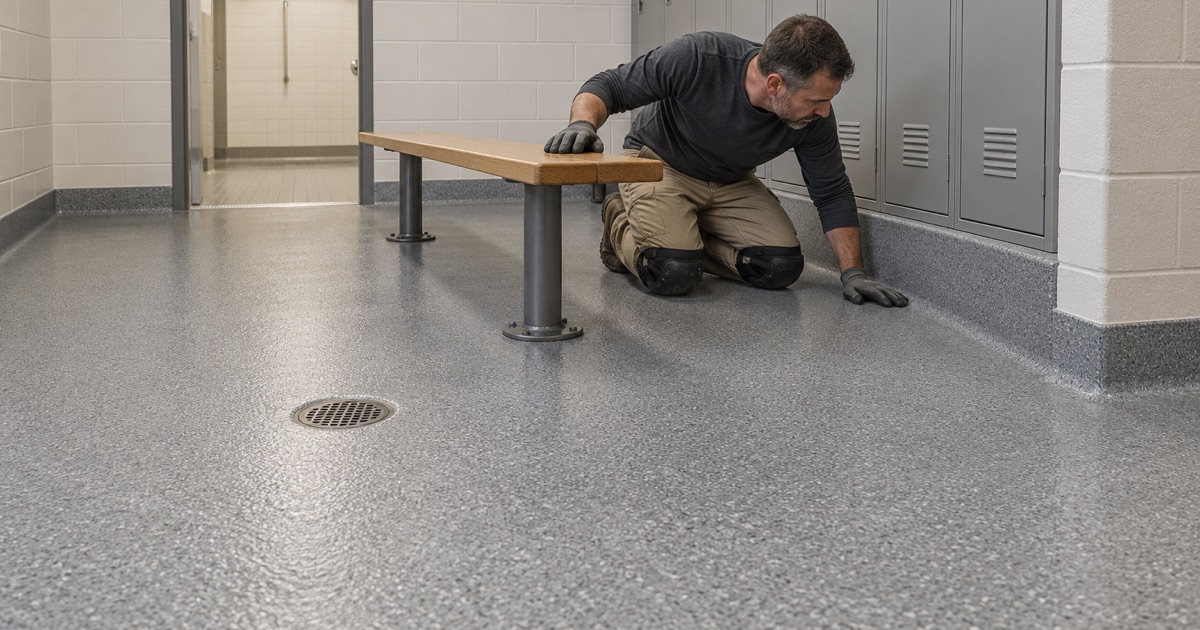
Locker rooms combine standing water, soap film and bare feet, which makes slip resistance the first decision rather than the last. We broadcast quartz aggregate into the body coat and lock it under a topcoat, setting the texture to the room instead of to a catalog photo. Floor drains are detailed so the coating carries into the drain body and water cannot work under the edge.
Where a locker room slab shows cracks, we say before the job that the coating will follow them. A film bonded to concrete moves with the concrete beneath it, and promising that a coating will stop that movement is how a floor gets blamed for something the slab did.
Kitchens and food service
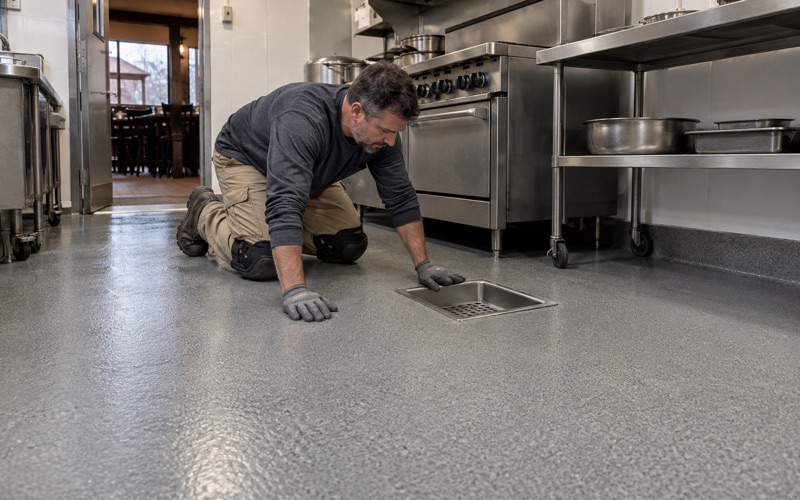
A school kitchen is washed hot, often and with strong cleaners, which is where urethane cement earns its place over a thin epoxy film. It tolerates thermal shock from hot water and steam far better. FDA Food Code 6-201.13 calls for coved floor and wall junctures in food areas, so we trowel an integral cove base up the wall instead of leaving a caulk joint where food and water can sit.
Where the Lake County Health Department reviews a food-service plan, we supply the floor product data that review asks for. The texture of a kitchen floor is also a balance: enough grip for wet work, and a surface the night crew can still squeegee and sanitize.
Shop rooms and corridors
Technical education shops take dropped tools, hot metal and cutting fluid, so the system there is a thicker 100% solids epoxy body coat under a chemical-resistant topcoat. The aim is a floor that shrugs off a spill long enough for someone to clean it up.
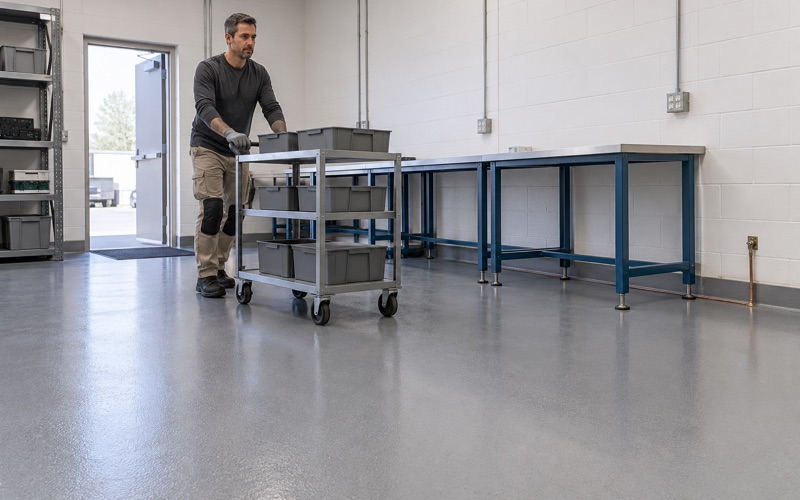
Corridors are a wear and appearance problem. A vinyl flake broadcast under a polyaspartic topcoat hides scuffing, and the fast cure of a polyaspartic topcoat is often the deciding reason to use it where a hallway has to reopen the next morning.
Home garages in Gages Lake: Lake County’s rules
No village, one county office
Most of Gages Lake is houses, and those houses answer to Lake County Planning, Building & Development because there is no village hall to call. The county requires a permit for new structures, additions and alterations, lists interior and exterior painting and carpet installation as exempt, and runs a registration track through its ePortal for minor work such as re-roofing, windows, fences and sheds. Floor coating is not named on either list.
Because it is not named, we do not guess. Before a garage job is scheduled we confirm with the county how it treats the scope, and we check the registration, bond and insurance rules that apply, since Illinois licenses no general, flooring or coatings contractor at the state level. The Gurnee or Grayslake on a homeowner’s envelope does not change which office that is.
Lake-area houses from the 1980s and 1990s
Gages Lake’s housing leans heavily on two decades. Of the 4,187 housing units counted in the Census Bureau’s American Community Survey, 929 were built in the 1980s and 1,035 in the 1990s, together 46.9 percent of the stock. Owners occupy 3,386 of the 4,081 occupied homes, so the typical garage floor here belongs to the person paying for the work.
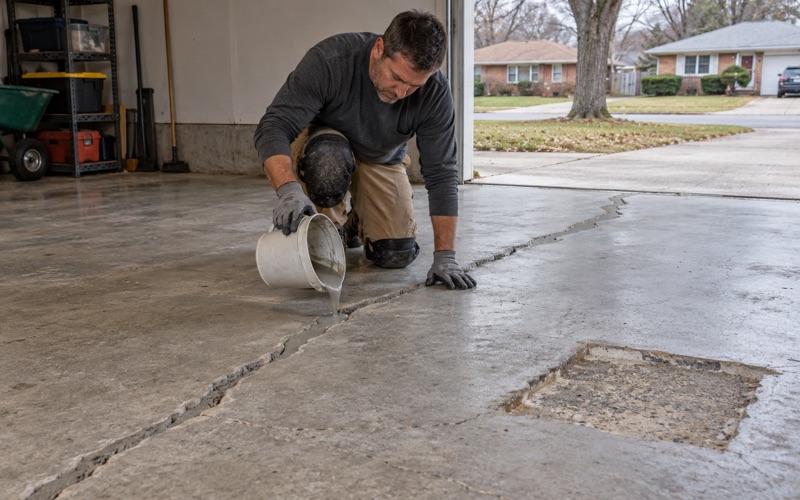
A garage slab with decades of Lake County winters behind it usually tells its history on the surface: scaling near the door, oil where a car sat, and sometimes a store-bought paint peeling in sheets. We read the cracks and any old coating before quoting, and if the slab needs repair or replacement before it can carry a coating, we say that plainly rather than coating over it.
Winter salt, curing and the home contract
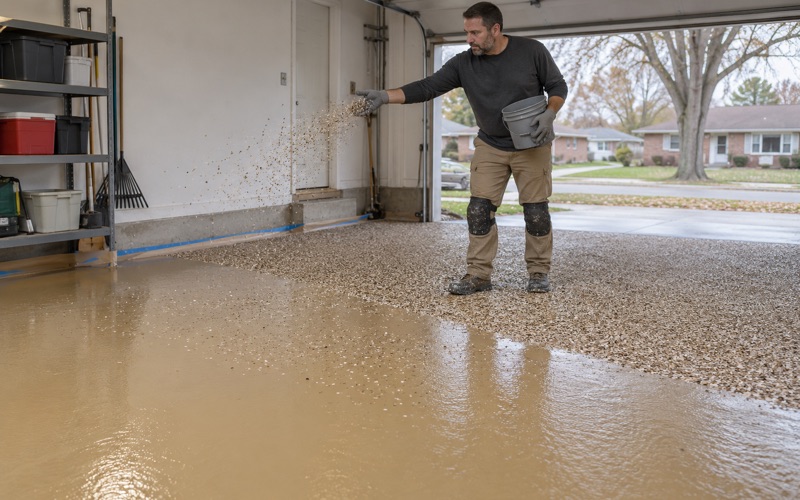
Garages here take calcium chloride brine and rock salt off the tires all winter, so we build them with a 100% solids epoxy or polyurea base, a full vinyl flake broadcast and a polyaspartic topcoat that resists both the salt and hot tire pickup. In an unheated garage we schedule cure against slab temperature and the dew point spread at the surface, and when the slab is too cold, the honest answer is spring.
Every home job is written under the Illinois Home Repair and Remodeling Act, with a written contract and the Home Repair: Know Your Consumer Rights pamphlet in hand before work starts. Warranty exclusions are read out before signing, with moisture first on the list, and we will not describe a floor coating as radon reduction, which in Illinois takes an IEMA mitigation license.
- 20+ Years Coating Floors
- Moisture Testing in Every Scope
- Free Written Estimates