Waukegan Epoxy Flooring has spent more than 20 years on epoxy flooring in Fox Lake and across Lake County, and the floors that teach the most are the ones that never get a chance to dry out. A room that stays damp, carries corrosive gases in its air and takes splashes of treatment chemicals asks for a different coating decision than a two-car garage does. We start those jobs from what the room does to concrete, not from a color chart.
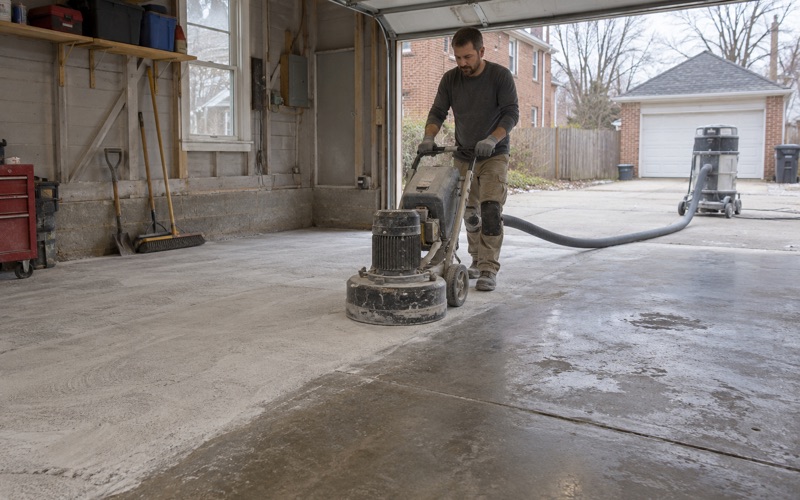
That order holds whether the owner is a household, a shop or a public utility with engineers of its own. We open every slab mechanically with a diamond grinder or a shot blaster, we never acid etch, and our proposal names the product, the system build and the finished thickness so whoever reviews it can check what was quoted against what went down.
Before anyone signs, we also read the warranty exclusions aloud, and moisture is the first one on that list. On a floor that lives wet, that conversation matters more than any finish sample.
A Regional Plant the Village Has Owned Since 1979
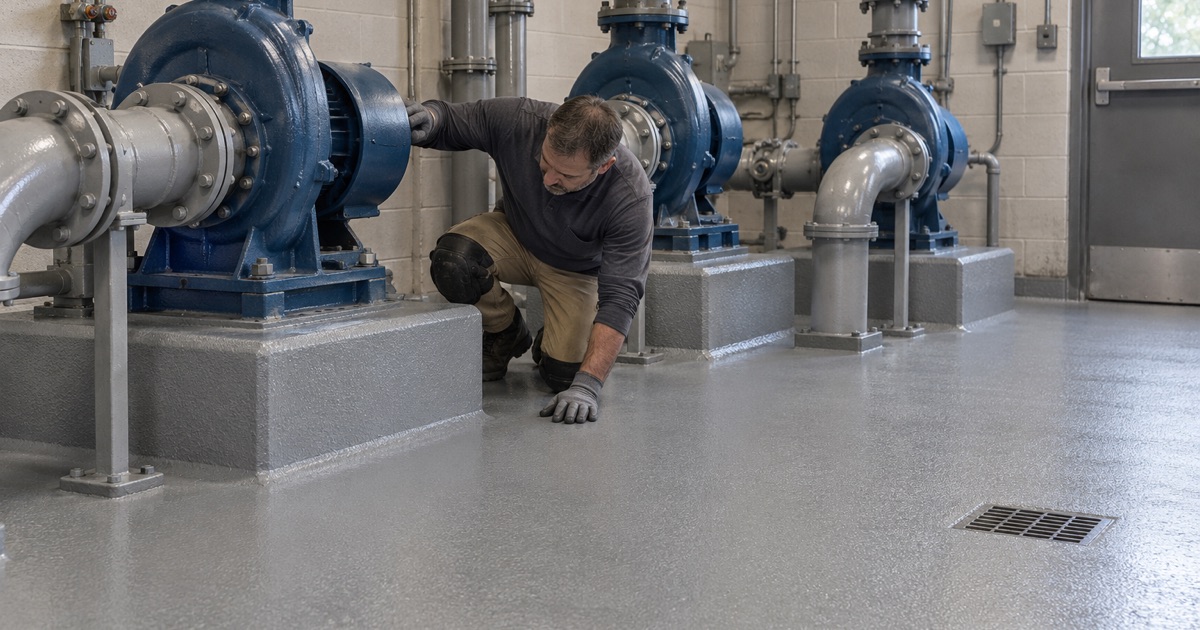
Fox Lake is a village of 10,978 people at the 2020 census, and it sits in Lake County with a portion reaching into Burton Township in McHenry County. It also owns and runs something most villages its size never take on: the Northwest Regional Water Reclamation Facility at 200 Industrial Avenue. That address geocodes inside the village, in Grant Township, Lake County.
One owner, many communities
The Village of Fox Lake is both the owner and the operator of the plant, which treats wastewater for Fox Lake and eight other communities. It went on line in 1979, and pollution of Round Lake, Long Lake and the Chain O’Lakes during the 1970s is what drove the need for a regional plant in the first place. Eighteen full-time employees staff it across two shifts.
That combination is unusual for a village of this size, and it shapes how any floor work there would be bought. The customer is not a property manager or a homeowner with a weekend free; it is a public utility answering to its own engineering and purchasing people.
A two-phase expansion completed in 2013
The plant finished a two-phase expansion in 2013 that addressed nutrient removal, energy efficiency and capacity for more than 20 years of development. In any treatment plant, an expansion is where floor decisions tend to be made in bulk, because new or reworked rooms each need a surface chosen for what will sit on it and spill across it.
We have not read which rooms that project touched or which floor systems went into them, and we will not pretend otherwise. What we can describe is how we approach the kinds of rooms every wastewater plant has, and why the answer there is so different from a showroom floor.
Looking for epoxy-flooring closer to Salem Lakes? See Salem Lakes Epoxy-Flooring.
What Wastewater Rooms Do to Concrete
A garage slab gets wet when a car drips on it and then dries. A pump room or process room in a treatment plant may never reach that second step, and concrete that stays damp behaves differently under a coating than concrete that cycles.
Damp that never leaves
In a constantly humid room, moisture works on a coating from both directions. Vapor rises from below through a slab that may have no vapor retarder under it, while condensation forms on top whenever the slab surface runs close to the dew point of the room air.
That is why we measure the dew point spread at the slab surface before we mix anything, and why curing gets scheduled against slab temperature and dew point rather than the calendar. Epoxy laid onto a surface sweating at the dew point can develop amine blush, a waxy film that weakens the bond of the next coat and has to be washed off before work continues.
Gases in the air
Wastewater gives off gases, and in enclosed rooms those gases can turn acidic once they meet moisture on concrete. Plain concrete has little defense against that kind of slow attack, which is one reason process areas are coated at all rather than just sealed.
A lithium silicate densifier hardens the top of a slab, but it does not stand up to acid the way a chemical-resistant resin system does. For a room with that exposure, we treat the densifier as a choice for dry warehouse floors and look at thicker resin builds instead.
Testing before we coat
Moisture testing is a line item in our scope rather than an upsell after a floor fails. We use ASTM F2170 in-situ relative humidity probes set into the slab, ASTM F1869 calcium chloride tests for the vapor emission rate, and the ASTM D4263 plastic sheet test as a quick first read.
Those numbers get compared with the ASTM F710 thresholds and with the limits on the product data sheet. When a reading comes back high, the conversation turns to a moisture-mitigation primer or a urethane cement system, and we say so in writing before anything is installed.
Chemical and Pump Rooms: Resistance Before Looks
In a room that handles treatment chemicals, nobody asks first how the floor looks. The questions are what it will resist, how thick it has to be to keep resisting, and what happens at the drains, pits and wall edges where liquid actually collects.
Choosing the system for the exposure
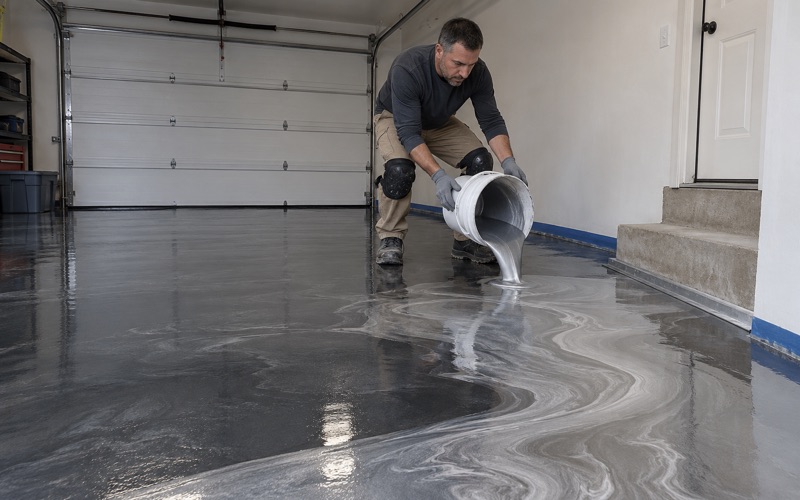
A 100% solids epoxy gives a dense, thick film with no solvent to flash off, and it is the usual starting point for a coated process floor. Where a room sees heavy wet traffic, hot washdown or a slab that holds more moisture than epoxy will tolerate, urethane cement is often the better base, because it is built to bond to damp concrete and handle thermal shock.
Polyaspartic and polyurea topcoats have their place on residential and light commercial floors, where fast return to service matters most. For chemical exposure, we match the resin to the specific chemicals named on the owner’s list and the product’s resistance chart, not to a general claim that a coating is tough.
Profile, thickness and the slab underneath
A thick system needs a deeper anchor than a thin one, so we specify the ICRI CSP surface profile in the proposal and prepare to it with grinding or shot blasting. Dust and slurry from that prep are collected on site and never washed toward a drain, which matters doubly in a building whose whole purpose is treating what goes down drains.
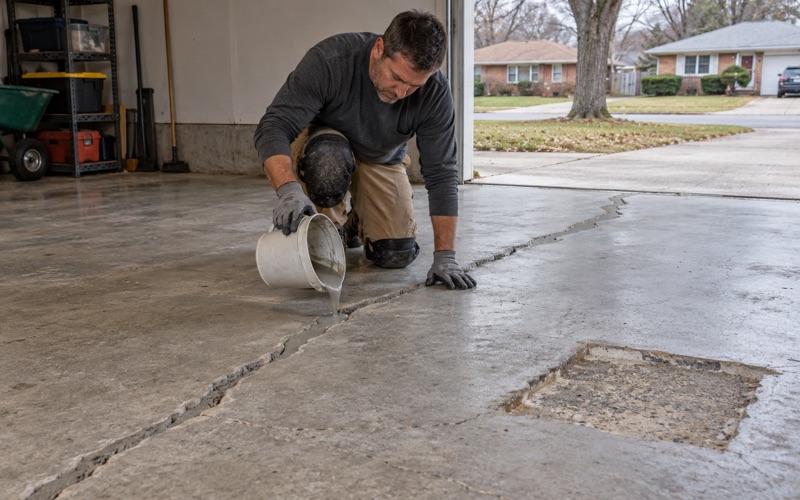
We read the cracks and any old coating before we quote, and we say plainly when a slab needs repair or replacement before it can carry a new system. A coating is a film that follows the concrete under it; it will not stop a moving crack from moving.
Texture, drains and edges
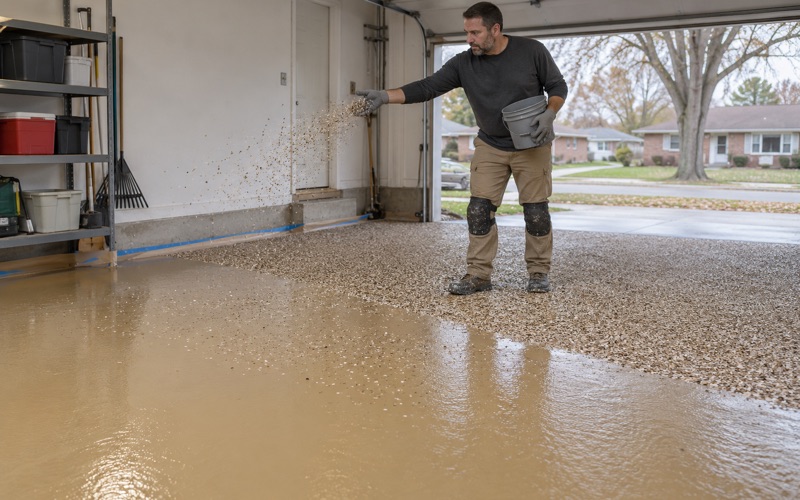
Wet floors need grip, so a quartz aggregate broadcast into the body coat gives traction that a smooth epoxy does not. The texture is set by the room, since too much makes a floor hard to rinse clean and too little leaves it slick under standing water.
Sump pit and floor drain detailing is where many coated floors fail first. We terminate the system into drains and pits deliberately and carry it up the walls as a cove where liquid will sit, so the edge does not become the place chemicals get under the film.
Working for a Municipal Owner
A village-owned plant buys work differently from a homeowner. Engineering staff write or review the scope, purchasing handles the paperwork, and a floor system has to be described clearly enough to be judged by people who will never stand on the job site during installation.
Paperwork that can be checked
Our proposals name the product, the system build and the finished thickness, which gives an engineer something concrete to compare against a specification. Warranty exclusions are spelled out in the same document, with moisture listed first.
Illinois issues no state license for flooring or coatings work, so we confirm the local contractor registration, bond and insurance requirements before any job is scheduled. In Fox Lake, the Community Development Department at 66 Thillen Drive handles permits under the 2015 International Building Code, and whether a given coating job needs a permit is that office’s call.
Rules the material has to meet
Lake County sits within the Chicago 2015 ozone nonattainment area, and our floor coatings are chosen within the VOC limits of 35 Ill. Adm. Code Part 223 Subpart C. That rule binds the installer as well as the manufacturer, alongside the national architectural coatings rule in 40 CFR 59 Subpart D.
We also do not sell a floor coating as radon reduction. In Illinois, that work takes an IEMA radon mitigation license, and a resin floor is not a substitute for a mitigation system.
Scheduling around a plant that never closes
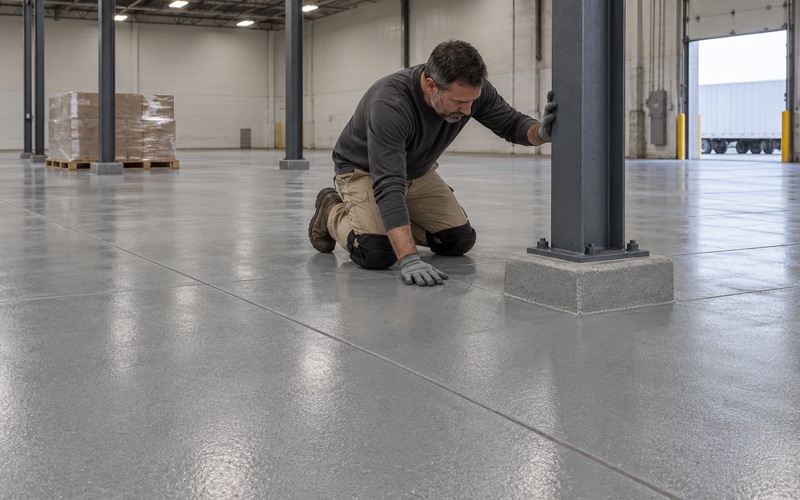
A treatment plant staffed on two shifts cannot simply stop for a week while a floor cures. We schedule industrial and institutional floors around the hours a building has to keep running, including overnight and weekend windows, and we plan the sequence room by room so service continues in the spaces we are not working in.
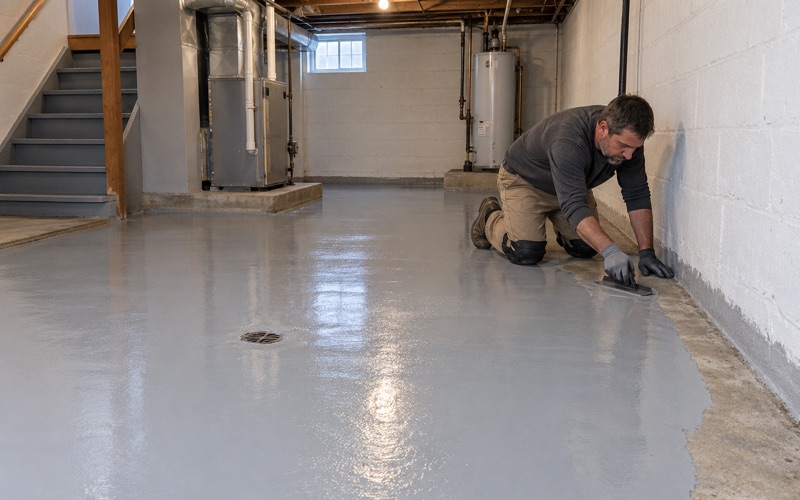
The same care carries over to homes in Fox Lake, where every residential job gets a written contract and the Home Repair: Know Your Consumer Rights pamphlet before work begins, as the Illinois Home Repair and Remodeling Act requires. A basement slab gets the same moisture testing as a process room, because a dry-looking floor is not always a dry one.
- 20+ Years Coating Floors
- Moisture Testing in Every Scope
- Free Written Estimates