
Waukegan Epoxy Flooring provides concrete grinding in Waukegan, IL, serving surrounding cities including Park City, Gurnee, North Chicago, Beach Park and Green Oaks. Grinding is the step that decides whether a floor coating stays bonded, and in more than 20 years we have never found a shortcut that works as well. Every slab we coat is opened with a diamond grinder or a shot blaster, and we do not acid etch.
We also grind as a standalone service: removing old coatings and adhesives, flattening lips at cracks and joints, cleaning up oil-soaked surfaces and preparing slabs for another trade’s flooring. In each case the goal is the same, sound and clean concrete with the profile the next layer needs.
Grinding dust is captured at the tool, and slurry from any wet work is collected on site rather than washed toward a drain.
Why Mechanical Prep Matters
What Grinding Removes
The top of a concrete slab is often a weak layer of fine paste called laitance, and it may carry sealers, curing compounds, paint, oil and old coatings. A coating bonded to any of those is only as strong as they are. Grinding cuts through them to the hard concrete beneath.
What Acid Etching Leaves Behind
Acid etching is cheap, and it is what most kit instructions call for. It leaves a shallow, uneven profile, it cannot remove sealers or paint, and any acid or salts left in the pores weaken the bond. We do not use it on any floor.
Opening the Surface to a Measured Profile
The International Concrete Repair Institute defines concrete surface profiles from CSP 1, almost smooth, to CSP 10, very rough. Each coating system calls for a range. We match the tooling to the target profile and check the result before any product goes down.
Grinding Methods and Equipment
Diamond Grinding
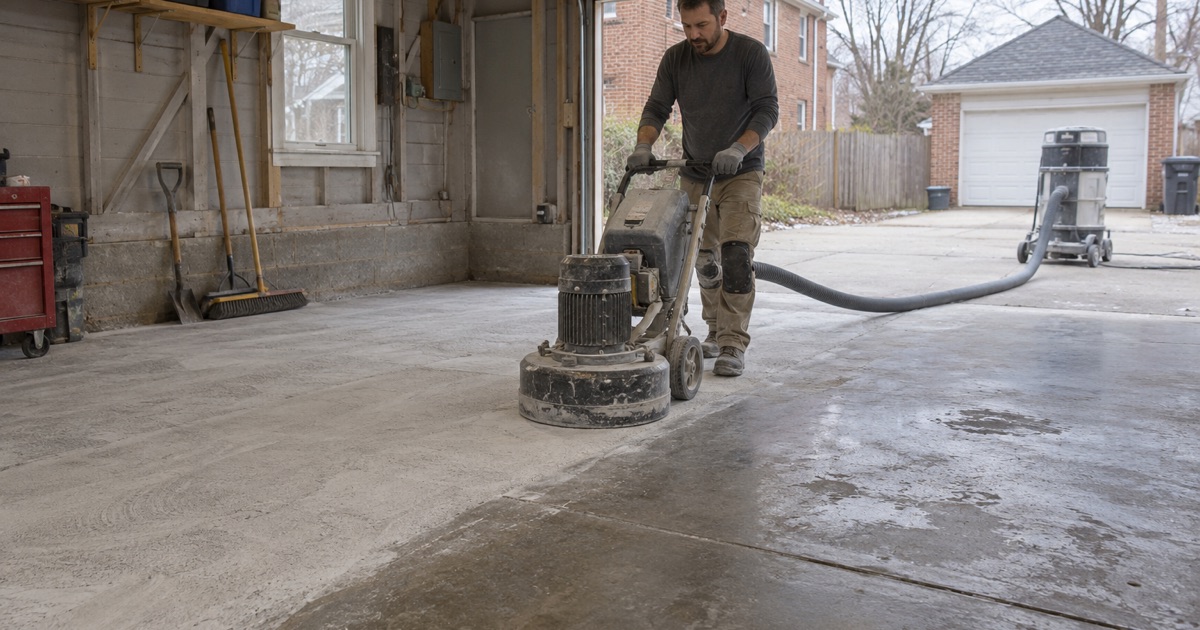
Planetary diamond grinders use rotating heads fitted with metal-bond diamond segments. Changing the grit and bond lets us remove heavy coatings, open a slab for a coating or begin the sequence for polished concrete. Edge grinders reach along walls and into corners.
Shot Blasting
A shot blaster throws steel shot at the floor and recycles it through the machine, leaving an even, textured profile. It is fast on large open floors such as warehouses and is a good choice where a heavier profile is required for thicker systems.
Scarifying and Heavy Removal
For thick coatings, mastic layers or uneven surfaces, a scarifier with rotating cutters removes material more aggressively than a grinder. We follow it with grinding to leave a clean, consistent profile.
Coating, Adhesive and Contaminant Removal
Old Epoxy and Paint
Failed epoxy and floor paint come off with coarse diamonds or a scarifier. Once the floor is clean, we look at the concrete for signs of why the old coating failed, such as moisture, contamination or poor prep, so the new floor does not repeat the problem.
Carpet Glue and Tile Mastic
Old basements and commercial spaces often hide black tile mastic or carpet adhesive. These gum up tooling and need specific diamonds. We remove them fully, because a coating or a new floor laid over adhesive residue will not bond properly.
Oil-Soaked Garage and Shop Floors
Oil soaks deep into concrete, especially in older garages. Grinding removes the surface layer, and degreasing treats what remains. If oil keeps wicking up, we tell you before coating so a stain does not reappear under the finish.
Flattening and Repairs
Lips at Cracks and Joints
When a slab cracks and one side settles, the edge forms a lip that catches carts and wheels. Grinding takes it down flush. If the crack is still moving, the lip may return, and we discuss whether the section needs repair.
Preparing for Self-Leveling or Overlays
When a slab needs a cementitious overlay or self-leveling underlayment, a heavier profile is required for the new material to bond. We grind or blast to that profile and prime the surface according to the product’s instructions.
Dust, Slurry and Site Control
Vacuum Collection at the Tool
Our grinders run with industrial vacuums that capture dust as it is made. In occupied buildings we add containment at doorways and plan the work for times when the space is empty.
No Slurry Down the Drain
Wet grinding produces a gray slurry of concrete fines. We collect it on site and dispose of it properly. Washing it toward a street or storm drain sends concrete fines into local waterways, and we never do it.
Testing the Slab After Grinding
Moisture Testing on Freshly Opened Concrete
Grinding opens the surface, which makes it a good moment to measure moisture. We use the ASTM D4263 plastic sheet test as a first read, and ASTM F1869 calcium chloride or ASTM F2170 relative humidity testing where a number is needed. Many older slabs in the area were poured without a vapor retarder, so we do not assume a floor is dry because it looks dry.
Checking Profile and Soundness
After grinding, we compare the surface with ICRI profile chips to confirm it matches what the coating requires. We also sound the slab for hollow areas and look for soft or crumbling concrete. Problems found at this stage are cheaper to fix than a failed floor later.
Grinding for Other Flooring Trades
Preparing Slabs for Tile, Vinyl and Wood
Tile setters, resilient flooring installers and wood floor contractors also need clean, flat, sound concrete. We grind off old adhesive and coatings, take down high spots and leave the surface ready for their primer or underlayment. That saves their crew a day of fighting with the slab.
Commercial Turnover and Tenant Improvements
When a tenant leaves a commercial space, the slab often carries old glue, paint, layout marks and stains. We clean it back to bare concrete so the next tenant’s flooring, or a polished finish, can go in on schedule. Work can run overnight or on weekends to fit a tight turnover.
- 20+ Years Coating Floors
- Moisture Testing in Every Scope
- Free Written Estimates