Waukegan Epoxy Flooring installs commercial epoxy flooring in Waukegan, IL, serving surrounding cities including Park City, Gurnee, North Chicago, Beach Park and Green Oaks. Our commercial work covers distribution floors, manufacturing and machine shops, clinics, retail and food facilities, and the common thread is a building that cannot simply close for a week. In more than 20 years, we have learned that the schedule is as much a part of the floor as the resin.
Every commercial floor we coat is opened mechanically, with diamond grinding or shot blasting to the profile the system needs, and every slab is tested for moisture before we price it. The proposal names the products, the build of each layer and the finished thickness, so your facilities team can check what was installed against what was bought.
We plan the work around the hours your building has to keep running, including overnight and weekend windows, and we phase large floors so the operation keeps moving.
Warehouse and Distribution Floors
Forklift Traffic and Load Capacity
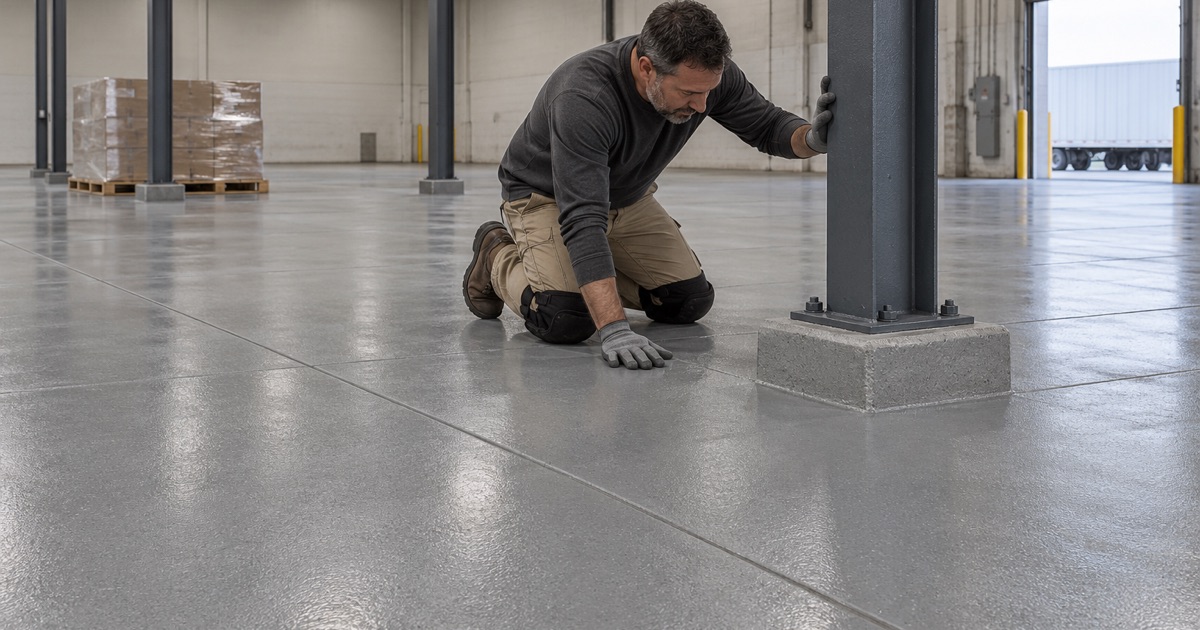
A distribution floor takes forklift wheels, pallet jacks and turning loads all day. We build these floors with a thicker 100% solids epoxy base, often with a quartz broadcast and a urethane topcoat to resist abrasion. The heaviest-traffic aisles can get extra build without coating the whole floor to the same spec.
Hard polyurethane forklift wheels are much tougher on a floor than pneumatic tires, and tight turns grind coatings faster than straight runs. We look at where traffic actually goes before setting the thickness.
Joint Rebuilding and Filling
The joints in a warehouse slab are where wheels hit hardest, and their edges chip into ragged channels. We cut back damaged edges, rebuild them with epoxy mortar and fill joints with a semi-rigid filler that supports wheels while letting the slab move.
Striping and Marked Zones
Aisle lines, pedestrian walkways, staging zones and hazard areas are built into the coating as colored lines or broadcast bands. They wear with the floor and are far more durable than tape.
Manufacturing, Shops and Service Bays
Chemical-Resistant Systems
Machine shops and service bays carry oil, coolant, hydraulic fluid, brake fluid and solvents. We choose an epoxy or urethane system rated for the chemicals in your space, and we finish it at drains and trench edges so fluids cannot get under the coating.
Coating Around Anchored Equipment
Some machines are anchored and cannot move. We grind and coat around them, seal the base so fluids do not undercut the coating, and plan the sequence so the line keeps running in the areas we are not working on.
Static-Dissipative Areas
Electronics assembly and some labs need a floor that conducts static to ground within a specified resistance range. We install static-dissipative and ESD systems in those zones and test them after installation.
Healthcare, Retail and Office Floors
Clinics and Medical Offices
A clinic floor has to be seamless, cleanable and installed without closing the practice for long. We phase the work room by room, use low-odor and fast-curing products where possible, and schedule around patient hours.
Showrooms and Retail Floors
A retail or showroom floor is part of the presentation. Flake, metallic and solid color systems give a durable, seamless surface, and a polyaspartic topcoat keeps the color steady under storefront sunlight.
Food Facilities and Wash-Down Areas
Commercial Kitchens and Food Plants
Food-service floors in Lake County are reviewed by the Lake County Health Department and must be smooth, durable, nonabsorbent and easy to clean, with coved floor and wall junctures under FDA Food Code 6-201.13. Where hot washdown and thermal shock would take an epoxy off, we install urethane cement.
Coolers, Freezers and Wet Rooms
Walk-in coolers and freezers need systems rated for low temperatures, and wet rooms need slip resistance. A quartz aggregate broadcast gives traction that still cleans well.
Compliance and Scheduling
VOC Limits on Commercial Floor Coatings
Lake County lies in the Chicago 2015 ozone nonattainment area, and Illinois limits the VOC content of floor and industrial maintenance coatings under 35 Ill. Adm. Code Part 223 Subpart C. Those limits bind the installer, so every product we put down is chosen to comply.
Contractor Registration and Insurance by Town
Illinois has no state license for flooring or coatings work, so each town sets its own rules. Waukegan, for example, requires annual contractor registration and a certificate of insurance naming the city. We confirm the rules for your address before the job is scheduled.
Dust and Slurry Control
Grinding dust is collected by vacuum at the tool, and wet slurry is captured on site. Nothing is washed toward a storm drain, which matters on a property with loading docks and parking lots draining to the street.
Planning a Commercial Floor Project
The Site Walk and Scope
A commercial project starts with a walk of the floor with your facilities or operations lead. We look at traffic patterns, chemicals in use, cleaning methods, drains, equipment that cannot move and the windows of time when each area can be handed over. The result is a scope that names the system for each zone instead of one spec forced across the whole building.
Moisture, Old Coatings and Slab Condition
Many commercial slabs carry old coatings, sealers or curing compounds, and some sit on grade with no vapor retarder beneath. We test moisture in several locations, since readings vary across a large floor, and identify what has to be removed. Where the readings are high, a moisture-mitigation primer is priced into the affected zones only.
Warranty Terms and Exclusions
Commercial floor warranties usually exclude failure from moisture coming through the slab, slab movement, chemical exposure beyond the system’s rating and mechanical damage. We go through those exclusions with you, moisture first, before the contract is signed, so the coverage is clear to everyone who will maintain the floor.
- 20+ Years Coating Floors
- Moisture Testing in Every Scope
- Free Written Estimates