Waukegan Epoxy Flooring has spent more than 20 years putting epoxy flooring in Cary rooms where the floor is judged on footing first and finish second: locker rooms, showers, prep kitchens and the hard-used program spaces of public buildings. Those floors get wet, get walked barefoot and get scrubbed with disinfectant every day, so the questions that matter are traction, how the coating turns up the wall and how long the room can stay closed. Color is the last decision, not the first.
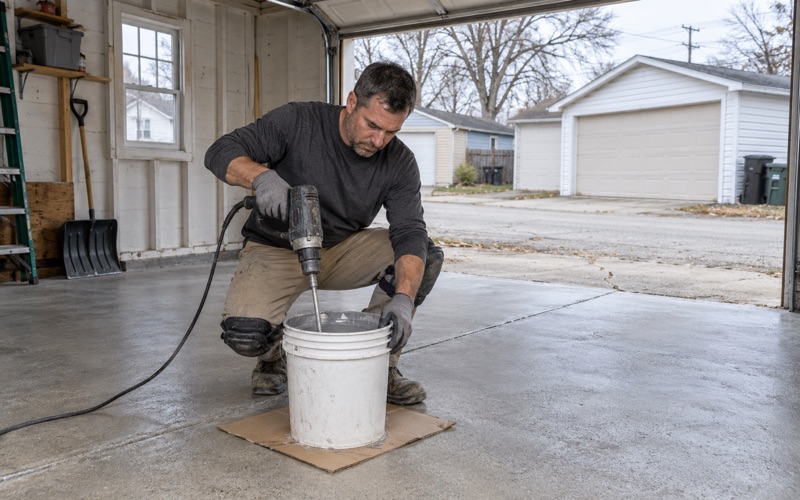
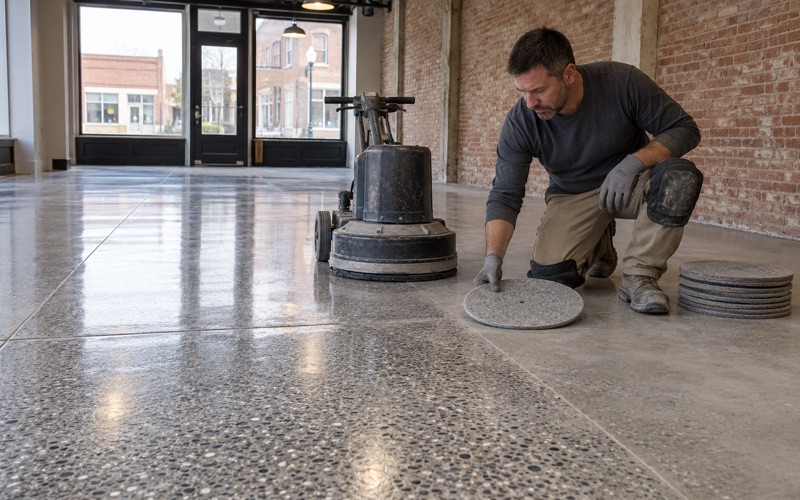
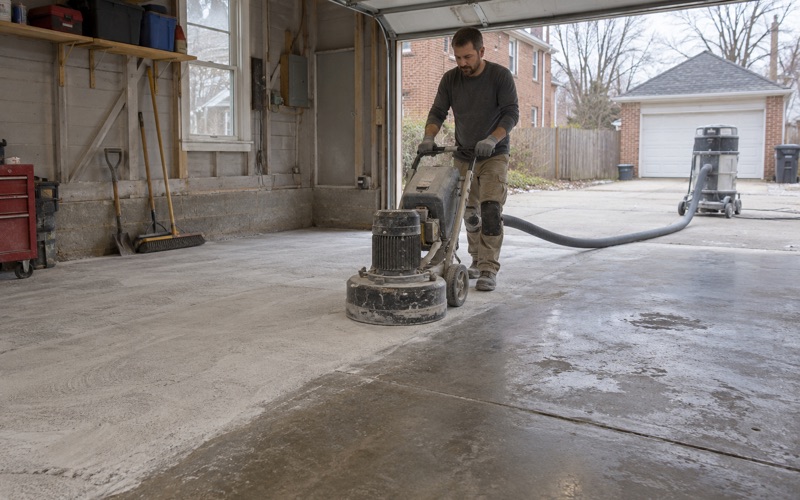
Every system we put down starts the same way. The slab is opened with a diamond grinder or a shot blaster to a measured ICRI CSP profile, never acid etched, and the moisture in it is tested as a priced line item before a single coat is mixed. The written proposal then names the product, the build and the finished thickness, so whoever manages the building can check what went down against what was quoted.
This page walks through one kind of Cary building in particular, a public recreation center that opens before dawn and stays busy into the evening, and what that schedule does to the choice of system. The same reasoning holds for a private health club, a school or a church hall with a kitchen behind it.
A 1978 Community Center That Opens at 5:30 a.m.
The clearest example of this kind of floor in the village is the Cary Park District Community Center at 255 Briargate Road. The address sits inside Cary, in Algonquin Township, McHenry County, and the district describes a building put up in 1978 with a fitness center and locker rooms, program and meeting rooms, a dance room, an aerobic room, an early childhood room and a kitchen. That is close to every hard-floor problem a coatings contractor sees, under one roof.
We are not describing a job we did there, and we have not inspected those floors. We use the building because it shows plainly what a mixed-use public floor asks for, and because anyone in Cary who manages a similar space, from a club locker room to a church kitchen, faces the same trade-offs.
A slab that has been in service for decades
A slab from the late 1970s may have been poured with no vapor retarder under it at all, and nobody can tell that by looking. So we test before we coat rather than trusting a dry-looking surface, using ASTM F2170 in-situ relative humidity probes or ASTM F1869 calcium chloride tests and comparing the readings with the product’s own limits. Where the numbers come back high, a moisture-mitigation primer goes into the scope before the finish system does.
Old coatings matter too. Before quoting a room that has been painted, sealed or tiled over the years, we read what is on the floor and how the cracks run, and we say plainly when a slab needs repair before anything can be bonded to it.
Hours that start before sunrise
The district posts weekday hours from 5:30 a.m. A building that has to be open for early members limits how long any one room can be taken out of service, and that single fact shapes the system choice more than any color chart does.
Looking for epoxy-flooring closer to Lincolnwood? See Epoxy-Flooring Services in Lincolnwood.
Locker Rooms: Barefoot, Wet and Disinfected Every Day
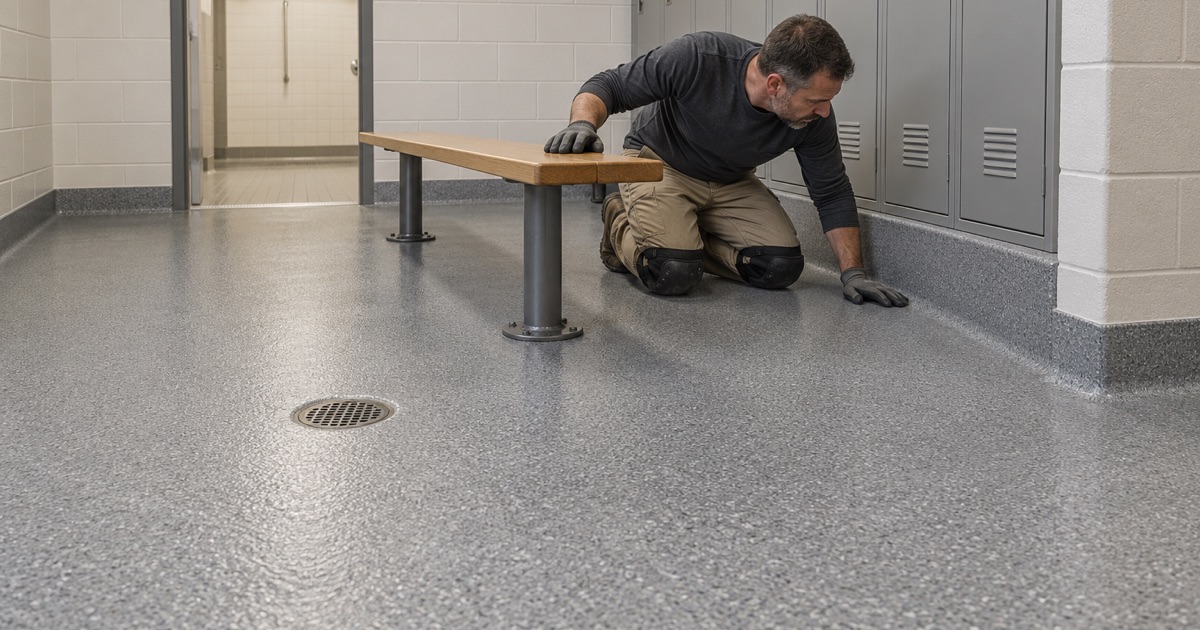
A locker room is the hardest room in a recreation building to coat well. Feet are bare and wet, soap film and body oils sit on the surface, and the floor is cleaned with disinfectant every day, often by a crew working fast before the doors open. A coating that looks perfect on day one but turns slick under a film of shampoo has failed at its only real job.
Slip texture is built in, not painted on
Traction in a wet room comes from aggregate broadcast into the resin, not from the resin itself. We typically build these floors as a 100% solids epoxy base with a quartz aggregate broadcast, locked in with a polyaspartic or urethane topcoat, and we set the grit size against how the room is cleaned. Coarser texture grips better and holds more grime; finer texture mops easier and grips less, and that trade-off is a conversation with whoever runs the cleaning, not a decision we make alone.
A vinyl flake broadcast reads well in a garage, but in a barefoot shower area the flake is mostly decoration. We would rather show a sample board with two or three texture levels and let the people who walk and clean the floor choose.
A cove where the floor meets the wall
The weak spot in a wet room is the joint between floor and wall. Water that gets behind a straight edge finds the slab, and a mopped corner collects grime that disinfectant never quite reaches. We trowel an integral cove up the wall in epoxy mortar or urethane cement, so the floor and the base become one continuous, cleanable surface, and we detail every floor drain so the coating terminates into it rather than stopping short.
Chemistry that survives daily disinfection
Disinfectants, hot water and frequent scrubbing all work on a topcoat. We match the topcoat to the cleaning products the staff actually use, ask for their data sheets, and say before the job which conditions the warranty excludes. Moisture is named first in those exclusions, because vapor pushing up from an untested slab is the most common reason a wet-room floor blisters.
Kitchen and Early-Childhood Rooms Under the Same Roof
The same building that holds the locker rooms also holds a kitchen, an early childhood room and rooms for dance and aerobics, and none of them want the same floor. Treating a whole building as one system is how a facility ends up with a floor too rough for a toddler room or too smooth for a kitchen.
A kitchen floor with coved corners
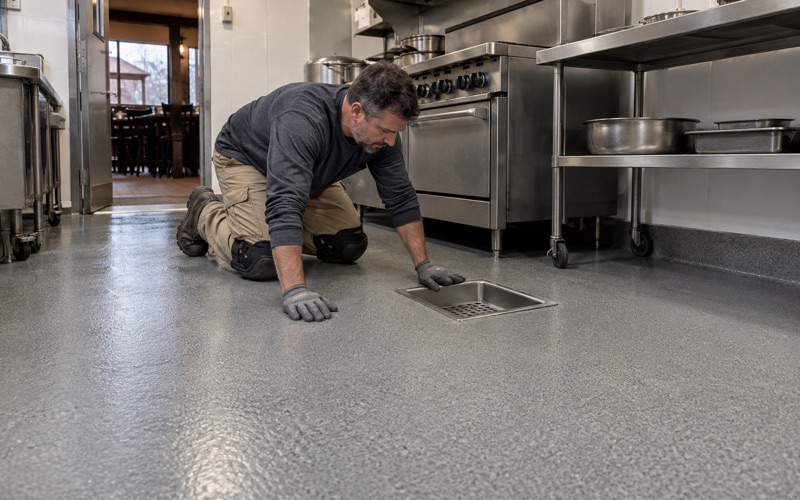
Where food is prepared, the FDA Food Code sets the floor standard. Section 6-201.13 calls for coved, sealed junctures between floor and wall, and 6-201.11 allows an antislip surface even though it is less smooth, which is what a quartz-textured urethane cement or epoxy system gives a kitchen. In this part of Cary the health authority is the McHenry County Department of Health, and we confirm its expectations with the operator before a kitchen floor is scoped.
Urethane cement earns its place here because kitchens see hot water, grease and the thermal shock of washdowns that a thin epoxy coat can struggle with. It also tolerates more slab moisture than many epoxies, though a reading still comes first.
Early-childhood and activity rooms
An early childhood room asks for almost the opposite: a smoother finish that cleans easily, low odor during installation, and enough cure time that nothing is still off-gassing when children come back. Every coating we use is chosen within the Illinois VOC limits in 35 Ill. Adm. Code Part 223, and in an occupied building we favor the lowest-odor system that will still do the job.
Dance and aerobic rooms commonly carry a sprung or sheet floor of their own rather than a coating. Where a program room does sit on bare concrete, a lithium silicate densifier or a thin sealed film may serve better than a heavy broadcast system, and we will say so rather than sell the bigger job.
Working Around a Public Building’s Hours
A floor in a building that opens at 5:30 a.m. is really a scheduling problem with chemistry attached. The usual approach is to coat one zone at a time, a single locker room or the kitchen, while the rest of the building stays open, and to fit the work into the overnight hours and weekends when that room would sit empty anyway.
Matching the system to the closure window
Fast-cure polyaspartic and polyurea topcoats can let a room return to light foot traffic far sooner than a standard epoxy build, which matters when a locker room can only be closed for a short stretch. The trade-off is a shorter working time and less tolerance for a damp or cold slab, so we choose the speed the room can afford rather than the fastest product on the shelf.
Cure is scheduled against slab temperature and the dew point spread at the surface, not just the clock. An overnight install in a cool building can leave amine blush on an epoxy coat if the surface drifts toward the dew point, and a topcoat laid over blush can peel, so we take readings before every coat.
Dust, odor and the people still in the building
Grinding a slab inside an occupied building has to be clean. We grind with dust collection, collect the slurry on site rather than washing it toward a drain, and seal the work zone off from the hallways members still use. Ventilation is planned with the facility before the first coat goes down.
Who signs off
The Village of Cary handles building and community development, and the Cary Fire Protection District at 400 Cary-Algonquin Road is a separate district rather than a village department. Illinois issues no state license for coatings work, so before a job is scheduled we confirm the village’s own contractor registration, bond and insurance requirements, and any bidding or procurement questions stay with the owner.
If you manage a locker room, a kitchen or a program room in Cary and the floor has started to look tired or feel slick underfoot, a site visit, a moisture reading and a written scope are where we start. That scope tells you which system we would use, how thick it ends up and how long the room has to stay closed.
- 20+ Years Coating Floors
- Moisture Testing in Every Scope
- Free Written Estimates