Waukegan Epoxy Flooring brings more than 20 years of epoxy-flooring work to Bensenville basements and garages, and the first question we ask about a basement here is whether the floor still has a sewer line running under it. If the house backs up in heavy rain and the owners are weighing a plumbing fix, that fix changes when and how the floor should be coated. A coating applied before the plumbing is settled can end up cut through a few months later.
So a Bensenville basement job with us usually starts as a sequencing conversation rather than a color chart. We want to know what the plumber has proposed, whether the village has signed off, and where on the slab the trenching will run. Once the pipe work is done and inspected, we come in and build the floor on concrete that is not going to be opened again.
The sections below walk through the village program that pays for most of that plumbing, the order the village sets for it, and what we do to a slab that has been trenched and patched before it can take a coating.
A Village Program That Pays for the Sewer, Not the Floor
The Village of Bensenville runs an Overhead Sewer Program for homeowners in incorporated Bensenville whose houses have, or may have, sanitary sewer backups during heavy rainfall. It is a reimbursement program, and it is aimed squarely at the plumbing that keeps sewage out of the basement. It does not pay for floor coatings, and nothing we put on a slab stops a backup.
We say that early because a coated floor is easier to clean after water comes in, and some owners hear that as protection. It is not. A floor coating is a film that follows the concrete under it, and when sewage rises through a floor drain, the coating does nothing to hold it back.
Overhead sewer conversion: 75 percent up to $7,500
For an overhead sewer, the village reimburses 75 percent of the cost up to $7,500. An overhead conversion moves the house’s sewer connection out from under the basement floor, so basement fixtures and the floor drain feed an ejector pit and are pumped up to a line that leaves the house above the slab. Because the drain no longer sits open to the street sewer, a surcharge in the main has no low point in the house to come out of.
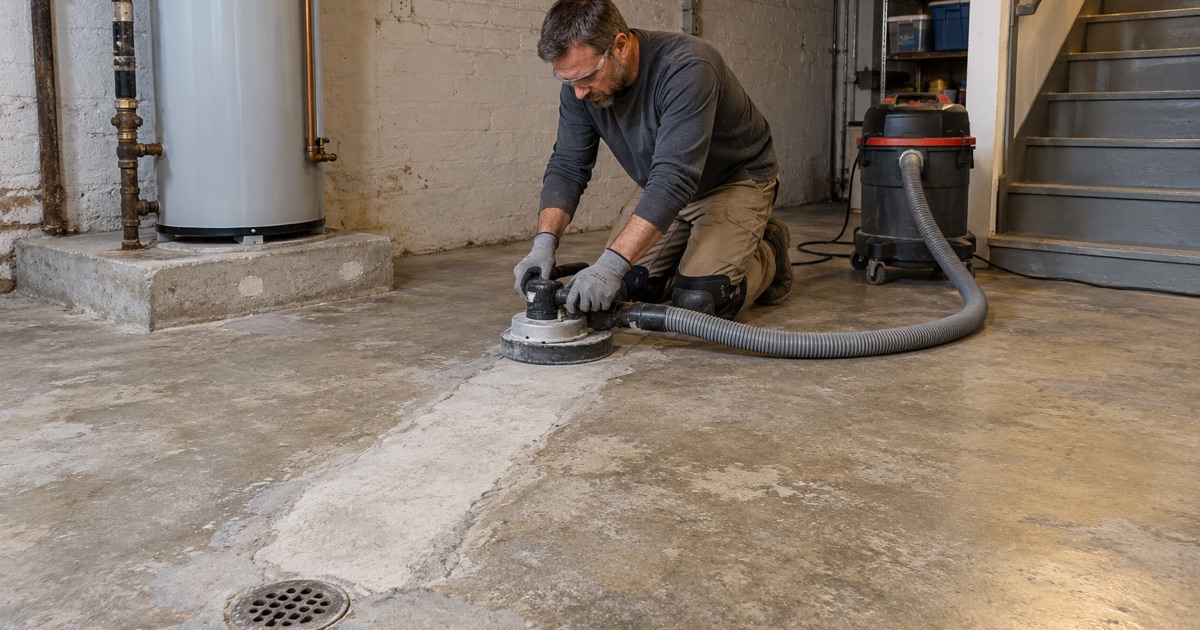
In general practice that means saw-cutting the basement floor, digging out for the pit and new piping, and pouring patches back over the trenches. That is the part that matters to us, because it is the floor we will be coating afterward.
Backflow prevention device: 75 percent up to $750
The smaller option is a backflow prevention device, which the program reimburses at 75 percent of the cost up to $750. A device of this kind is fitted to the existing line and does not move the sewer connection. Depending on where it goes and how it is installed, it may involve far less concrete work than a full conversion, or it may still mean opening a section of floor.
We are not plumbers, and we do not install overhead sewers or backflow devices. Which route is right for a given house is a question for a licensed plumber and the village, and program questions go to the village at (630) 350-3411.
Looking for epoxy-flooring closer to Burlington? See Epoxy-Flooring in Burlington.
Approval First, Then the Plumbing, Then Us
The village is specific about order. Building permits and inspections are required, and village approval is needed before any work commences. A homeowner who starts digging and then applies for reimbursement has the sequence backward.
That order suits a floor coating, too. Every step the village requires happens on or under the slab, and every one of them has to be finished before a coating has a stable surface to bond to.
Plumbing contractors post a bond with the village
The village permit application requires plumbing contractors to be licensed by an Illinois municipality and to submit an original $10,000 surety bond to the village. That is the plumber’s paperwork, not ours, but it is worth knowing before a homeowner signs with anyone for the sewer half of the job. Illinois issues no state license for flooring or coatings work, so on our side we confirm the village’s own registration, bond and insurance requirements for a coatings contractor before we put a Bensenville job on the calendar.
Why the coating goes on last
An inspector may need to see the trench, the pit, the piping and the backfill before the floor is closed up. If a coating is already down, those openings cut straight through it, and a patched coating over a fresh trench almost always reads as a patch. Coating last also means the new concrete has had its time to cure before we test it.
When owners call us while the plumbing is still being bid, we can walk the basement, read the existing floor and give a written proposal that assumes the patched areas will be ground and tested once they are poured. That proposal names the product, the system build and the finished thickness. It also says plainly which items depend on what the plumbing work leaves behind.
A written contract before work starts
Every home job we take gets a written contract and the state’s Home Repair: Know Your Consumer Rights pamphlet before work starts, as the Illinois Home Repair and Remodeling Act requires. For a basement that is going through a sewer conversion, we time that contract to the plumber’s schedule. Signing a coating contract with a start date that lands in the middle of an open trench helps nobody.
Coating a Basement Slab That Has Been Trenched and Patched
A basement floor after an overhead sewer conversion is really two slabs. There is the original concrete, often decades old, and there are the new patch pours over the trenches and around the ejector pit. They differ in age, density, moisture content and surface texture, and a coating has to bond to both.
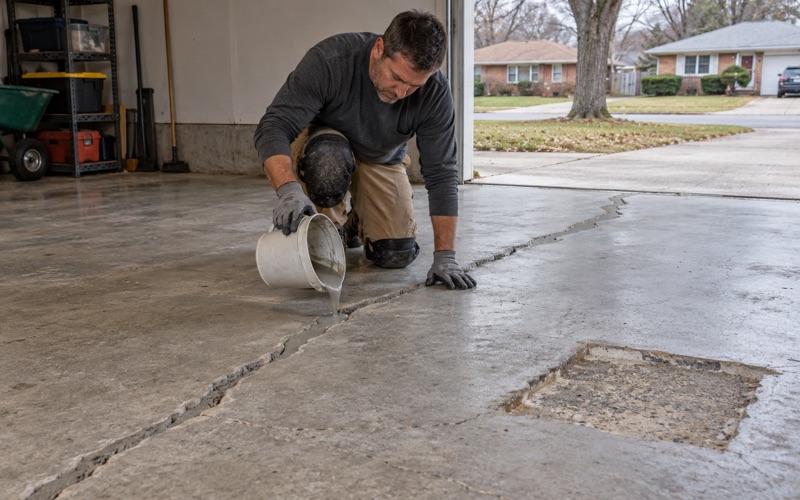
We read the cracks and the old coating before quoting, and that read matters more here than on an untouched floor. Saw cuts can start cracks that run out from the patch edges. If the floor needs repair beyond the plumber’s patches before it can be coated, we say so before quoting.
Opening both surfaces to the same profile
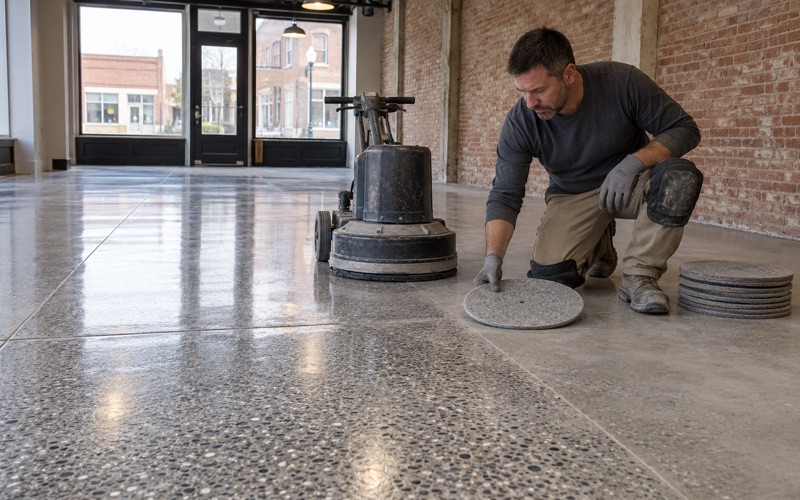
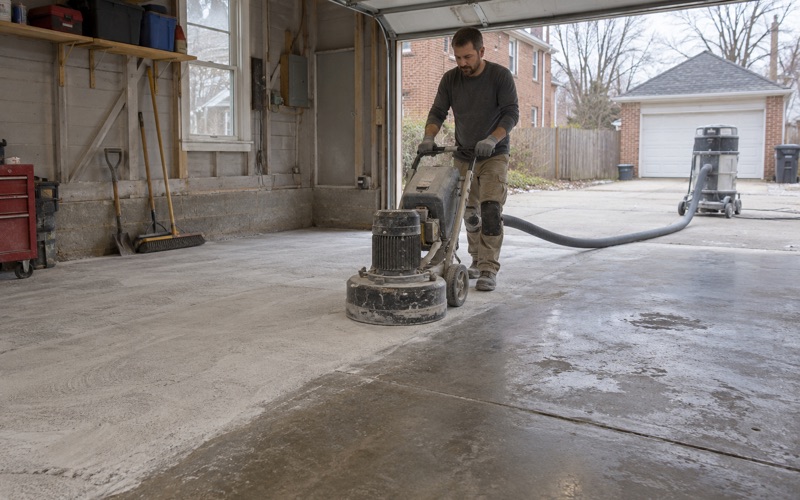
Every slab is opened mechanically with diamond grinding or shot blasting before anything goes on, and we do not acid etch. On a patched basement, that step evens out the difference between the smooth original troweled surface and the rougher patch concrete, bringing both to a comparable ICRI CSP profile. Patch edges that sit proud or low get ground or filled so the coating does not telegraph a ridge across the room.
Grinding dust is collected on site with vacuum extraction and never washed toward a floor drain or a street drain. In a basement where the drain has just been rebuilt, that is the last place slurry belongs.
Moisture testing is a line item, not an afterthought
Moisture testing is part of the scope on every basement we coat, and on a freshly patched floor it is not optional. New concrete gives off water as it cures, and older basement slabs may have no vapor retarder under them at all. A floor that looks dry can still push enough vapor to blister a coating within months.
Depending on the slab, we use ASTM F2170 in-situ relative humidity probes, ASTM F1869 calcium chloride vapor emission tests, or a quick ASTM D4263 plastic sheet test as a first read. Where readings run high, we specify a moisture-mitigation primer rather than gamble on a standard primer. Warranty exclusions are read out before the job is sold, and moisture is the first one on the list.
Building the system over the patch lines
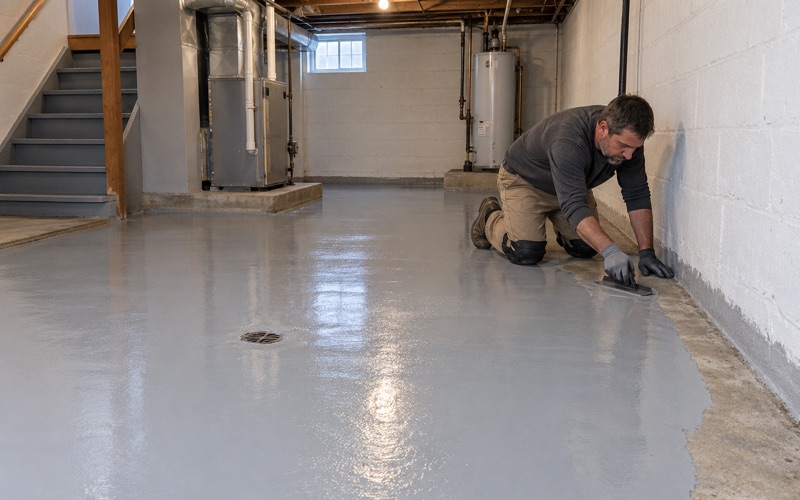
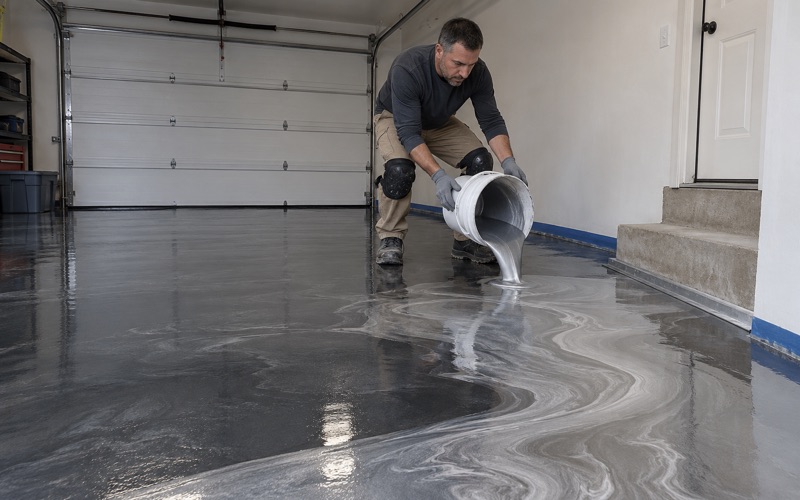
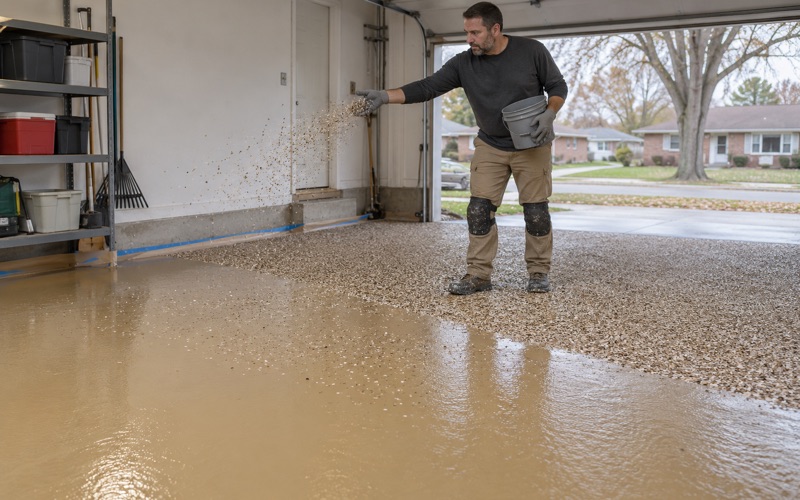
Once the profile and the moisture numbers are where they need to be, a typical basement system is a primer, a 100% solids epoxy body coat and a polyaspartic topcoat, with a vinyl flake broadcast if the owner wants texture and some hiding power. The new floor drain and the ejector pit lid get detailed so the coating terminates cleanly at their edges rather than feathering into a lip that catches water. Curing is scheduled against slab temperature and the dew point spread at the surface, not the calendar.
On a heavily patched floor, we tell owners plainly that the coating follows the concrete. If a patch edge moves or a saw-cut crack opens later, the coating will show it. That is a property of every film coating, and we would rather say it before the job than explain it after.
Who Qualifies: Owner-Occupied Houses on the Village Sewer
The Overhead Sewer Program is limited to owner-occupied single-family homes within the corporate limits that are connected to the Village of Bensenville sanitary sewer. A rented house, a condominium in a larger building or a home on a different system does not fit that description. If eligibility is unclear, the village is the one to ask before anyone schedules plumbing.
Bensenville is a village near O’Hare International Airport, mostly in DuPage County with a portion in Cook County. Census figures count 3,080 owner-occupied single-family detached houses in the village, which is the pool the program is written around.
An older housing stock, and what it means under the floor
Of Bensenville’s 7,283 housing units, 73.8 percent were built before 1980, with the largest single decade being the 1970s. Basements from those decades were rarely poured over the kind of under-slab vapor retarder a new house gets today. That is one reason we test every one rather than judging a floor by how dry it looks.
An older basement may also carry a previous coating, paint or mastic from an old tile floor. We grind that off rather than coat over it, since a new system is only as well bonded as whatever it sits on.
When the basement is not part of the program
Plenty of Bensenville jobs have nothing to do with the sewer. A garage floor, a basement that has never backed up, or a house where the plumbing was handled years ago all go through the same grinding, testing and written proposal without any village sequencing to wait for. Garage floors here get a system built for the calcium chloride brine and rock salt that ride in on tires through winter.
Where a house is owner-occupied but the plumbing question is still open, we are glad to quote the floor now and schedule it later. The quote stays tied to the patches the plumber leaves behind, and we come back to test before anything is mixed.
- 20+ Years Coating Floors
- Moisture Testing in Every Scope
- Free Written Estimates