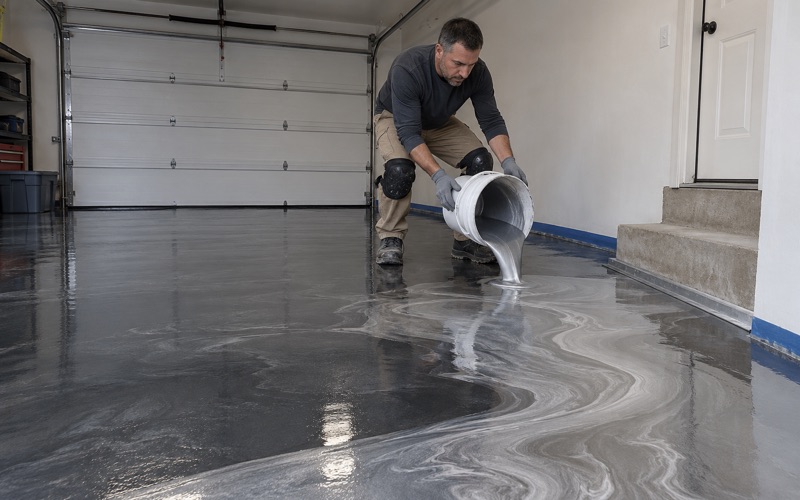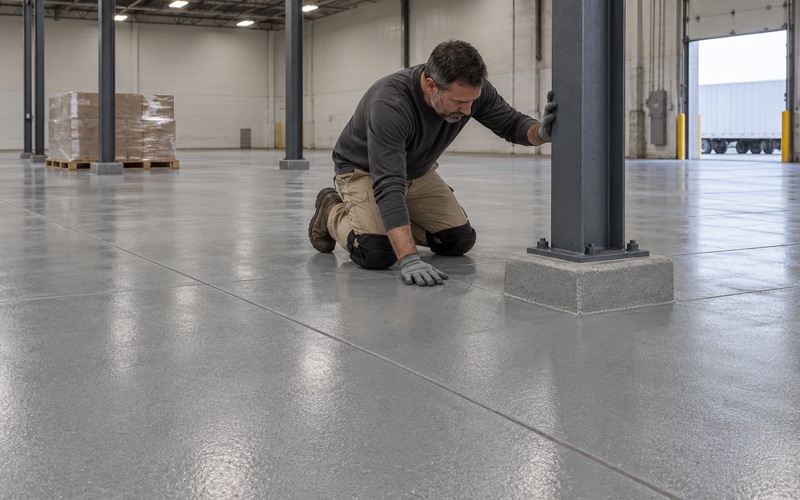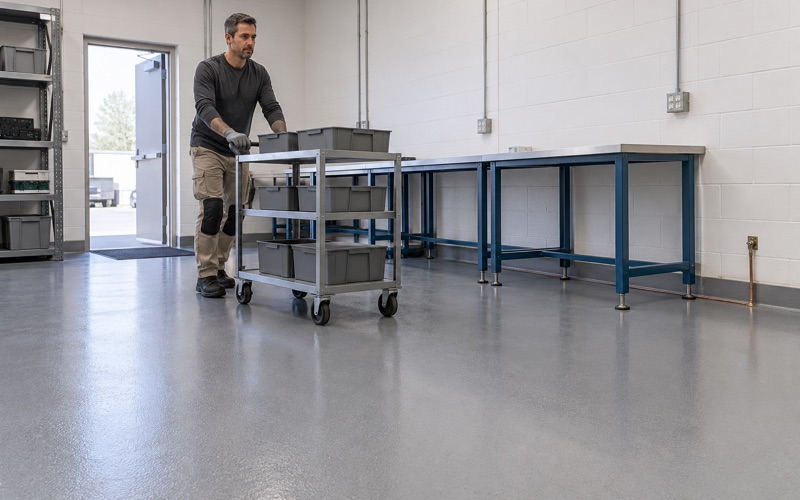
Waukegan Epoxy Flooring has spent 20+ years on epoxy flooring in Antioch and the surrounding county, and the floors that bring us here most often are working floors: plant aisles, warehouse racking rows and the strip just inside a dock door. A floor like that is judged by how it holds up under forklift wheels, how clearly it tells a driver and a pedestrian where each belongs, and how quickly it comes clean at the end of a shift. Decorative flake systems have their place, but they are rarely what a production manager calls us about.
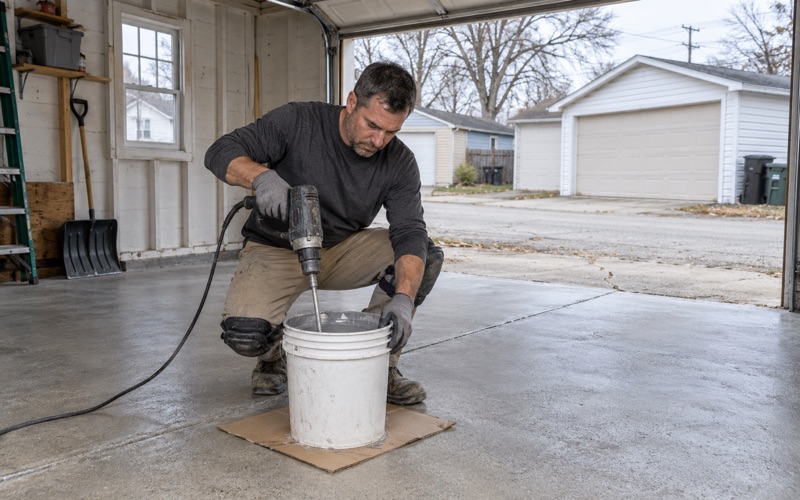
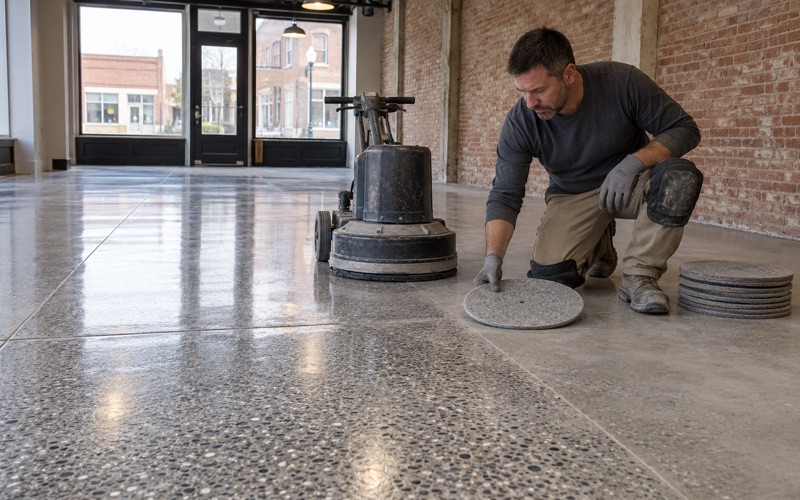
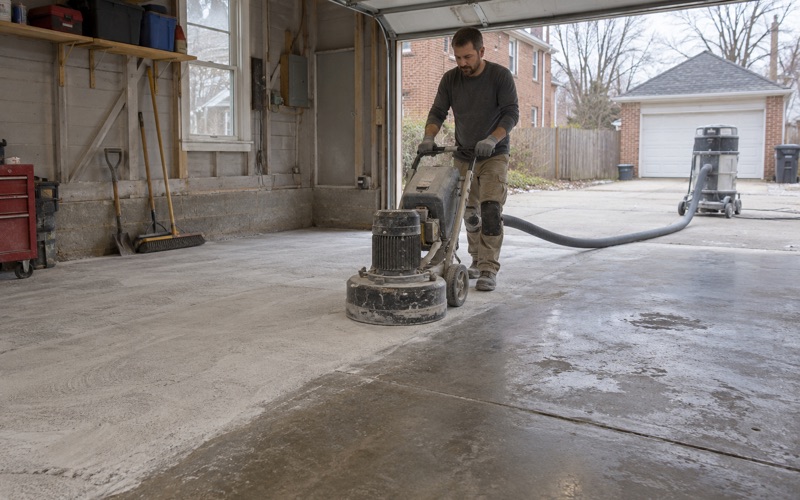
Every job starts the same way, with the slab opened by diamond grinding or shot blasting to a measured ICRI CSP surface profile; we never acid etch. Before we price anything, we read the cracks, the joints and any old coating, and we tell an owner plainly when a section needs repair before it can carry a new system. The proposal then names the product, the system build and the finished thickness, so a maintenance lead can check what went down against what was bought.
Plants rarely get to stop for a floor. We schedule around the hours a building has to keep running, including overnight and weekend windows, and we set cure times by slab temperature and dew point rather than by the calendar. Grinding dust and slurry are captured on site and never washed toward a storm drain.
Plant Floors in Antioch’s Route 173 Business Parks
Antioch’s industrial floor stock is young. The business parks off Route 173 filled in from 2018 on: Handi-Foil built its foil-container plant at Antioch Corporate Center that year, and Westfall Technik began medical plastic injection molding and assembly at 606 Drom Court in spring 2021. A 170,000-square-foot paper-products plant run by Fisher Paper Product and tenants such as NuWave and GFX round out the mix.
Antioch Corporate Center itself covers 97 acres on Route 173, about 1.5 miles west of I-94 and half a mile east of Route 45. Its Building A is a 454,276-square-foot spec warehouse with 36-foot clear height and 48 x 60 foot bays, and the park is planned for 1.3 million square feet in total. That is high-bay, high-throughput space, where the floor’s job is to carry traffic and direct it rather than to look like a showroom.
Reading the Floor Before the Quote
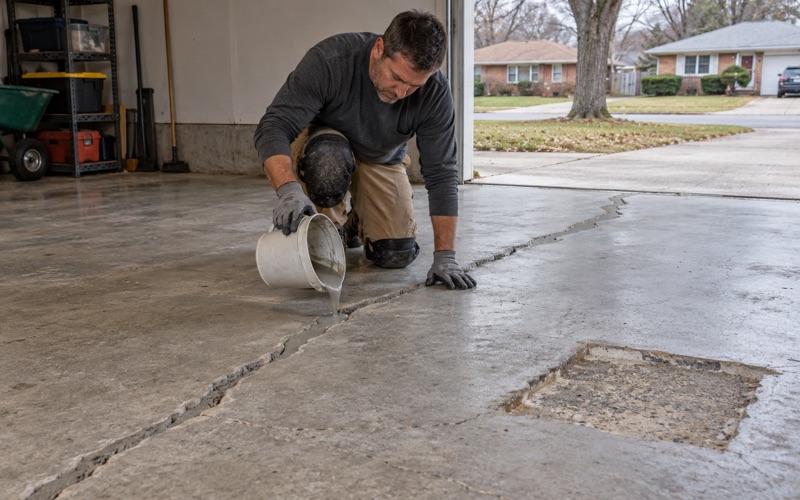
Before we write a number, we walk the aisles with the people who run them. Saw-cut joints, spalled joint edges under forklift traffic, patched trenches and any earlier coating all change the scope, and we name each one in writing. If a joint needs filling or an edge needs rebuilding first, the proposal says so rather than leaving it for a change order.
What a Coating Will and Will Not Do
A coating is a film that follows the slab beneath it. It will protect and mark the surface, but it will not stop a slab from moving or close a crack that is still active, and we say that before the job starts. Warranty exclusions are read out at the same time, with moisture named first, which is why moisture testing with ASTM F2170 in-situ relative humidity probes sits in the scope as its own line.
Looking for epoxy-flooring closer to Deerfield? See Epoxy-Flooring Services in Deerfield.
Forklift Aisles, Pedestrian Lanes and the Dock Doors
In a forklift building the floor is part of the traffic plan. Aisle lines tell a driver where racking starts, pedestrian lanes give people on foot a marked route between the time clock, the break room and the line, and hatched zones keep staged product out of the turning path. We lay out striping with the plant’s own safety lead, because the people who walk the floor every day know where the near-misses happen.
Line Striping That Survives the Wheels
Single-coat line paint over bare concrete tends to wear first exactly where loaded forklifts pivot. We install striping as part of the coating system, with the color coat set into a ground surface and protected under a clear wear coat, so the line and the floor around it age together. Colors follow whatever convention the plant already uses, so a new aisle reads the same as the old ones.
Pedestrian Lanes and Crossings
A walkway only works if people stay inside it, so we route lanes along the paths workers already take instead of the ones a drawing assumes. Crossings where a lane meets a forklift aisle get the strongest marking on the floor, often a hatched or contrasting band that reads clearly from a driver’s seat. Around fixed hazards such as charging stations, columns and conveyor ends, keep-clear zones are coated into the system rather than taped on and replaced every few months.
Dock Doors, Where an Industrial Floor Wears First
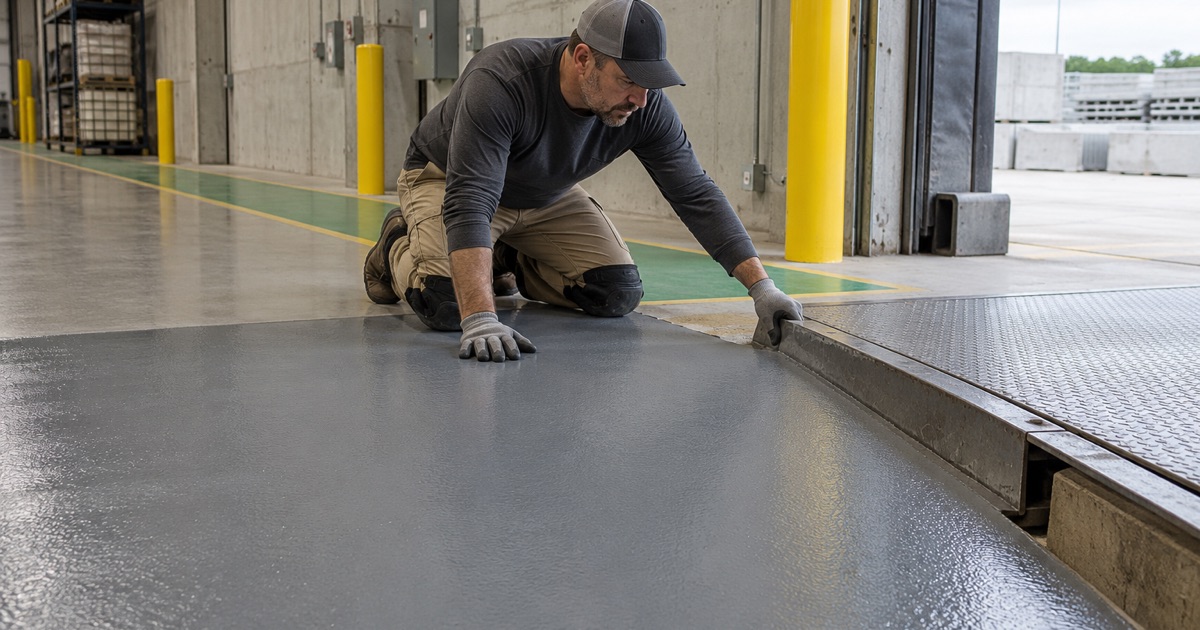
The stretch just inside a dock door takes the hardest punishment in the building. Forklifts brake and turn there under full loads, pallet jacks drag across it, and in a Lake County winter every trailer brings in brine, rock salt and meltwater. We build those zones heavier than the aisles, with a quartz aggregate broadcast in a 100% solids epoxy under a tougher topcoat, and where wash-down and thermal shock are part of the routine, urethane cement is the better fit.
Dock plates and leveler pits get their own detailing so the coating terminates cleanly instead of lifting at the edge. Where a dock zone wears faster than the rest of the floor, a maintenance recoat of that zone alone can be planned into the scope, which keeps the aisles in service while the dock is renewed.
Phasing Around Production
Most plants cannot clear a whole floor at once. We split the work into zones, coat one bay or one aisle run while the rest of the building keeps shipping, and move on once the first zone has cured enough to carry traffic. Polyaspartic topcoats can shorten that return-to-service window where the schedule is tight.
Cleanable Floors for Medical and Packaging Manufacturers
A medical-device molder like Westfall Technik is the kind of tenant whose customers audit housekeeping, and a floor that sheds dust or holds grime in its pores works against that. We do not claim a coating makes a plant compliant with anything; what a seamless, sealed floor does is give the sanitation crew a surface that mops clean and stops dusting. The same reasoning applies to foil-container and paper-products lines, where fine debris and dropped product collect along the aisles.
Texture Against Cleanability
Every floor in a production building trades slip resistance against how easily it cleans. More aggregate in the broadcast gives better footing in wet or oily areas, while a finer texture is faster to scrub, so we set that balance zone by zone rather than across the whole plant. Coved transitions at walls and equipment bases remove the corner where debris settles.
Wash-Down Areas and Drains
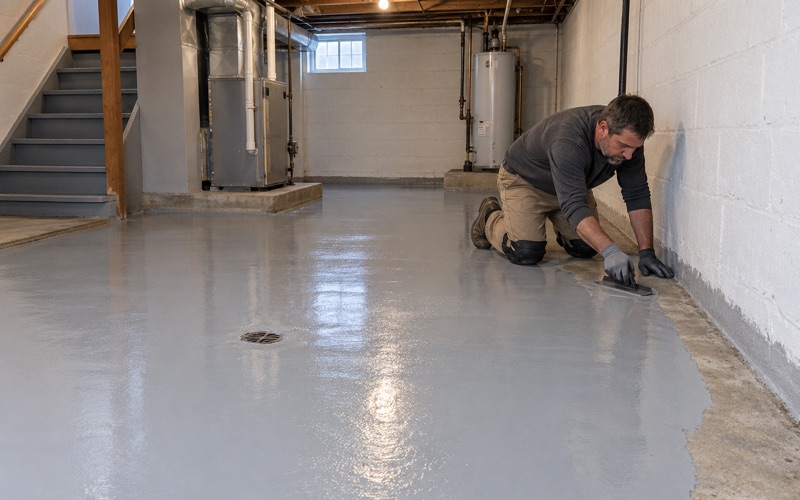
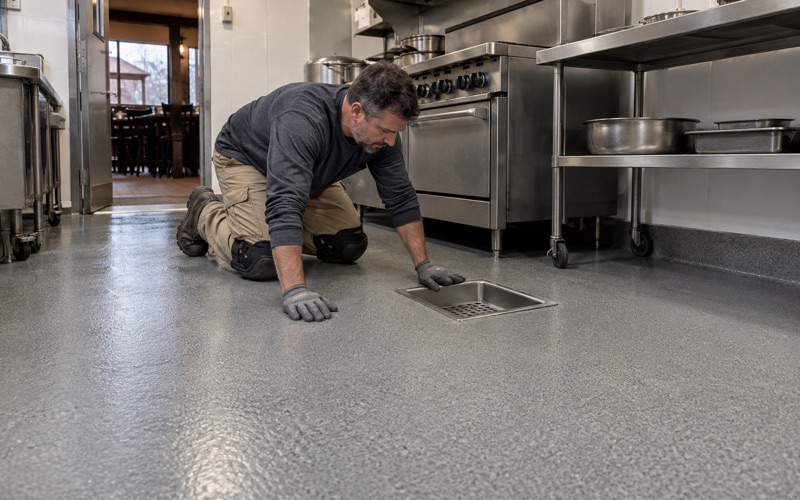
Where a line is hosed down rather than mopped, the floor has to shed water toward a drain instead of holding it in low spots. We check slope and drain detailing before coating, terminate the system cleanly into each drain body, and choose a build that tolerates hot water and cleaning chemicals. Urethane cement is usually our first choice for those rooms, with a standard epoxy system kept to the dry aisles.
Static-Sensitive Lines
Where a line handles static-sensitive components, a static-dissipative or ESD system is designed to a specified resistance range and tested after installation. That range is a specification the plant’s engineers set, and we build to it rather than guess at it.
VOC Limits in Lake County
Lake County sits inside the Chicago 2015 ozone nonattainment area, classified Serious, and Illinois Part 223 sets VOC limits that bind the applicator as well as the manufacturer: 250 grams per liter for floor coatings and 340 grams per liter for industrial maintenance coatings. We choose products within those limits before the proposal is written, which also keeps application inside an occupied plant more manageable for the people still working there.
Antioch Garages, Cure Time and Shutdown Windows
Away from the business parks, Antioch is mostly owner-occupied detached homes, and its housing peaked in the 2000s: 1,747 of the village’s 5,507 housing units date from 2000 to 2009, or 31.7 percent. Many of those subdivision garages are now at the stage where an early coating has worn through at the tire tracks or a bare slab is showing the effects of years of winter deicers.
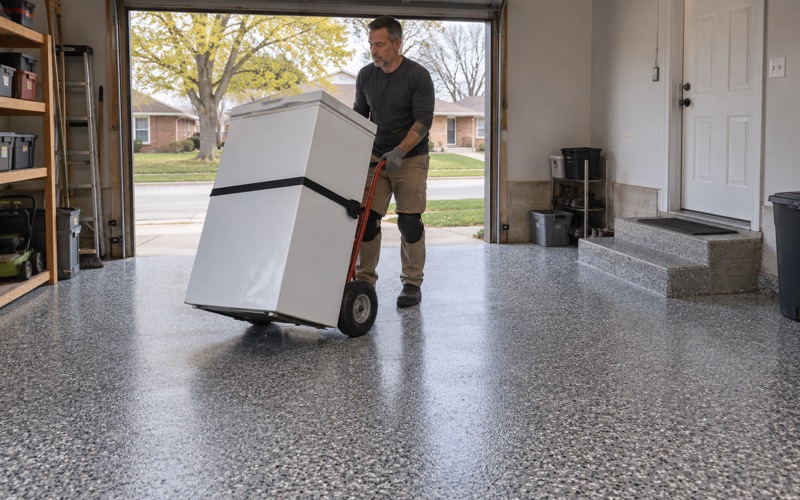
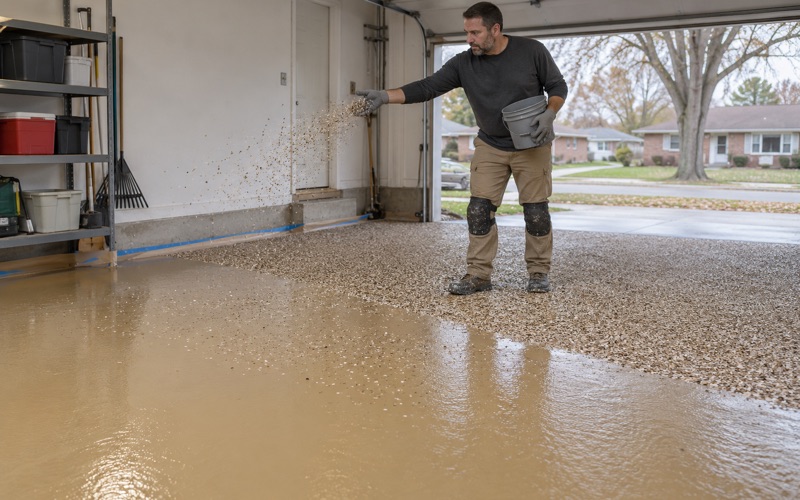
Garage floors here are built for the calcium chloride brine and rock salt a Lake County winter carries in on the tires. That usually means a ground slab, a 100% solids epoxy base with a vinyl flake broadcast, and a polyaspartic topcoat chosen to resist hot tire pickup. Every home job comes with a written contract and the Home Repair: Know Your Consumer Rights pamphlet before work starts, as the Illinois Home Repair and Remodeling Act requires.
Illinois licenses no flooring or coatings contractor, so the local rules are the ones that count. We confirm the Village of Antioch Building Department’s registration, bond and insurance requirements before a job goes on the calendar, for a plant floor and a garage alike.
How Long Does a Plant Floor Stay Out of Service?
That depends on the system and the slab rather than a fixed number of days. Cure is governed by slab temperature and the dew point spread at the surface, and epoxy laid down too close to dew point risks amine blush. We plan each zone’s return to forklift traffic around those readings and tell the plant ahead of time.
Can the Work Happen During a Holiday Shutdown?
Often, and a shutdown is usually the best window for the dock zones and main aisles that cannot be closed during a normal week. We plan that work well ahead, with materials staged and moisture testing done beforehand, so the days the plant is dark go to grinding and coating rather than to discovery. Smaller zones fit into overnight and weekend windows the rest of the year.
When Does an Unheated Garage Have to Wait?
An unheated garage has to warm before it can be coated, and in deep winter that sometimes means waiting for spring. We tell a homeowner that when we quote rather than coating a cold slab and hoping the cure catches up.
- 20+ Years Coating Floors
- Moisture Testing in Every Scope
- Free Written Estimates